Livelihoods, gender and social issues

Aquaculture livelihoods and social issues in rural communities.

Creative Commons Attribution.

Related

Subject tags

A collection of subject tags relating to technical matters.

In this collection

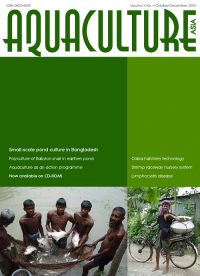
Aquaculture Asia Magazine, October-December 2005

In this issue:

Small-scale pond culture in Bangladesh. Issues and challenges in community-based aquaculture. Aquaculture as an action programme building confidence and self-worth. Transforming policy recommendations into pro-poor service provision. Grow out of spotted Babylon to marketable size in polyculture with seabass. Influence of economic conditions and global shocks on grouper markets. Status of cobia hatchery technology in Vietnam. Organic shrimp raceway system. Macrobrachium rosenbergii in Vembanad Lake. Management of monogenean parasites.

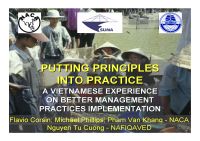
Putting principles into practice: A Vietnamese experience on better management practices implementation

This presentation provides an overview of Vietnamese experience on the implementation of better management Practices (BMPs) and good aquaculture practices (GAP) in shrimp aquaculture. Practices were implemented collectively by encouraging small-scale farmers to form groups that collaborate on issues such as screening seed for disease and improving water quality management. Improvements to crop outcomes were observed. The results presented include the profitability of BMP adopted ponds.

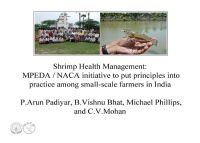
Shrimp health management: MPEDA/NACA initiative to put principles into practice among small-scale farmers in India

Presentation on a MPEDIA/NACA intiative to implement better management practices for shrimp farming amongst small-scale farmers in India via formation of farmer groups. The practices are based on the International Principles for Responsible Shrimp Farming. Adoption of improved farming practices reduces the incidence of disease and improves crop outcomes for small-scale farmers. This presentation was made at the World Aquaculture Society Conference in Bali, Indonesia, 2005.

Sổ tay thực hành: Kỹ thuật Nuôi tôm - rừng kết hợp: Tài liệu dành cho cán bộ khuyến ngư

Sổ tay nẩy với mục đích giúp đỡ cho cán bộ khuyến ngư hướng dẫn người nông dân kỹ thuật nuôi tôm nhằm mục đích đạt được sản lương và thu nhập ngày càng cao trong hệ thống nuôi kết hơp tôm - rừng ở Đồng bằng Sông Cửu Long. Với những kỹ thuật đơn giản, thông thường giúp cho ngư dân từng bước gia tăng sản lương mà ít bị rủi ro.

Mixed shrimp-mangrove farming practices: A manual for extension workers

This manual has been prepared to assist extension officers to advise farmers on techniques for improving yields and farm income in mixed shrimp farming-mangrove forestry farming systems in the Mekong Delta. It focuses mainly on simple, common sense techniques that will allow farmers to make step-by-step improvements to production without taking unnecessary risks. The manual is based on a 6-year collaborative research and development project between the Governments of Vietnam and Australia.

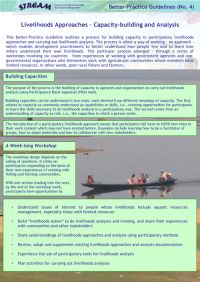
Better practice guidelines: Livelihoods approaches - capacity building and analysis

This guide outlines a process for building capacity in participatory livelihoods approaches and carrying out livelihoods analysis. The process is about a way of working that enables development practitioners to better understand how people live and to learn how others understand their own livelihoods. This particular process emerged from experiences of working with government agencies and non-governmental organisations who themselves work with agricultural communities whose members have limited resources, in other words, poor rural fishers and farmers.

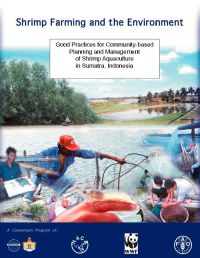
Good practices for community-based planning and management of shrimp aquaculture in Sumatra, Indonesia

The case study for this report was conducted in the coastal village Pematang Pasir, Sumatra, Indonesia. Pematang Pasir hosts a pilot project promoting environmentally and responsible shrimp aquaculture implemented by the Indonesian Coastal Resources Management Project. This paper describes the lessons learned to date and offers strategies for community-based coastal resource management, which can be used in a broader perspective as more general guidelines for community-based and participatory development of shrimp aquaculture in marginalised coastal areas.

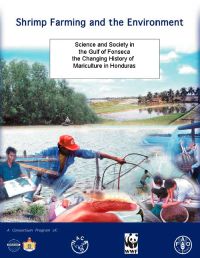
Science and society in the Gulf of Fonseca: The changing history of mariculture in Honduras

Shrimp farming in southern Honduras has generated considerable controversy around the issues of natural resource access and management. This case study reviews the reasons for and history of that controversy. The study relies on an extensive literature review and insights from the author’s previous research trips to southern Honduras between 1991 and 2000. In addition, representatives from several government offices, the shrimp industry, and the primary nongovernmental organisations were interviewed in May 2000.

Shrimp aquaculture in Africa and the Middle East: The current reality and trends for the future

This case study reviews shrimp aquaculture development in East Africa and the Middle East, as well as the problems and prospects for future development. Given that shrimp aquaculture development has not yet occurred on any significant scale, although increasing, it should be possible to learn the lessons from other parts of the world and apply them in these contexts. The countries in this report are: Egypt, Iran, Mozambique, Madagascar with some information on other countries in both regions.

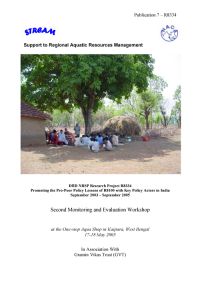
Second monitoring and evaluation workshop: Promoting the pro-poor policy lessons of R8100 with key policy actors in India

The objective of this project, in taking forward the achievements of the earlier projects, is to develop and promote mechanisms for the delivery of rural services that can reach and benefit marginalised poor men and women of scheduled tribes and scheduled castes. This workshop in Kaipara Village was meant to “understand the quality of performance in service delivery to poor people through the project monitoring and evaluation system.” Significant change stories were prepared by participants.


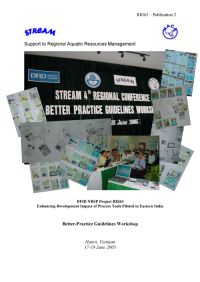
Report of the Better-Practice Guidelines Workshop, Hanoi, Vietnam, 17-18 June 2005

This workshop report is an output from an additional uptake and promotion activity of the DFID NRSP Project R8363 “Enhancing Development Impact of Process Tools Piloted in Eastern India”, which was extended to the end of August 2005. It describes a Better-Practice Guidelines (BPG) Workshop which was the latest project activity to share process tools for Building Social Capital (Self-Help Groups), Consensus-Building and Information Access Surveys. Since the project began, the BPG genre has expanded from the original three concepts shared, to currently twenty-five BPGs prepared not only by STREAM but also by farmers and fish producers. The genre has also been adopted by other organisations, including the DFID-funded Western Orissa Rural Livelihoods Project to share rural aquaculture techniques, and Stirling University to support the uptake and promotion of their work on Self-Recruiting Species and Local Resource User Groups.

The workshop was attended by STREAM National Coordinators and Communications Hub Managers from Cambodia, India, Indonesia, Myanmar, Nepal, Pakistan, Philippines, Sri Lanka and Vietnam, and STREAM Regional Office colleagues based in Thailand, Australia and India. The participants reviewed and assessed the BPGs and Policy Briefs in Bahasa Indonesia, Bengali, English, Hindi, Ilongo, Khmer, Myanmar, Nepali, Oriya, Sinhala, Urdu and Vietnamese. They also began to plan how the uptake and promotion of these tools may be specifically supported in each national context as well as planning the development of further BPG and PB topics.
STREAM Journal Volume 4, No. 3, July-September 2005

In this issue: One-stop aqua shops - an emerging phenomenon in eastern India. Ranchi One-stop Aqua Shop. Kaipara One-stop Aqua Shop. Bilenjore One-stop Aqua Shop. Patnagarh One-stop Aqua Shop. Using bar-coding in a one-stop aqua shop. About the STREAM Journal. About STREAM.

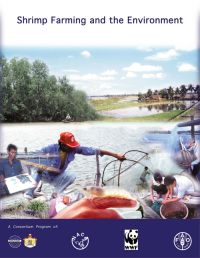
Shrimp Farming and the Environment: A Consortium Program to Analyse and Share Experiences on the Better Management of Shrimp Aquaculture in Coastal Areas

This report provides details of the activities and outcomes of work conducted under the World Bank, NACA, WWF and FAO consortium program on Shrimp Farming and the Environment. The report synthesises the major findings of the consortium program from 1999-2002. It includes the outcome from a stakeholder workshop that discussed the program findings, hosted by the World Bank in Washington DC, in March 2002.

Aquaculture Asia Magazine, July-September 2005

In this issue:

Asian Development Bank study on aquaculture and poverty. The consequences of converting to organic shrimp farming. Recycling water and making money with Artemia. Advances in the seed production of cobia Rachycentron canadum in Vietnam. Australian success with barramundi cod Cromileptes altivelis. Recent grouper breeding developments in Thailand. Application of probiotics in rotifer production systems. Contract hatchery systems. Rainbow trout culture in Iran. Spotted babylon Babylonia areolata growout in earthern ponds.

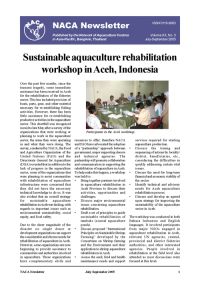
NACA Newsletter Volume XX, No. 3, July-September 2005

In this issue:

Sustainable aquaculture rehabilitation workshop in Aceh, Indonesia. STREAM policy briefs and better practice guidelines. 25 years of training in integrated fish farming. The Responsibilities of Leadership. A helping hand for those who needed it after the tsunami. An introduction to Mirza Koochek Khan Higher Fisheries Education & Training Centre, Iran. ACIAR funded regional project on shrimp health. Impact of aquatic animal health strategies. Farewell Sih Yang Sim. Welcome Koji Yamamoto.

Cultivo de Camarón y Medio Ambiente: Un programa en consorcio "Para analizar y compartir experiencias a fin de mejorar el manejo de la acuicultura de camarón en las áreas costeras"

Este reporte da detalles de las actividades y resultados del trabajo conducido bajo el Programa en Consorcio del Banco Mundial, NACA, WWF y FAO sobre “Cultivo de Camarón y el Medio Ambiente”. Este reporte sintetiza los resultados más importantes del programa del consorcio desde 1999 hasta marzo de 2002. Incluye los resultados de los talleres de usuarios que discutieron los resultados del programa, auspiciados por el Banco Mundial en Washington, DC, en marzo de 2002. 

Shrimp aquaculture, the people and the environment in coastal Mexico

This report reviews the state of shrimp aquaculture developent in Mexico, including its impact on employment, complexities surrounding coastal property rights, investment and health issues. Regulation and monitoring of the industry are still in their infancy, but SEMARNAP is putting in place a system that may be able to ensure that aquaculture will be sustainable. More effective involvement of the NGO community in the aquaculture sector may also help to monitor and ensure compliance with environmental regulations.

Economics of better management practices for semi-intensive shrimp farms in Honduras and shrimp cooperatives in Nicaragua

Several stakeholder groups have formulated and recommended the implementation of better management practices (BMPs)aimed at improving production efficiency and/or ameliorating impacts of shrimp farming on the environment. In this study, an economic optimisation model with an environmental component was used to evaluate the effects of five specific BMPs on the profitability, optimal selection of management strategies, and net quantities of nutrients discharged by semi-intensive shrimp farms in Honduras and small-scale operations in Honduras and Nicaragua.

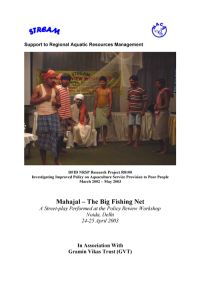
Mahajal - the big fishing net: A street play performed at the Policy Review Workshop, Noida, Delhi, 24-25 April 2003

Mahajal – The Big Fishing Net was written by Mr Rakesh Raman, a playwright from Ranchi, Jharkhand, and performed by his theatre troupe. The play was written as an interpretation of the outcomes of the project case studies carried out in Jharkhand, Orissa and West Bengal. Act One sets the scene of fisherfolk’s livelihoods and the difficulties they face in a tribal village. Act Two places the project’s policy change recommendations within the context of their lives and aspirations.

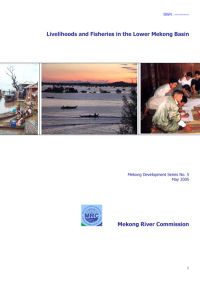
Livelihoods and fisheries in the lower Mekong basin

People who manage fisheries in the lower Mekong are beginning to think of themselves as a community within a common river basin. This is a different way of thinking; managing fisheries is no longer seen as an isolated activity but as a part of the life of people who live along the river. Previously, fisheries managers might have thought of their job as safeguarding or increasing fish production, but now they must share in the effort to alleviate poverty.