Nutrition and feeding

Information relating to nutrition and feeding in aquaculture.

Creative Commons Attribution.

Related

Subject tags

A collection of subject tags relating to technical matters.

In this collection

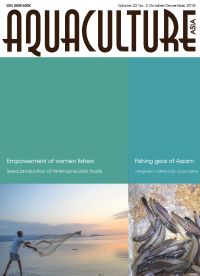
Aquaculture Asia Magazine, October-December 2018

In this issue:

Concept of seed production of Heteropneustes fossilis in farmers' fields in West Bengal, India; Fishing gear and practices in flood waters of Assam; Fisherwomen empowerment: Shedding light on the invisible gender; Integrated multi-trophic aquaculture systems: A solution of sustainability.

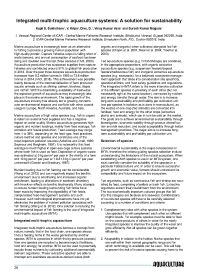
Integrated multi-trophic aquaculture systems: a solution for sustainability

Marine aquaculture of high value species such as fish is generally reliant on external food supplies and has a negative impact on water quality, generating high organic and nutrient loadings. Integrated multi-trophic aquaculture offers a solution to reduce environmental impact of farming systems, culturing complimentary species that can recycle nutrients and reduce nutrient pollution while generating additional products for sale. This article looks at species selection and integration of trophic levels in system design.

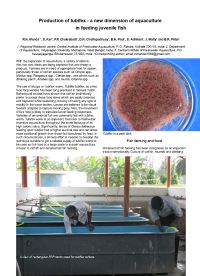
Production of tubifex - a new dimension of aquaculture in feeding juvenile fish

The use of sludge or ‘tubifex’ worm, Tubifex tubifex, as a live food for juvenile fish has been long practiced in farmers’ fields and it is an important fish food for spawn rearing. The cost of tubifex worm becomes prohibitive in the dry season, when supplies are limited. We conducted trials to test the feasibility of culturing tubifex using a selection of agro-industrial wastes. Net biomass production was highest using rice mill sludge as a food source, over a culture period of 20 days.

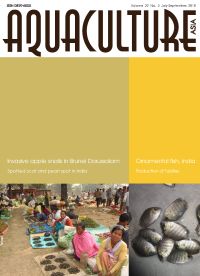
Aquaculture Asia Magazine, July-September 2018

In this issue:

Rearing of spotted scat and pearlspot in coastal West Bengal, India; harvesting Eurayle ferox (makhana) from wetland fisheries of Assam; prospects of ornamental fish culture in seasonal water bodies in Assam; production of tubifex, a new dimention in aquaculture in feeding juvenile fish; invasive apple snails in Brunei Darussalam; aquaculture trends and opportunities in Sindh, Pakistan; NACA Newsletter.

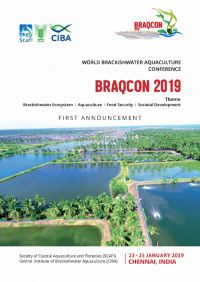
World Brackishwater Aquaculture Conference, 23-25 January 2019, Chennai, India

BRAQCON 2019 wil cover latest research and development in the broader themes of the conference in the form of special sessions, contributed papers, expert group discussions and brainstorming on issues facing aquaculturists and ecosystem managers in India and around the world. The conference themes include: Brackishwater ecosystems, estuarine biodiversity and conservation; aquaculture production systems; larviculture; fish and shellfish nutrition; environment and climate change; aquatic animal health; socio-economic and livelihood issues; and aquaculture genetics and biotechnology.

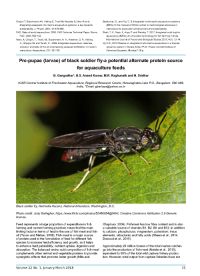
Pre-pupae (larvae) of black soldier fly - a potential alternative protein source for aquaculture feeds

Insects form a natural food source for many aquatic animals. This and the presence of chitinase makes insect meals a logical alternative to fish meal in the formulation of aquaculture diets. Insect meals have also been shown to allow for enriching through dietary intake. Of particular interest has been the use of black soldier fly larvae. This article reviews the life history and potential of black soldier fly larval meal to replace fishmeal used in fish diets.

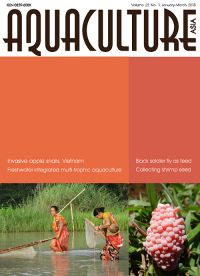
Aquaculture Asia Magazine, January-March 2018

In this issue:

Invasive apple snails (Pomacea spp.) in Vietnam: Short review; A review of fresh water integrated multi-trophic aquaculture: Catching up on the dream of a blue revolution in India; Pre-pupae (larvae) of black soldier fly - a potential alternate protein source for aquaculture feeds; Penaeid shrimp and giant prawn seed collection from Rupnarayan River in Purba Medinipur, West Bengal, India; NACA Newsletter; First training course on culture-based fisheries held in Nha Trang, Vietnam.

Culture-based fisheries: What, why, where and how?

A briefing on the context and relevance of culture-based fisheries in rural development.

Why fish and aquaculture?

Video presentation on the rationale for increased fish production and consumption.

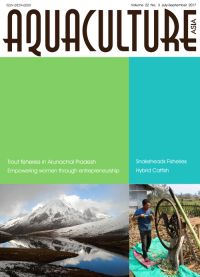
Aquaculture Asia Magazine, July-September 2017

In this issue:

Regional network on culture-based fisheries and stock enhancement; trout fisheries in the uplands of Arunachal Pradesh - resources and opportunities; empowering young Indian women through entrepreneurship development - opportunities and constraints; a view on murrel (snakehead) fisheries in India; hybrid catfish Clarias batrachus x Heteropneustes fossilis produced by farmers in West Bengal, India; Backyard fish based pig farming using low-cost feed in Arunachal Pradesh - a success story; NACA Newsletter.

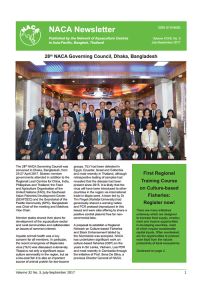
NACA Newsletter, Vol. XXXII, No. 3, July-September 2017

In this issue:

28th NACA Governing Council, Dhaka, Bangladesh; register for the First Regional Training Course on Culture-based Fisheries; 11th Indian Fisheries and Aquaculture Forum, Kochi, 21-24 November; audio recordings for regional feed consultation now available; tilapia lake virus; Proceedings of the International Symposium on Aquatic Animal Health and Epidemiology for Sustainable Asian Aquaculture; ICAR-CIBA launch "Vanami Shrimpapp", a mobile app on Pacific white shrimp (Penaeus vannamei) farming; Pakistan officials train on aquaculture certification.

Regional Consultation on Responsible Production and Use of Feed and Feed Ingredients for Sustainable Growth of Aquaculture in Asia-Pacific

A regional consultation on aquaculture feed production and use in Asia-Pacific was held from 7-9 March 2017. The consultation reviewed the current situation of aquaculture feed production and use, sourcing of ingredients, policy and research needs. This collection contains audio recordings of the technical presentations made by experts, international organisations, the private sector and governments in the region. The report of the consultation is in press and will be made available for download in due course.

Introduction to the regional consultation

Miao Weimin, FAO, provides an introduction and background brief to the Regional Consultation on Responsible Production and Use of Feed and Feed Ingredients for Sustainable Growth of Aquaculture in Asia-Pacific.

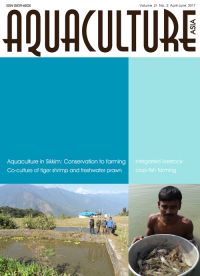
Aquaculture Asia Magazine, April-June 2017

In this issue:

Inspiring story of aquaculture in Sikkim - a journey from conservation to farming; farming of scampi and tiger shrimp together - a case study from West Bengal; Labeo pangusia - a candidate for diversification of hill aquaculture; sustainability of an integrated livestock-fish-crop farming system as a small scale enterprise; sustainable coastal aquaculture in India; potential scope and prospects of domestic fish market in Chhattisgarh.

Sustainability of an integrated livestock-fish-crop farming system as a small-scale enterprise

We examined the sustainability and economic viability of a model integrated livestock-fish-crop farming system developed by the Fisheries Research Centre, Assam Agricultural University, over an extended period of 13 years. The system was developed as an ecologically sustainable alternative technology for small and margin farmers. It incorporates two livestock components, pig and poultry, with horticulture and carp polyculture. Analysis of cash flow and benefit-cost ration revealed the system to be economically sustainable over the long term.

Aquaculture Asia Magazine, January-March 2017

In this issue:

Anti-microbial resistance in aquaculture; participatory market chain approaches to boost fish nurseries; traditional community fishing practices of rural Assam; practical significance of restricted feeding regimes in aquaculture; Bangana dero: A potential indigenous fish species for diversification of carp culture; shell colour variation in farmed Litopenaeus vannamei: Comparison of white- and brown-shelled shrimp; culture-based fisheries: A low-tech, greenhouse friendly approach to improving food and income for Cambodian families.

NACA Newsletter, Vol. XXXII, No. 1-2, January-June 2017

In this issue:

The 15th meeting of the Asia Regional Advisory Group on Aquatic Animal Health; a regional consultation on responsible production and use of feed in aquaculture; a report on the Giant Prawn 2017 conference; a preview of the new NACA website; and new initiatives on a very serious emerging issue - reducing the human and animal health risks from development of anti-microbial resistance in the aquaculture industry.

Giant Prawn 2017

The fourth major international event on giant freshwater prawns was organised by the Asian Institute of Technology from 20-24 March 2007. The conference, organised by Salin Krishna and Michael New, built on a series of highly successful events that trace back to the very beginnings of the industry. The first conference, Giant Prawn 1980 brought together all those involved in freshwater prawn research and farming for the first time and set many priorities for future research and development.

Practical significance of restricted feeding regime in aquaculture

Feed is the most expensive component of an aquaculture enterprise. Successful cultured fish production requires optimisation of feeding practices to ensure the most economically effective growth rates. Reducing feed costs for culture practices can be achieved by taking the advantage of restricted feeding strategies. Under a restricted feeding regime fish convert a greater portion of feed to body weight. Case studies of restricted feeding are presented for several species and the costs savings and other benefits are briefly discussed.

Regional consultation on responsible production and use of feeds in aquaculture

FAO, NACA and the Thai Department of Fisheries convened a Regional Consultation Responsible Production and Use of Feed and Feed Ingredients for Sustainable Growth of Aquaculture in Asia-Pacific in Bangkok, 7-9 March 2017. The objective of the consultation was to review the current status of aquaculture feed production and use, demand and supply, sourcing of ingredients, government policies and institutional support, ongoing progress and development gaps. The meeting brought together government and private sector representatives.