Molluscs (shellfish and other)

Issues relating to aquaculture of shellfish, cephalopods and other molluscs.

Creative Commons Attribution.

Related

Species / commodity tags

Major farmed commodity or species groups.

In this collection

FAO/NACA workshop to developing a regional strategy for aquatic organism health using progressive management pathways

On 28-29 November FAO and NACA collaborated on a virtual workshop to develop a regional strategy for aquatic organism health, using a progressive management pathway for improving aquaculture biosecurity. The workshop was held under the auspices of the project “Responsible use of fisheries and aquaculture resources for sustainable development component 3: Biosecurity and health management”. The workshop involved 31 experts from 16 countries, including national focal points, FAO and NACA. The objectives of the workshop were to: Present and analyse country responses to a self-assessment survey on biosecurity and health management capacity and performance; to provide guuidance to country participants on conducting a SWOT analysis; and to prepare a detailed plan for Phase II of the initiative.

Reported Aquatic Animal Diseases in the Asia-Pacific Region during the Second Quarter of 2022

With the implementation of the new aquatic animal disease reporting in the Asia Pacific region from January 2021, and in lieu of the published QAAD Reports (last issue published was 4th quarter of 2020), NACA is publishing reported aquatic animal diseases submitted by countries in the Asia-Pacific region.  This report covers the second quarter of 2022 and the original and updated reports can be accessed at the QAAD page

Free registration: 2022 China-ASEAN International Forum on "Sustainable Development of Fisheries and Aquaculture Under the Blue Transformation Strategy”

Ocean University of China and partners will convene the forum from 20 to 22 November 2022. The forum will cover the following: Topic 1: International talent cultivation and training;Topic 2: Science and technology innovation; Topic 3: Industrial synergy. The forum will host discussions about the implementation of the “Blue Transformation” strategy, further expansion of the space for fisheries and aquaculture, and ways of improving the production capacity of aquatic products, with the purpose of facilitating the achievement of the UN Sustainable Development Goals. Participation is free but registration is required. Registration closes on 22 October.

NACA Newsletter, Vol. XXXVII, October-December 2022

In this issue:

Training Course on Mariculture Technologies in Asia-Pacific; FAO/NACA Virtual Workshop on Aquaculture Transformation in Asia and the Pacific Region; Belt & Road Forum for International Freshwater Fishery Industry Innovation; 8th Global Conference on Gender in Aquaculture and Fisheries, 21-23 November; Reported Aquatic Animal Diseases in the Asia-Pacific Region during the First Quarter of 2022; International Training Course on Biology and Pathology of the Penaeid Shrimp 2022; Angkasa Putra inaugurated as first President of the South-East Asian Fisheries and Aquaculture Student Association; Artemia webinars: Video recordings of technical presentations available.

Aquaculture Asia Magazine, July-September 2022

In this issue:

Dynamics of small-scale aquaculture development in India: A review; Green water technology as an essential support to larval rearing of hilsa shad; Collection of freshwater molluscs and sale of meat by women in Purba Medinipur, West Bengal, India; A success story of ornamental fish farming as a tool for alternative livelihood of tribal women in Keonjhar District, Odisha, India; Recent trends in seed production of stinging catfish, Heteropneustes fossilis, in India; NACA Newsletter.

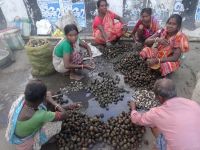
Collection of freshwater molluscs and sale of meat by women in Purba Medinipur, West Bengal, India

The common freshwater snail Bellamya bengalensis, golden apple snail Pila globosa and freshwater pearl mussel Lamellidens marginalis are naturally found in West Bengal. These molluscs are also an important source of protein for poor rural communities, and are also gaining popularity in middle and high income suburban areas for their nutritional and traditional medicinal values. They also represent a significant source of employment and income generation for women from Scheduled Tribes and Scheduled Castes. This article documents the collection, preparation, trade and use of freshwater molluscs in Paschim Medinipur and Purba Medinipur districts of West Bengal.

Register now: Free Training Course on Mariculture Technologies in Asia-Pacific

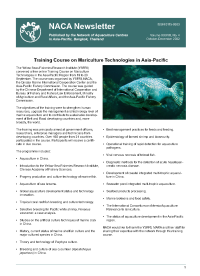
The Yellow Seas Fisheries Research Institute (YSFRI) will convene a free online Training Course on Mariculture Technologies in the Asia-Pacific Region from 19 to 23 September (please note the change of date). The course is organised by YSFRI, NACA, the Qindao Marine International Cooperation Center and the Asia-Pacific Fishery Commission. The training course will cover: Theory and technology for producing high-quality seed; New mariculture modes and technology; Nutrient regulation and feeding technology; Disease prevention and control technologies; Product processing and utilisation technologies. Applications close 5 September.

Reported Aquatic Animal Diseases in the Asia-Pacific Region during the First Quarter of 2022

With the implementation of the new aquatic animal disease reporting in the Asia Pacific region from January 2021, and in lieu of the published QAAD Reports (last issue published was 4th quarter of 2020), NACA is publishing reported aquatic animal diseases submitted by countries in the Asia-Pacific region.  This report covers the fourth quarter of 2021 and the original and updated reports can be accessed from the QAAD page.

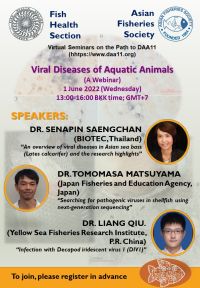
Free FHS Webinar: Viral Diseases of Aquatic Animals

The Fish Health Section of the Asian Fisheries Society is inviting you to a Zoom Webinar on Viral Diseases of Aquatic Animals, 1 June at 13:00 Bangkok time (GMT +7).

Participation is free but advance registration is required.
Reported Aquatic Animal Diseases in the Asia-Pacific Region During the Fourth Quarter of 2021

With the implementation of the new aquatic animal disease reporting in the Asia Pacific region from January 2021, and in lieu of the published QAAD Reports (last issue published was 4th quarter of 2020), NACA is publishing reported aquatic animal diseases submitted by countries in the Asia-Pacific region.  This report covers the fourth quarter of 2021 and the original and updated reports can be accessed from the QAAD page.

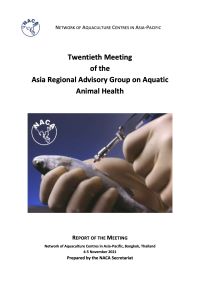
Twentieth Meeting of the Asia Regional Advisory Group on Aquatic Animal Health

This report summaries the proceedings of the 20th meeting of the Regional Advisory Group on Aquatic Animal Health, held 4-5 November 2021. The meeting discussed: Progress on NACA’s Asia Regional Aquatic Animal Health Program; updates from the OIE Aquatic Animal Health Standards Commission; aquaculture biosecurity; Progressive Management Pathway for Improving Aquaculture Biosecurity activities relevant to Asia; a systematic approach for quantifying biosecurity measures in aquaculture; aquatic animal health strategy; updates on the OIE Regional Collaboration Framework on Aquatic Animal Health; and updates on the QAAD Reporting and Disease List.

FAO Reviews of Aquaculture now available online

We are pleased to announce that the FAO Reviews of Aquaculture have been published online at the FAO website, including the six Regional Reviews and a Global Synthesis, which were developed and published in conjunction with the Global Conference on Aquaculture Millennium +20 (GCA+20). The publications are linked below. Video presentations of the reviews, including expert panel discussions and question and answer sessions, are also available from the GCA+20 website.

Reported Aquatic Animal Diseases in the Asia-Pacific Region During the Third Quarter of 2021

With the implementation of the new aquatic animal disease reporting in the Asia Pacific region from January 2021, and in lieu of the published QAAD Reports (last issue published was 4th quarter of 2020), NACA is publishing reported aquatic animal diseases submitted by countries in the Asia-Pacific region.  This report covers the third quarter of 2021. The original and updated reports are available from the QAAD page.

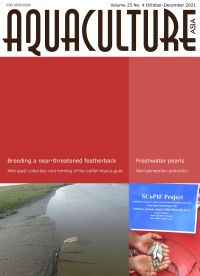
Aquaculture Asia Magazine, October-December 2021

In this issue:

Habitat breeding and seed rearing of a near threatened featherback, Chitala chitala; Wild seed collection and modified-extensive farming of Mystus gulio in inland water bodies of South 24 Parganas, West Bengal; Freshwater pearl culture practices and challenges in India; Next generation probiotics: Future therapeutics for sustainable aquaculture; NACA Newsletter.

Freshwater pearl culture practices and challenges in India

In 1987, ICAR-CIFA initiated research on the culture and production of freshwater pearls and since then it has been working towards the development of the technology of producing pearls in freshwater environments. Though the breeding protocol for seed production of Lamellidens marginalis is under progress, the culture practice for pearl production has already been standardised. This article describes the culture practices used for freshwater pearl farming in India, including site selection, implant techniques, post-operative care and growout conditions. Challenges and future prospects of the industry are also discussed.

Reported Aquatic Animal Diseases in the Asia-Pacific Region during the First and Second Quarters of 2021

With the implementation of the new aquatic animal disease reporting in the Asia Pacific region from January 2021, and in lieu of the published QAAD Reports (last issue published was 4th quarter of 2020), NACA will be reporting aquatic animal diseases that are occurring or present in the countries of the region, on quarterly basis.  This report covers the first and second quarters of 2021 and the original and updated reports are also available.   

Apply now: Training Course on Mariculture Technology in Asia-Pacific

A free training course on mariculture technologies will be offered online via Zoom from 18 October to 5 November, by the Yellow Sea Fisheries Research Institute (YSFRI), People’s Republic of China. The course will cover genetics and breeding of mariculture species; large-scale propagation; disease control and prevention; nutrition research and feed development; technology for different farming models; equipment research, engineering and construction of farming facilities; quality and safety inspection technology for aquatic products. Space is limited, applications close 11 October.

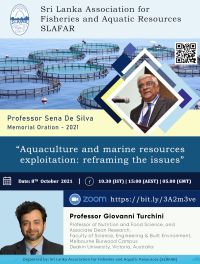
Professor Sena De Silva Memorial Oration, 8 October 2021

Join us on 8 October 2021 for the Professor Sena De Silva Memorial Oration. The topic for the oration is "Aquaculture and marine resources exploitation: reframing the issues", presented by Professor Govanni Turchini of Deakin University and organised by the Sri Lanka Association for Fisheries and Aquatic Resources. The oration will be held at 05:00 GMT (15:00 AEST) via Zoom. To participate, please use the following link: Professor Sena De Silva Memorial Oration 2021.

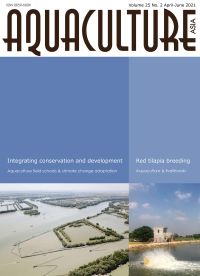
Aquaculture Asia Magazine, April-June 2021

In this issue:

Integrated taxonomy, conservation and sustainable development: Multiple facets of biodiversity; A note on 100th birth anniversary of the late Dr Hiralal Chaudhuri; Aquaculture field schools supporting mangroves for climate change adaptation of Indonesian milkfish-shrimp farmers; An insight to red tilapia breeding and culture: A farmer advisory; Aquaculture for livelihoods and food security in North-western India; NACA Newsletter.

Quarterly Aquatic Animal Disease Report, October-December 2020

The 88th edition of the Quarterly Aquatic Animal Disease Report contains information from thirteen governments. The foreword provides an announcement on the new format for the Aquatic Animal Disease Report from January 2021 onwards.