Shrimp

Information relating to the aquaculture of marine shrimp.

Creative Commons Attribution.

Related

Species / commodity tags

Major farmed commodity or species groups.

In this collection

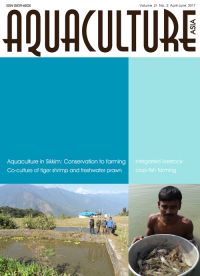
Aquaculture Asia Magazine, April-June 2017

In this issue:

Inspiring story of aquaculture in Sikkim - a journey from conservation to farming; farming of scampi and tiger shrimp together - a case study from West Bengal; Labeo pangusia - a candidate for diversification of hill aquaculture; sustainability of an integrated livestock-fish-crop farming system as a small scale enterprise; sustainable coastal aquaculture in India; potential scope and prospects of domestic fish market in Chhattisgarh.

Farming of scampi and tiger shrimp together: A case study from West Bengal, India

We report on an Indian farmer co-culturing tiger shrimp Penaeus monodon and the giant freshwater prawn, Macrobrachium rosenbergii. The farm utilises wild-caught riverine seed, stocked at a relatively low density and fed on a Macrobrachium pellet which P. monodon also accepts.

Sustainable coastal aquaculture in India

Coastal aquaculture in India was historically focussed mainly on tiger shrimp farming (Penaeus monodon) but production issues and disease led to the introduction of SPF Pacific white shrimp (L. vannamei) in 2009. A robust technical and legal framework was established by the Coastal Aquaculture Authority. Improved regulation has improved sustainability of the sector and underpinned production, with farmed Pacific shrimp output rising from 1,731 tonnes in 2009-2010 to 353,413 tonnes in 2014-2015.

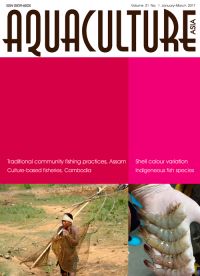
Aquaculture Asia Magazine, January-March 2017

In this issue:

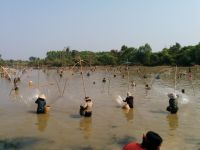
Anti-microbial resistance in aquaculture; participatory market chain approaches to boost fish nurseries; traditional community fishing practices of rural Assam; practical significance of restricted feeding regimes in aquaculture; Bangana dero: A potential indigenous fish species for diversification of carp culture; shell colour variation in farmed Litopenaeus vannamei: Comparison of white- and brown-shelled shrimp; culture-based fisheries: A low-tech, greenhouse friendly approach to improving food and income for Cambodian families.

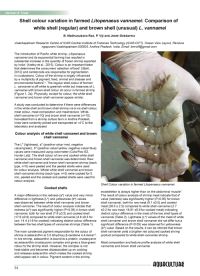
Shell colour variation in farmed Litopenaeus vannamei: Comparison of white shell (regular) and brown shell (unusual) L. vannamei

The regular shell colour of farmed Litopenaeus vannamei is off-white to greenish-white but instances of L. vannamei with brown-shell colour do occur in farmed shrimp. A study was conducted to determine if there were differences vis-à-vis shell colour, meat colour, meat composition and meat texture. White-shelled vannamei was determined to be better in terms of meat composition and texture profile but brown-shelled vannamei yielded a more brightly red-coloured cooked product.

Report of the fifteenth meeting of the Asia Regional Advisory Group on Aquatic Animal Health, 21-23 November 2016

The Asia Regional Advisory Group on Aquatic Animal Health meets annually to discuss regional health issues including emerging disease threats. This report includes a review of regional disease status circa 2016, global and regional disease reporting arrangements, global issues and standards, progress in implementation of the the Regional Technical Guidelines on Health management for the Responsible Movement of Live Aquatic Animals, identification and designation of regional aquatic animal health resources and regional and international cooperation.
15th meeting of the Asia Regional Advisory Group on Aquatic Animal Health

The 15th meeting was held from 21-23 November 2016, in Bangkok, Thailand. A special session was held on addressing the use of anti-microbial substances in aquaculture and the development of anti-microbial resistance. This is an issue of global concern for both human and animal health, and it had been addressed by a resolution at FAO’s Thirty-ninth Conference in June 2015. The meeting reviewed in detail the status of aquatic animal disease in the region.

Participating R&D centres

Directory of research and development centres and other partners that participate in the Network of Aquaculture Centres in Asia-Pacific.

Culture-based Fisheries Development in Lao PDR and Cambodia

Culture-based fisheries (CBF) are a useful development strategy for improving the income and food security of rural communities. CBF requires minimal capital outlay, mobilising farming communities to make use of existing small dams and reservoirs for the secondary purpose of foodfish production. The objective of this project is to introduce community-based CBF to Cambodia, and to consolidate the gains of communities that have adopted CBF in Lao PDR.

Development of regional code of practice for movement of aquatic organisms in the lower Mekong basin

The objective of this project was to develop an agreed code of practice for the transboundary movement of aquatic organisms that feeds into the fisheries management strategy for the lower Mekong basin. The code of practice provides guidance on risk management and mitigation measures be taken into account for live aquatic animal imports or other transfers that are part of the established commercial practice, or those related to scientific study at research facilities.

Staff directory

Directory of NACA's staff members and their contact details.

Technical Advisory Committee

The Technical Advisory Committee is a body of independent experts that make recommendations on development of the NACA Work Programme. The committee meets bi-annually.

Governing Council

The Governing Council is NACA's peak policy body, consisting of representatives from member governments.

A new and improved PCR detection method for Enterocytozoon hepatopenaei (EHP) based on a gene encoding a spore wall protein

Hepatopancreatic microsporidiosis (HPM) caused by Enterocytozoon hepatopenaei (EHP) is a newly emerging disease of cultivated shrimp in Asia. Current evidence indicates that it can be associated with severe growth retardation that may not be clearly evident until the second month of culture and may cause low continuous mortality in the case of very severe infections. We present a new method for detecting EHP that has superior specificity to the first generation SSU-PCR developed in 2009.

FAO Second International Technical Workshop on Acute Hepatopancreatic Necrosis Disease (AHPND)

The Second International Technical Seminar/Workshop on AHPND: There is a way Forward! will be held from 23-25 June 2016 in Thailand. The purpose of the meeting is to update knowledge and exchange experiences in dealing with AHPND, to validate current concepts and models under different systems and environmental conditions and to put into action the responsibilities of the different sectors (i.e. government, producer and academe) as a way forward to deal with AHPND.

Report of the fourteenth meeting of the Asia Regional Advisory Group on Aquatic Animal Health, 23-25 November 2015

The Asia Regional Advisory Group on Aquatic Animal Health meets annually to discuss regional health issues including emerging disease threats. This report includes a review of regional disease status circa 2015, global and regional disease reporting arrangements, global issues and standards, progress in implementation of the the Regional Technical Guidelines on Health management for the Responsible Movement of Live Aquatic Animals, identification and designation of regional aquatic animal health resources and regional and international cooperation.
Sustainable intensification of aquaculture in the Asia-Pacific region: Documentation of successful practices

This publication is the major output of a regional programme jointly implemented by FAO and NACA in 2015 to document and disseminate successful practices that contribute to the sustainable intensification of aquaculture in the Asia-Pacific region. Twelve practices are described that contribute to at least one of the following: Improved production and resource use efficiency (land, water, feed, energy); improved environmental benefits; strengthened economic viability and farmers' resilience; and improved social acceptance and equity.

NACA Newsletter, Volume XXXI, No. 1-2, January-June 2016

In this issue:

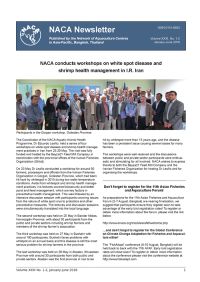
NACA conducts workshops on white spot disease and shrimp health management in I.R. Iran. Don’t forget to register for the 11th Asian Fisheries and Aquaculture Forum! NACA pays tribute to Professor H.P.C. Shetty – Patron of the Pillay Aquaculture Foundation. EHP: Shrimp industry survey. 3rd International Conference on Fisheries and Aquaculture, 24-25 August, Negombo, Sri Lanka. Special Session on the Status of Aquatic Genetic Resources for Food and Agriculture. Second International Technical Workshop on Acute Hepatopancreatic Necrosis Disease (AHPND). Guidebook on Farmer-to-Farmer Extension Approach for Small-Scale Freshwater Aquaculture. Sustainable intensification of aquaculture in the Asia-Pacific region.

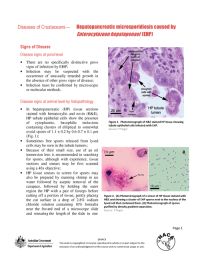
Hepatopancreatic microsporidiosis caused by Enterocytozoon hepatopenaei: Disease card

This disease card describes the diagnosis and range of a microsporidian shrimp pathogen, Enterocytozoon hepatopenaei (EHP), first discovered in Penaeus monodon in Thailand in 2004. It infects only the tubule epithelial cells of the hepatopancreatic tissue of shrimp. EHP was later found to also infect P. vannamei cultivated in Thailand and is suspected to have been reported from P. japonicus in Australia in 2001. EHP has been reported from Vietnam and is associated with white faeces syndrome.

A regional proficiency testing program for aquatic animal disease diagnostic laboratories in Asia-Pacific

A Regional Proficiency Testing Program for Aquatic Animal Disease Diagnostic Laboratories in Asia-Pacific was developed to strengthen diagnostic capability across Asia. This capability was identified as a requirement to facilitate the sanitary safety of trade in aquatic animal products. The program provided 41 laboratories across the Asia-Pacific with the opportunity to assess their diagnostic performance for 10 regionally significant aquatic animal pathogens, and to adapt or modify practices where necessary to improve.