Shrimp

Information relating to the aquaculture of marine shrimp.

Creative Commons Attribution.

Related

Species / commodity tags

Major farmed commodity or species groups.

In this collection

Vulnerability and adaptation to climate change for shrimp farmers in India

K. Muralidhar presents on climate change vulnerability and adaptation for shrimp farms in India.

Vulnerability and adaptation to climate change for improved extensive shrimp farming systems in Vietnam

Presentation on climate change vulnerability and adaptation in improved extensive shrimp farming systems in Vietnam.

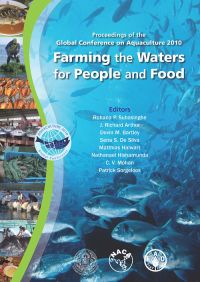
Proceedings of the Global Conference on Aquaculture 2010

The Global Conference on Aquaculture 2010 reviewed the present status and trends in aquaculture development, addressed emerging issues relevant to aquaculture development, assessed opportunities and challenges for future aquaculture development and built consensus on advancing aquaculture as a global, sustainable and competitive food production sector. This volume provides information on how aquaculture could be mobilized to alleviate global poverty and improve food and nutrition security in the coming decades.

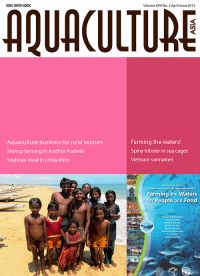
Aquaculture Asia Magazine, April-June 2012

In this issue:

Shrimp farming in Andhra Pradesh, India. Small indigenous freshwater fish species in village community ponds to ensure nutritional security of rural poor. Postlarvae culture and technical status of whiteleg shrimp Penaeus vannamei hatcheries, Vietnam. Jatropha meal as a promising plant protein source for aquaculture feeds. Use of soybean meal in cobia diets. Capture based aquaculture of spiny lobster Panulirus polyphagus in open sea cages. Institutional linkage helping rural women gain employment.

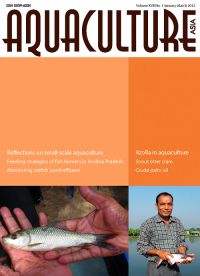
Aquaculture Asia Magazine, January-March 2012

In this issue:

Reflections on small-scale aquaculture. Azolla - an aquatic fern of significance to small-scale aquaculture. Monitoring quantity and quality of striped catfish pond effluent. Feeding strategies adopted by fish farmers in Andhra Pradesh, India. Hatchery techniques applied for the artificiant production of snout otter clam (Lutraria rhynchaeria) in small scale farms in Nha Trang City, Vietnam. Crude palm oil is a sustainable alternative to the growing fish oil scarcity, particularly for the aquaculture of warm freshwater fish species.

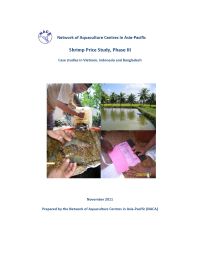
Shrimp price study, phase III: Case studies in Vietnam, Indonesia and Bangladesh

This study is a continuation of “Evaluation of the impact of the Indian Ocean tsunami and US antidumping duties on the shrimp farming sector of South and South-East Asia” with the aim of assessing the impact of the 2004 Indian Ocean tsunami and the introduction of anti-dumping duties on shrimp farming in the Asian region, with special focus on the effect that these unforeseen events had on shrimp prices and livelihoods of the stakeholders.

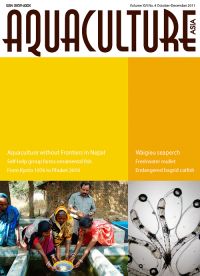
Aquaculture Asia Magazine, October-December 2011

In this issue:

Visit to the AwF funded small-scale aquaculture project in Nepal. Success story of the Barakhandapat Ornamental Fish Breeding Unit, India. From Kyoto 1976 to Bangkok 2000 and Phuket 2010: Aquaculture development and personal transitions. Embryonic and larval development of Waigieu seaperch Psammoperca waigiensis. Culture feasibility of freshwater mullet Rhinomugil corsula in ponds in India. Management in seed production of an endangered catfish Horabagrus brachysoma during its hatchery phase.

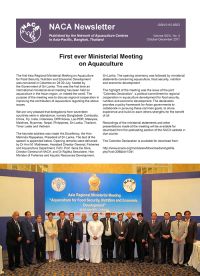
NACA Newsletter, Volume XXVI, No. 4, October-December 2011

In this issue:

First ever Ministerial Meeting on aquaculture. Keynote address delivered by His Excellency, Mahinda Rajapaksa, President of Sri Lanka. Farewell Sena and welcome Eknath! 2nd Regional Training Course on Application of Business Management Principles in Small Scale Aquaculture. Consultation on Lake and Reservoir Fisheries and Aquaculture Development in Asia. Asia Regional Seminar on Certification for Small Scale Aquaculture in Thailand. Special issue of the AFS Journal: Integrated technologies for advanced shrimp production. Farmers as Stakeholders in Commercial Aquaculture: Free download. Marker for banned antibiotic naturally occurs in freshwater prawns and other crustaceans.

Opening ceremony of the National Workshop on Scaling up of Shrimp BMP Programme at the National Level

Opening ceremony of the National Workshop on Scaling up of Shrimp Better Management Practices at the National Level, held in India, July 2011.

BMPs and cluster management: Way forward for small scale farmers to remain competitive and sustainable

Sena De Silva presents on better management practices and cooperatives as a means for small-scale farmers to ramain competitive and sustainable.

Aquaculture certification and market access: Opportunity or bottleneck for small scale farmers?

C.V. Mohan presents on aquaculture certification and market access and the implications for small-scale farmers.

Fair trade certification: Enabling mechanism for small scale farmer groups

Sureel Singh presents on Fair trade as an enabling mechanism for small-scale farmers in India.

Shrimp BMP adoption through cluster management approach in India

G. Rajkumar presents on adoption of better management practices for shrimp farming via small-scale farmer cooperatives in India.

Lessons learned from ACIAR shrimp BMP programmes in Indonesia

Richard Callinan presents on lessons learned in ACIAR's shrimp BMP programmes in Indonesia.

Role of institutions in scaling up: Central Aquaculture Authority

Baskaran Manimaran presents on the Central Aquaculture Authority and scaling up of better management practices for shrimp farming in India.

National Workshop on Scaling up of Shrimp BMP Programme at the National Level

Better management practices have proved to be a highly effective tool for the Indian shrimp farming industry. Work to extend adoption of the practices is ongoing and in this view a national workshop was held in Chennai, 16-18 May 2011 at the Central Institute of Brackishwater Aquaculture to discuss scaling up strategies, to extend the concept to new areas and to involve more farmers and identify lessons learned that can be applied elsewhere.

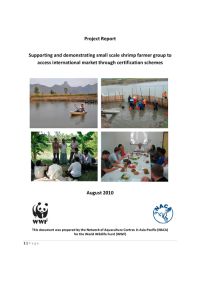
Supporting and demonstrating small scale shrimp farmer group to access international market through certification

This project was conducted to demonstrate small scale shrimp farmer group access to international markets through certification schemes. This project proved that small-scale farmers organised into groups, can improve their technical capacities, and achieve access to markets. This achievement was the result of strong partnerships with producers, private sector and government agencies assisting to develop a sustainable business model for small scale aquaculture. Cost of compliance was found to be a significant barrier to entry.

National Training Workshop for Cluster Certification Trainers

International requirements on food safety, traceability, animal health and welfare and social responsibility are increasingly stringent. The burden of compliance and the cost of certification are particularly heavy for small scale farmers who are often excluded by the limited resources at their disposal. Working in groups can help small scale farmers attain economies of scale necessary to address compliance issues and participate in certification schemes, improving their competitive position.

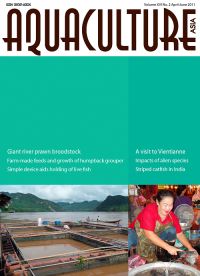
Aquaculture Asia Magazine, April-June 2011

In this issue:

A visit to Vientianne, Lao PDR. Development of captive broodstock of giant river prawn Macrobrachium rosenbergii. Alien introduction and its impact on native fisheries and aquatic bioiversity of West Bengal, India. Ecological impacts of exotic fish species in India. Farm-made feeds support good growth and survivial of the humpback grouper. An easy way to hold live fish. Litopenaeus vannamei introduction: Sound management or expediency? Newsletter and more.

Report of the ninth meeting of the Asia Regional Advisory Group on Aquatic Animal Health, 8-10 November 2010

The Asia Regional Advisory Group on Aquatic Animal Health meets annually to discuss regional health issues including emerging disease threats. This report includes a review of regional disease status circa 2010, global and regional disease reporting arrangements, global issues and standards, progress in implementation of the the Regional Technical Guidelines on Health management for the Responsible Movement of Live Aquatic Animals, identification and designation of regional aquatic animal health resources and regional and international cooperation.