1 September 2004 | Matthew Briggs, Simon Funge-Smith, Rohana Subasinghe and Michael Phillips | 3241 Downloads | .pdf | 470.06 KB
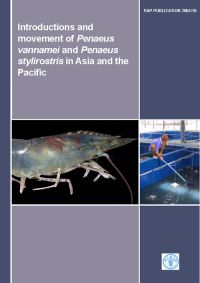
This report has attempted to gather all of the currently available data on the extent of P. vannamei and P. stylirostris importation and culture in Asia, its potential problems and benefits, to provide a source document from which to investigate further the means by which control over this issue might be re-established. Recommendations aimed at controlling the importation, testing and culture of these species have been made for all levels and are included in this report.
This information sheet on slow growth syndrome in Penaeus monodon provides some background information on the possible aetiology and a working case definition. This will be useful for surveillance and epidemiological purposes to collate more information about this syndrome in the region.
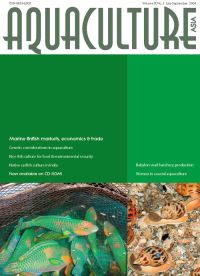
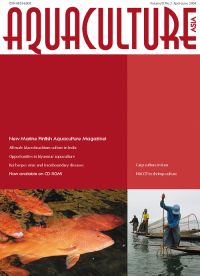
Genetic considerations in fisheries and aquaculture with regards to biodiversity. Rice-fish culture for food and environmental security. Land-based aquaculture of spotted babylon Babylonia areolata in Thailand: Hatchery-based seedling operation. Shrimp health question and answer. Women in coastal aquaculture. Insights into live marine food fish markets in Asia. Farming practices, market chains and prices of marine finfish in Malaysia, Indonesia and Hong Kong.
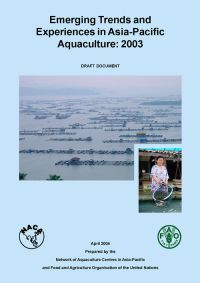
This document provides an overview of topical issues in Asian aquaculture for 2003, including a review of its status, progress in research and development, major issues and experiences, together with suggestions on actions for addressing opportunities and constraints. The document was prepared by NACA and FAO to facilitate discussions at the 15th NACA Governing Council meeting, hosted by the Government of Sri Lanka on 21st-25th April 2004.
Genetic impacts of translocation on aquatic biodiversity in Asia. Carp culture in Iran. Opportunities and challenges in Myanmar aquaculture. Impacts of monosex Macrobrachium culture on seed availability in India. Use of new technology and skills for eco-friendly production of tiger shrimp Penaeus monodon. Larval rearing and spat production of the windowpane shell Placuna placenta. HACCP in shrimp farming. First breeding success of Napoleon wrasse Cheilinus undulatus and coral trout Plectropomus leopardus.
The recommendations are derived from discussions at the consultation and three expert working groups and were adopted during the final plenary session of the Expert Consultation. Together they represent a powerful set of recommendations in use of rapid diagnostic tools for better health management in shrimp aquaculture. They have been put together in this summary document for rapid dissemination to potential users, researchers and other interested parties, in India and elsewhere.
19 March 2004 | Department for International Development | 2464 Downloads | .pdf | 300.93 KB
In February 2002 the shrimp fry collection ban was placed into abeyance pending further review of how biodiversity could be conserved at the same time as protecting the livelihoods of 400,000 fry collectors. A Shrimp Action Plan for the period April - September 2002 was drawn up to identify trends impacting on distribution and growth in the shrimp sector, and to explore alternative models for the management of fry resource and to assess their social, institutional and economic implications.
18 March 2004 | Macfadyen, G., Banks, R., Phillips, M., Haylor, G., Mazaudier, L. and Salz, P. | 3232 Downloads | .pdf | 939.05 KB
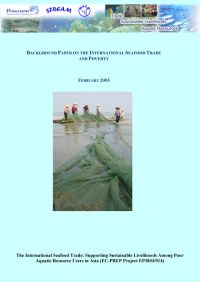
The purpose of this report is to provide an overview of the international seafood trade and poverty, with special reference to the trade in some selected marine products between Asia and the European Union. It represents Output 1 of the project “The International Seafood Trade: supporting sustainable livelihoods among poor aquatic resource users in Asia”, which was funded by the European Community's Poverty Reduction Effectiveness Programme (EC-PREP).
4 March 2004 | Claude E. Boyd | 2116 Downloads | .pdf | 14.94 KB
This article compares the use of chemical and biological amendments in shrimp farming in Asia and the Americas. The information comes mainly from the author’s experience in Thailand and Ecuador, as well as from the literature. The amendments are discussed according to three major categories: (1) water and soil quality management products, (2) biocides, and (3) feed additives. Certain agents, while necessary to successful shrimp farming, should be used only when needed and in a safe and responsible manner.
3 February 2004 | Haylor, G., Briggs, M.R.P., Pet-Soede, L., Tung, H., Yen, N.T.H., Adrien, B., O'Callaghan, B., Gow, C., De Vantier, L., Santos, R., Pador, E., de la Torre, M., Bulcock, P., and Savage, W. | 26855 views | .pdf | 2.25 MB
Wild-harvest fisheries for live reef fish are largely over-exploited or unsustainable. Sustainable aquaculture – such as that of groupers – is one option for meeting increasing demand for reef fish as well as potentially maintaining livelihoods of coastal communities. This report draws upon secondary literature, media sources and four diverse case studies from at-risk reef fisheries, to frame a strategy for encouraging sustainable aquaculture as an alternative to destructive fishing practices. It was commissioned by the APEC Secretariat.
3 February 2004 | Matthew Briggs | 6880 Downloads | .pdf | 582.74 KB
Sulawesi has the largest coral reef area in Indonesia, at the epicenter of worldwide marine biodiversity, but is one of the areas most threatened in Southeast Asia by destructive fishing practices. This case study reviews the potential for aquaculture to provide alternative livelihoods for fishers within the context of an integrated, community-based coastal management plan with involvement of local communities empowered to control and steward their resources so that they can conserve and utilise them sustainably.
Aquaculture and food security in Iraq. Natural breeding in captivity - conservation of the threatened freshwater featherback Notopterus notopterus. Culture of Penaeus japonicus. Enzymes for sustainable aquaculture. Review of global tilapia farming practices. Fish culture in Yucatan, Mexico. Shrimp farm project planning, preparation and implementation. Coping with low shrimp prices. Efficiencies in barramundi culture. The innovative contributions of women in aquaculture. Marine finfish section. What's new on the web. Aquaculture calendar.
Outcomes of the 15th Governing Council. Aquaculture seminar. Council Chair for 2004-2005. Shrimp disease and coastal management - four years. New Import Risk Analysis publications. Reducing the risk of shrimp disease outbreaks in Vietnam. Network of Aquaculture Centres in Central and Eastern Europe. OASIS: The One Stop Aqua Shop Information Service. Other recent STREAM activities. New faces at NACA.
11 December 2003 | Erik Hempel, Ulf Winther and John Hambrey | 28369 Downloads | .pdf | 632.13 KB
This report is intended primarily as a discussion paper, to serve as the basis for informed dialogue and policy development to encourage more detailed guidelines following further study and consultation. It seeks, in particular, to answer three commonly posed questions: Is sustainable shrimp farming possible? Can poor coastal communities benefit from it? And, if so, what role can agencies like the World Bank play to ensure that basic minimal requirements to achieve this are met?
The Asia Regional Advisory Group on Aquatic Animal Health meets annually to discuss regional health issues including emerging disease threats. This report includes a review of regional disease status circa 2003, global and regional disease reporting arrangements, global issues and standards, progress in implementation of the the Regional Technical Guidelines on Health management for the Responsible Movement of Live Aquatic Animals, identification and designation of regional aquatic animal health resources and regional and international cooperation.
23 November 2003 | Tran Van Nhuong, Michael J. Phillips and Raymon Van Anrooy | 1543 Downloads | .pdf | 102.66 KB
This case study was carried out in the North and North Central of Vietnam. The study was based on discussions and structured interviews with farmers, extension officers and other stakeholders. The objectives of the study were to describe the current coastal aquaculture practises, the impact on the livelihood of the coastal inhabitants and on the environment, to discuss the current situation in relation to the Code of Conduct for Responsible Fisheries and identify issues where BMPs should be introduced.
23 November 2003 | Ayu Nissapa and Somsak Boromthanarat | 1452 Downloads | .pdf | 2.35 MB
This case study documents the success and lessons learnt from local co-management approaches involving farmers associations and local government in Thailand. The case study also shows the linkages and relationships of institutions operating at different levels of administration from farm to national levels and their effect on management. The case study provides an analysis of institutional supports and mechanisms needed for successful shrimp farming management via case studies.
23 November 2003 | P.G.S.N. Siriwardena and R. Willman | 2010 Downloads | .pdf | 13.85 KB
The code development work was undertaken by the NARA in collaboration with the NAQDA, MFNWP, PEA, Shrimp Farmers and Exporters Associations, Shrimp Breeders Association, feed suppliers and manufacturers. This was developed mainly conducting consultations with different stakeholders of the industry and discussed at a forum with the representation of all stakeholders to reach consensus. The code includes technical specifications for the siting, design, construction and operation of shrimp hatcheries and farms.
23 November 2003 | M.N. Kutty, P. Ravichandran, M. Krishnan, M. Kumaran and C.P. Balasubramanian | 1343 Downloads | .pdf | 11.01 KB
The present case studies concentrated on three sites, Kandaleru in Andhra Pradesh, Dhigirpar in West Bengal and Brahmagiri in Orissa. The three sites are markedly differentbut have a common feature that all three mainly are concerned with small farmers groupings. Earlier shrimp farming failures owing to the overexploitation of the ecosystem, by overstocking and consequent high inputs, resulting in degradation of the environment, diseases and eventual collapse, have alerted all shrimp farm groups to be wary.
23 November 2003 | Stanislaus Sonnenholzner, Laurence Massaut, Carlos Saldias, Jorge Calderon and Claude E. Boyd | 3581 Downloads | .pdf | 18.6 KB
This case study review shrimp aquaculture development in Ecuador. The prevailing farming systems and practices are described. Most farms are extensive or semi-intensive and the industry is shifting to hatchery-reared PL rather than wild due to unpredictability in wild PL supply and disease outbreaks. A survey of water quality intake and outfall from farms is reported on with suggestions for farm design to reduce nutrient load in outfall is discussed. Health issues and mangrove degredation are discussed.