Shrimp

Information relating to the aquaculture of marine shrimp.

Creative Commons Attribution.

Related

Species / commodity tags

Major farmed commodity or species groups.

In this collection

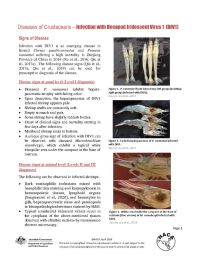
Infection with decapod iridescent virus 1 (DIV1): Disease card

Infection with DIV1 is an emerging disease in farmed Cherax quadricarinatus and Penaeus vannamei suffering a high mortality. This disease card provides information on signs of disease at pond and animal level (levels I - III diagnoses), the disease agent, known host range and distribution in the Asia-Pacific region, molecular diagnostic methods and provides key expert contact points.

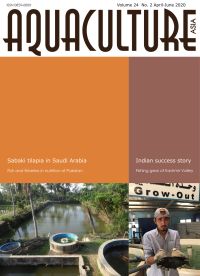
Aquaculture Asia Magazine, April-June 2020

In this issue:

Potential new species in the Kingdom of Saudi Arabia: Sabaki tilapia (Oreochromis spilurus); Role of fish & fisheries in national nutrition of Pakistan; Success story of first fish farmer in India to be awarded ‘Padma Shri’; Insights into the fishing gear and ichthyofauna of major lentic water bodies of Kashmir Valley; NACA Newsletter.

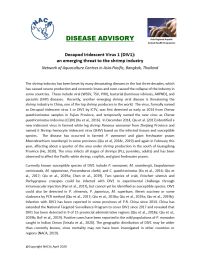
Disease advisory: Decapod Iridescent Virus 1 (DIV1): An emerging threat to the shrimp industry

This disease advisory describes the history, known host range, clinical signs and PCR detection methods for decapod iridescent virus 1 (DIV1). Preventative strategies are suggested. Currently known susceptible species of DIV1 include Penaeus vannamei, Macrobrachium rosenbergii, Exopalaemon carinicauda, M. nipponense, Procambarus clarkii, and Cherax quadricarinatus. Clinical signs of infected P. vannamei are not typical, including slightly reddish body, hepatopancreatic atrophy with colour fading, and empty stomach and guts.

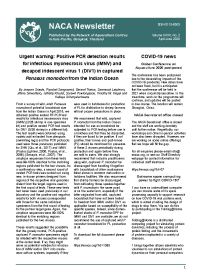
NACA Newsletter, Vol. XXXV No. 2, April-June 2020

In this issue:

Urgent warning: Positive PCR detection results for infectious myonecrosis virus (IMNV) and decapod iridescent virus 1 (DIV1) in captured Penaeus monodon from the Indian Ocean; COVID-19 news; Urgent announcement on usefulness of the lymphoid organ (LO) as an additional prime target for diagnosis of decapod iridescent virus 1 (DIV1) in diseased P. vannamei; Fresh or frozen seafood?; Report of the Eighteenth Meeting of the Asia Regional Advisory Group on Aquatic Animal Health; COVID-19 fallout could push half a billion people into poverty in developing countries; Simple techniques double crablet production.

Urgent warning: Positive PCR detection results for infectious myonecrosis virus (IMNV) and decapod iridescent virus 1 (DIV1) in captured Penaeus monodon from the Indian Ocean

From a survey of wild, adult Penaeus monodon of potential broodstock size from the Indian Ocean in April 2018, we obtained positive nested RT-PCR test results for infectious myonecrosis virus (IMNV) and positive nested PCR test results for DIV1. As a confirmatory step, a second round of nested PCR tests was carried out using new, in-house primers designed from regions of the respective viral genomes distant from the target regions used in the first round of tests. These results suggested the possibility that the grossly normal, PCR-positive captured P. monodon specimens might be infected with the respective viruses at the carrier level. If so, they might serve as potential vehicles for introduction of IMNV and/or DIV1 into crustacean culture systems, especially if they were used in hatcheries for production of PL for distribution to shrimp farmers without proper precautions in place.

Urgent announcement on usefulness of the lymphoid organ (LO) as an additional prime target for diagnosis of decapod iridescent virus 1 (DIV1) in diseased P. vannamei

We carried out laboratory injection challenges that employed extracts prepared from shrimp naturally-infected with decapod iridovirus 1 (DIV1). We found that diseased shrimp from the injection trials showed pathognomonic lesions for DIV1 in the hematopoietic tissue that matched those reported for DIV1 in P. vannamei from China (Qiu et al. 2017. Scientific Reports. 7). In addition, we also found distinctive lesions in the lymphoid organ that could be used as an additional indicator in confirming diagnosis of DIV1 disease. Also, the lesions from shrimp challenged with the 10x dilution were more severe than those from 100x dilution, and for some shrimp in the 100x dilution, the lesions were very clear in the LO but absent in the HPT. Altogether, the results suggested that histology of the HPT and LO could be used together to help in the diagnosis of DIV1 in conjunction with RT-PCR, amplicon sequencing and in situ hybridization (ISH) analysis. This is particularly important in confirming the presence of virulent isolates of DIV1 in new geographical locations.

Aquaculture Asia Magazine, January-March 2020

In this issue:

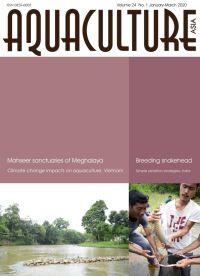
Mahseer sanctuaries of Meghalaya: A conservation and recreational perspective; Impacts of climate change on aquaculture in Vietnam: A review of local knowledge; Simple means of water aeration adopted by progressive fish breeders in West Bengal, India; Breeding striped snakehead (Channa striata) using the concrete tank method in the Cangkringan Area, Special Region of Yogyakarta; NACA Newsletter.

NACA Newsletter, Vol. XXXV No. 1, January-March 2020

In this issue:

Join us for the aquaculture event of the decade! 18th Meeting of the Asia Regional Advisory Group on Aquatic Animal Health; New Director General of the Department of Fisheries, Thailand; Thailand holds National Sea Bass Fair; Tuskfish CMS 2.0 is available; Regional consultations on strengthening aquaculture governance and demographic changes in fishing communities; INFOFISH World Shrimp Conference and Exposition.

11th Symposium on Diseases in Asian Aquaculture, Kuching, Malaysia

The 11th Symposium on Diseases in Asian Aquaculture (DAA11) marks 30 years since the Fish Health Section - Asean Fisheries Society (FHS-AFS) establishment and it will be celebrated in Malaysia. Local hosts, the Department of Fisheries Malaysia (DOF) under the Ministry of Agriculture and Agro-based Industry together with the Ministry of Modernisation of Agriculture, Native Land and Regional Development Sarawak (MANRED) will be organising the event in cooperation with the FHS-AFS.

Aquaculture Asia Magazine, October-December 2019

In this issue:

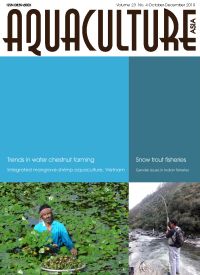
Trends in water chestnut Trapa bispinosa farming in West Bengal, India; Improving livelihoods and increasing coastal resilience: A look at integrated mangrove-shrimp aquaculture in Vietnam; Snow trout fisheries in Arunachal Pradesh of the Eastern Himalayas; Gender issues in the fisheries sector of India; NACA Newsletter.

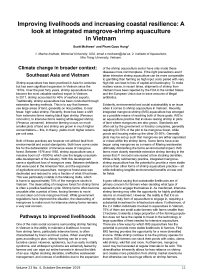
Improving livelihoods and increasing coastal resilience: A look at integrated mangrove-shrimp aquaculture in Vietnam

In the last decade, integrated mangrove-shrimp aquaculture has emerged as a means of cultivating shrimp while maintaining the benefits of rearing shrimp in their natural environment. Furthermore, mangrove-shrimp aquaculture provides an additional means for farmers to secure livelihoods. Increased mangrove coverage provides considerable benefits to ecosystems and communities. Mangrove forests have also been shown to increase coastal resilience to climate change as they mitigate the effects of climate change and erosion. This research attempts to assess the feasibility of large scale implementation of integrated mangrove-shrimp aquaculture in coastal Vietnam.

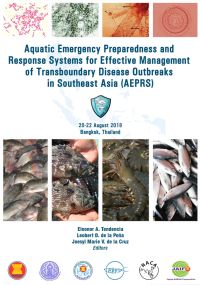
ASEAN Regional Technical Consultation on Aquatic Emergency Preparedness and Response Systems for Effective Management of Transboundary Disease Outbreaks in Southeast Asia

The ASEAN Regional Technical Consultation on Aquatic Emergency Preparedness and Response Systems for Effective Management of Transboundary Disease Outbreaks in Southeast Asia was held from 20-22 August 2018 in Bangkok, Thailand. The consultation discussed the status of and/or need for aquatic emergency preparedness and response systems for effective management of transboundary disease outbreaks in Southeast Asia. Issues were addressed through country reports, technical presentations and a workshop.

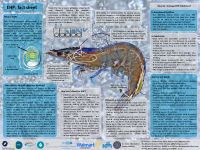
Fact sheet on Enterocytozoon hepatopenaei, a microsporidian parasite of shrimp

EHP or Enterocytozoon hepatopenaei is a fungal microsporidian parasite that infects the hepatopancreas (hp) of tiger shrimp (Penaeus monodon) and whiteleg shrimp (P. vannamei) in Thailand and results in slow growth and, in chronic infections, mortalities. EHP is also known from Brunei, China, India, Indonesia, Malaysia, Philippines, Venezuela and Vietnam. This fact sheet provides information on the EHP life cycle, signs of infection, diagnosis and management in both hatcheries and growout, as well technical contacts for further information.
18th Meeting of the Asia Regional Advisory Group on Aquatic Animal Health

The Advisory Group (AG) is a body of technical experts that meets annually to provide advice to NACA member governments on aquatic animal health management. The group is drawn from academia, the private sector and government. The role of the AG is to review disease trends in the region, identify emerging threats and developments in global aquatic disease issues and standards, evaluate the Quarterly Aquatic Animal Disease Reporting Programme operated by NACA/FAO/OIE and regional governments, and to provide guidance on strategies to improve aquatic animal health management. This year’s meeting took place from 18-19 November at the Amari Don Muang Airport Hotel in Bangkok.

INFOFISH World Shrimp Conference and Exposition

Shrimp 2019 was held in Bangkok, Thailand from 12-14 November at the JW Marriot Hotel, jointly organised by INFOFISH, the Thai Department of Fisheries, NACA and the Thai Shrimp Association. The conference provided a forum for publicising shrimp farming technology, production standards, harvesting, and processing products, as well as related trade and investment. Over 200 participants attended from all regions of the world. The theme of the conference was “Modelling for Sustainability”.

NACA Newsletter, Vol. XXXIV No. 4, October-December 2019

In this issue:

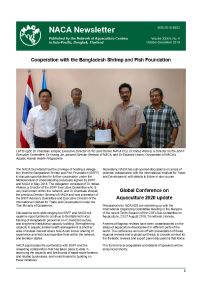
Cooperation with the Bangladesh Shrimp and Fish Foundation; Global Conference on Aquaculture 2020 update; Quarterly Aquatic Animal Disease Report, January-March 2019; A fresh look at inland fisheries and their role in food security and livelihoods; Tuskfish 2 Beta: Testers wanted; APAARI Regional Workshop on Underutilized Fish and Marine Genetic Resources and Their Amelioration; Joint Research Project on Utilization of Thailand Local Genetic Resources to Develop Novel Farmed Fish for Global Market; Impacts of climate change on fisheries and aquaculture.

NACA Newsletter, Vol. XXXIV No. 3, July-September 2019

In this issue:

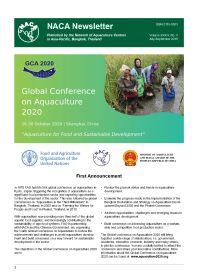
First announcement: Global Conference on Aquaculture 2020, 26-30 October, Shanghai, China; Bangladesh delegation visits Thailand to study shrimp aquaculture; Expert Consultation on Development of Sustainable Aquaculture Guidelines, Rome; Report of the Seventeenth Meeting of the Asia Regional Advisory Group on Aquatic Animal Health; Quarterly Aquatic Animal Disease Report, October-December 2018; Tuskfish 2 Alpha: Testers wanted.

Bangladesh delegation visits Thailand to study shrimp aquaculture

NACA and the Bangladesh Shrimp and Fish Foundation collaborated to organise a study tour programme focused on shrimp operations in Thailand for fourteen Bangladesh officers during 29 April to 2 May 2019. The study tour was supported by the Winrock Foundation and coordinated by Dr Cherdsak, the outgoing Director General of NACA. The group met with CP Executives, DOF-Thailand and Banjong Farm in Chachoengsao Province.

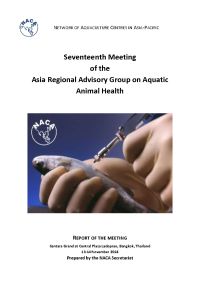
Report of the Seventeenth Meeting of the Asia Regional Advisory Group on Aquatic Animal Health

This report summarises the proceedings of the 17th meeting of the Advisory Group, held 13-14 November 2018 in Bangkok, Thailand. The group's role includes reviewing disease trends and emerging threats in the region, identifying developments in global aquatic disease issues and standards, evaluating the Quarterly Aquatic Animal Disease Reporting Programme and providing guidance on regional strategies to improve aquatic animal health management.

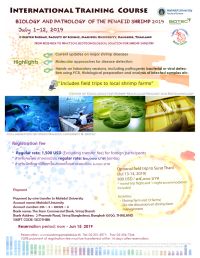
International Training Course - Biology and Pathology of the Penaeid Shrimp

This year’s International Training Course on the Biology and Pathology of Penaeid Shrimp will take place from 1-12 July at Centex Shrimp, Mahidol University, Bangkok. Tailored to those interested in doing shrimp research or learning about shrimp diseases, you will get to learn from the very best in the field about major and emerging shrimp diseases, shrimp farm management, gross inspection and molecular diagnosis of infectious shrimp diseases. You will have opportunities to try your hand in a series of practical sessions.