15 January 2020 | DAA 11 national Technical Organizing Committee | 1421 Downloads | .pdf | 1.05 MB
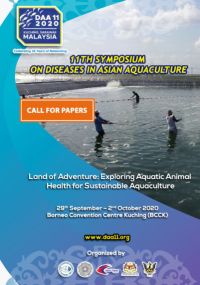
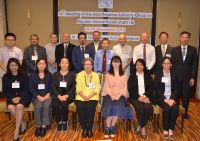
The 11th Symposium on Diseases in Asian Aquaculture (DAA11) marks 30 years since the Fish Health Section - Asean Fisheries Society (FHS-AFS) establishment and it will be celebrated in Malaysia. Local hosts, the Department of Fisheries Malaysia (DOF) under the Ministry of Agriculture and Agro-based Industry together with the Ministry of Modernisation of Agriculture, Native Land and Regional Development Sarawak (MANRED) will be organising the event in cooperation with the FHS-AFS.
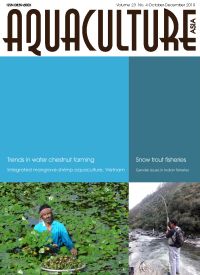
Trends in water chestnut Trapa bispinosa farming in West Bengal, India; Improving livelihoods and increasing coastal resilience: A look at integrated mangrove-shrimp aquaculture in Vietnam; Snow trout fisheries in Arunachal Pradesh of the Eastern Himalayas; Gender issues in the fisheries sector of India; NACA Newsletter.
18 December 2019 | Scott McIlveen and Pham Quoc Hung | 3080 Downloads | .pdf | 183.83 KB
In the last decade, integrated mangrove-shrimp aquaculture has emerged as a means of cultivating shrimp while maintaining the benefits of rearing shrimp in their natural environment. Furthermore, mangrove-shrimp aquaculture provides an additional means for farmers to secure livelihoods. Increased mangrove coverage provides considerable benefits to ecosystems and communities. Mangrove forests have also been shown to increase coastal resilience to climate change as they mitigate the effects of climate change and erosion. This research attempts to assess the feasibility of large scale implementation of integrated mangrove-shrimp aquaculture in coastal Vietnam.
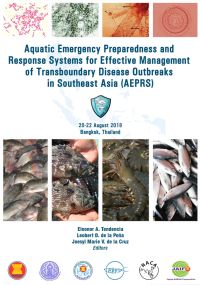
The ASEAN Regional Technical Consultation on Aquatic Emergency Preparedness and Response Systems for Effective Management of Transboundary Disease Outbreaks in Southeast Asia was held from 20-22 August 2018 in Bangkok, Thailand. The consultation discussed the status of and/or need for aquatic emergency preparedness and response systems for effective management of transboundary disease outbreaks in Southeast Asia. Issues were addressed through country reports, technical presentations and a workshop.
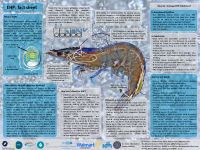
EHP or Enterocytozoon hepatopenaei is a fungal microsporidian parasite that infects the hepatopancreas (hp) of tiger shrimp (Penaeus monodon) and whiteleg shrimp (P. vannamei) in Thailand and results in slow growth and, in chronic infections, mortalities. EHP is also known from Brunei, China, India, Indonesia, Malaysia, Philippines, Venezuela and Vietnam. This fact sheet provides information on the EHP life cycle, signs of infection, diagnosis and management in both hatcheries and growout, as well technical contacts for further information.
The Advisory Group (AG) is a body of technical experts that meets annually to provide advice to NACA member governments on aquatic animal health management. The group is drawn from academia, the private sector and government. The role of the AG is to review disease trends in the region, identify emerging threats and developments in global aquatic disease issues and standards, evaluate the Quarterly Aquatic Animal Disease Reporting Programme operated by NACA/FAO/OIE and regional governments, and to provide guidance on strategies to improve aquatic animal health management. This year’s meeting took place from 18-19 November at the Amari Don Muang Airport Hotel in Bangkok.
Shrimp 2019 was held in Bangkok, Thailand from 12-14 November at the JW Marriot Hotel, jointly organised by INFOFISH, the Thai Department of Fisheries, NACA and the Thai Shrimp Association. The conference provided a forum for publicising shrimp farming technology, production standards, harvesting, and processing products, as well as related trade and investment. Over 200 participants attended from all regions of the world. The theme of the conference was “Modelling for Sustainability”.
Cooperation with the Bangladesh Shrimp and Fish Foundation; Global Conference on Aquaculture 2020 update; Quarterly Aquatic Animal Disease Report, January-March 2019; A fresh look at inland fisheries and their role in food security and livelihoods; Tuskfish 2 Beta: Testers wanted; APAARI Regional Workshop on Underutilized Fish and Marine Genetic Resources and Their Amelioration; Joint Research Project on Utilization of Thailand Local Genetic Resources to Develop Novel Farmed Fish for Global Market; Impacts of climate change on fisheries and aquaculture.
First announcement: Global Conference on Aquaculture 2020, 26-30 October, Shanghai, China; Bangladesh delegation visits Thailand to study shrimp aquaculture; Expert Consultation on Development of Sustainable Aquaculture Guidelines, Rome; Report of the Seventeenth Meeting of the Asia Regional Advisory Group on Aquatic Animal Health; Quarterly Aquatic Animal Disease Report, October-December 2018; Tuskfish 2 Alpha: Testers wanted.
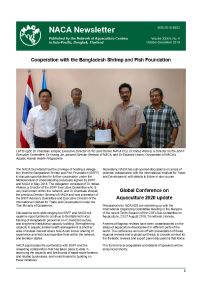
NACA and the Bangladesh Shrimp and Fish Foundation collaborated to organise a study tour programme focused on shrimp operations in Thailand for fourteen Bangladesh officers during 29 April to 2 May 2019. The study tour was supported by the Winrock Foundation and coordinated by Dr Cherdsak, the outgoing Director General of NACA. The group met with CP Executives, DOF-Thailand and Banjong Farm in Chachoengsao Province.
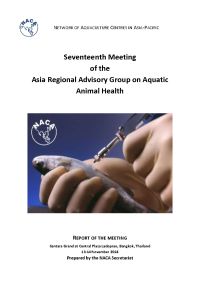
This report summarises the proceedings of the 17th meeting of the Advisory Group, held 13-14 November 2018 in Bangkok, Thailand. The group's role includes reviewing disease trends and emerging threats in the region, identifying developments in global aquatic disease issues and standards, evaluating the Quarterly Aquatic Animal Disease Reporting Programme and providing guidance on regional strategies to improve aquatic animal health management.
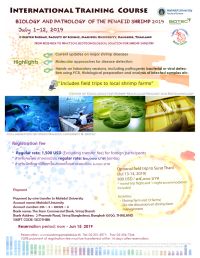
This year’s International Training Course on the Biology and Pathology of Penaeid Shrimp will take place from 1-12 July at Centex Shrimp, Mahidol University, Bangkok. Tailored to those interested in doing shrimp research or learning about shrimp diseases, you will get to learn from the very best in the field about major and emerging shrimp diseases, shrimp farm management, gross inspection and molecular diagnosis of infectious shrimp diseases. You will have opportunities to try your hand in a series of practical sessions.
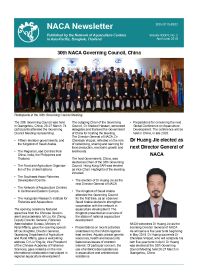
30th NACA Governing Council Meeting, China; Dr Huang Jie elected as the next Director General of NACA; Expert Consultation on Genetically Responsible Aquaculture; Launch of AGRISI: Aquatic Genetic Resource System of India; Aquatic animal epidemiology training course held at NBFGR; Asia-Pacific Laboratory Proficiency Testing Workshop; Proceedings of the FishAdapt Conference; Quarterly Aquatic Animal Disease Report, July-September 2018; Centex Shrimp International Training Course on Biology and Pathology of Penaeid Shrimp; INFOFISH World Shrimp Trade Conference and Exposition.
The 79th edition of the Quarterly Aquatic Animal Disease report contains information from eleven governments. The foreword discusses the outcomes of the 17th Meeting of the Asia Regional Advisory Group on Aquatic Animal Health, held in Bangkok, 13-14 November 2018.
The 78th edition of the Quarterly Aquatic Animal Disease Report contains information from twelve governments in the Asia-Pacific region. The foreword discusses three recent aquatic animal health consultations: The ASEAN Regional Technical Consultation on Aquatic Emergency Preparedness and Response Systems for Effective Management of Transboundary Disease Outbreaks in Southeast Asia; the Regional Consultation and Related Study on Antimicrobial Resistance Risk to Aquaculture in Asia; and the Preliminary Consultation on Monitoring of Antimicrobial Resistance in Bacterial Pathogens in Aquaculture.
The 77th edition of the Quarterly Aquatic Animal Disease Report contains information from nine governments. The foreword discusses an intensive seven-day training course on tilapia lake virus (TiLV) that was jointly organised by China's National Fisheries Extension Center, Sun Yat-Sen University and the Food and Agriculture Organization of the United Nations.
29th Governing Council Meeting held in Malé, Maldives; Proceedings of the Emergency Regional Consultation for Prevention and Management of Tilapia Lake Virus in the Asia-Pacific; NACA signs MOU on cooperation with the Bangladesh Shrimp and Fish Foundation; Aquaculture in China: Success Stories and Modern Trends; Quarterly Aquatic Animal Disease Report; Gender in Aquaculture and Fisheries 2018; International Training Course on the Biology and Pathology of Penaeid Shrimp; ASEAN-India Research Training Fellowships and more.
5 July 2018 | S. Senapin | 5313 views | .jpg | 1.11 MB
The Center for Excellence for Shrimp Molecular Biology and Biotechnology (Centex Shrimp) will organise this training course from 10-21 September, 2018. Tailored to those involved in shrimp research, you will learn from the very best in the field about major and emerging shrimp diseases, shrimp farm management, gross inspection and molecular diagnosis of shrimp infectious diseases. You will have opportunities to try your hand in a series of practical sessions, including anatomical inspection using digital slides, nucleic acid detection, and many more.
The 76th edition of the Quarterly Aquatic Animal Disease Report contains information from 14 governments. The foreword discusses the outcomes of a Stakeholder Consultation on Progressive Management Pathway to Improve Aquaculture Biosecurity, organised by the Food and Agriculture Organization of the United Nations, Mississippi State University and the World Bank.
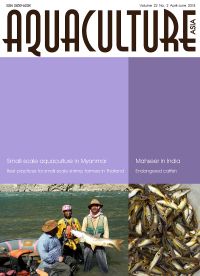
Mahseer in recreational fisheries and ecotourism in India; Small-scale aquaculture of wild fish in Myanmar: A preliminary report from the Bago Region; Current know how and possibility for growout culture of an endangered catfish, Horabagrus brachysoma; Accelerated poverty alleviation of tribal households - cage fish farming by displaced fishers in reservoirs of Jharkhand; Adaptive learning in sustainable aquaculture: Best practices for small-scale shrimp farmers in Thailand; NACA Newsletter.