Global population is forecast to reach around 9 billion by 2050. To feed the world, global agricultural output must increase by around 60% from present levels. This must be achieved against a background of increasing competition for natural resources such as water, feed ingredients and farming sites.
Maintaining environmental integrity while massively increasing food production will require farming systems to reduce their unit production environmental footprint. Many farming practices that are regarded as sustainable today will not be acceptable when scaled up. Sustainable intensification of aquaculture means doing more with less. The Environment and Sustainability Programme aims to help aquaculture become a more efficient user of natural resources, both in terms of farm productivity and environmental efficiency.
The programme develops better management practices for major aquaculture farming systems, and promotes aquaculture as a secondary or additional use of water resources. The programme focusses on practical interventions that can be directly achieved by small-scale farmers in a developing country context.
Key activities
Key activities of the programme are:
Development of better management practices for key aquaculture production systems.
Organising small-scale farmers into associations to facilitate cluster-based approaches to extension.
Development of culture-based fisheries as a secondary use of water bodies.
Development of strategic policy frameworks to guide governments and development agencies in promoting sustainable intensification of aquaculture.
11 December 2003 | Erik Hempel, Ulf Winther and John Hambrey | 28359 Downloads | .pdf | 632.13 KB
This report is intended primarily as a discussion paper, to serve as the basis for informed dialogue and policy development to encourage more detailed guidelines following further study and consultation. It seeks, in particular, to answer three commonly posed questions: Is sustainable shrimp farming possible? Can poor coastal communities benefit from it? And, if so, what role can agencies like the World Bank play to ensure that basic minimal requirements to achieve this are met?
23 November 2003 | Tran Van Nhuong, Michael J. Phillips and Raymon Van Anrooy | 1537 Downloads | .pdf | 102.66 KB
This case study was carried out in the North and North Central of Vietnam. The study was based on discussions and structured interviews with farmers, extension officers and other stakeholders. The objectives of the study were to describe the current coastal aquaculture practises, the impact on the livelihood of the coastal inhabitants and on the environment, to discuss the current situation in relation to the Code of Conduct for Responsible Fisheries and identify issues where BMPs should be introduced.
23 November 2003 | Ayu Nissapa and Somsak Boromthanarat | 1451 Downloads | .pdf | 2.35 MB
This case study documents the success and lessons learnt from local co-management approaches involving farmers associations and local government in Thailand. The case study also shows the linkages and relationships of institutions operating at different levels of administration from farm to national levels and their effect on management. The case study provides an analysis of institutional supports and mechanisms needed for successful shrimp farming management via case studies.
23 November 2003 | P.G.S.N. Siriwardena and R. Willman | 2009 Downloads | .pdf | 13.85 KB
The code development work was undertaken by the NARA in collaboration with the NAQDA, MFNWP, PEA, Shrimp Farmers and Exporters Associations, Shrimp Breeders Association, feed suppliers and manufacturers. This was developed mainly conducting consultations with different stakeholders of the industry and discussed at a forum with the representation of all stakeholders to reach consensus. The code includes technical specifications for the siting, design, construction and operation of shrimp hatcheries and farms.
23 November 2003 | M.N. Kutty, P. Ravichandran, M. Krishnan, M. Kumaran and C.P. Balasubramanian | 1342 Downloads | .pdf | 11.01 KB
The present case studies concentrated on three sites, Kandaleru in Andhra Pradesh, Dhigirpar in West Bengal and Brahmagiri in Orissa. The three sites are markedly differentbut have a common feature that all three mainly are concerned with small farmers groupings. Earlier shrimp farming failures owing to the overexploitation of the ecosystem, by overstocking and consequent high inputs, resulting in degradation of the environment, diseases and eventual collapse, have alerted all shrimp farm groups to be wary.
23 November 2003 | Stanislaus Sonnenholzner, Laurence Massaut, Carlos Saldias, Jorge Calderon and Claude E. Boyd | 3579 Downloads | .pdf | 18.6 KB
This case study review shrimp aquaculture development in Ecuador. The prevailing farming systems and practices are described. Most farms are extensive or semi-intensive and the industry is shifting to hatchery-reared PL rather than wild due to unpredictability in wild PL supply and disease outbreaks. A survey of water quality intake and outfall from farms is reported on with suggestions for farm design to reduce nutrient load in outfall is discussed. Health issues and mangrove degredation are discussed.
The goal of this project was to optimise the economic yield from mixed shrimp aquaculture-mangrove forestry farming systems in Ca Mau Province, Vietnam, in a sustainable manner. Specific objectives were to investigate factors controlling the yields of shrimp and wood from shrimp farming-mangrove systems, experiment with shrimp pond and mangrove forest management to evaluate different culture options, identify improved practices and assist government to transfer the results of the project to the wider coastal farming community.
20 November 2003 | Michael Phillips, Jason Clay, Ronald Zweig, Carl Gustav Lundin and Rohana Subasinghe | 1341 Downloads | .doc | 39 KB
This article describes the international Consortium Programme on Shrimp Farming and the Environment, which was formed based on the recommendations of the World Bank review on shrimp aquaculture and the environment (1998), a 1999 NACA/WWF meeting in Bangkok, Thailand on shrimp management practices, and an FAO Bangkok technical consultation on policies for sustainable shrimp aquaculture (12/1997). The article was prepared for publication in InterCoast Issue #39, Cross Portfolio Learning for Enhancing Integrated Coastal Management.
This collection of publications originates from the International Consortium Program on Shrimp Farming and the Environment, which was implemented by the World Bank, the Network of Aquaculture Centres in Asia-Pacific (NACA), the World Wildlife Fund (WWF), the Food and Agriculture Organization of the United Nations (FAO), and the United Nations Environment Programme (UNEP). The consortium supported 35 complementary case studies prepared by more than 100 researchers in more than 20 shrimp farming countries.
19 November 2003 | P. Leung and K.R. Sharma (eds.) | 2312 Downloads | .pdf | 1.56 MB
The sixteen papers in this volume were largely based on the data from a survey of more than 5,000 shrimp and close to 6,000 carp farms in sixteen countries and territories in the Asia-Pacific region. They provide an economic and technical efficiency of production analysis for Asian shrimp and carp farming systems. This survey was conducted under the ADB/NACA regional study and workshop on aquaculture sustainability and the environment (RETA 5534).
Freshwater prawn Macrobrachium nobilii for rural nutrition. Snapshots of a socially responsible farm in Sri Lanka. Introduction of rainbow trout in Nepal. Tilapia seed production in Ho Chi Minh City, Vietnam. Seaweed mariculture - scope and potential in India. Growth enhancement of carp and prawn through dietary suppliementation with salt. Fertilisation and water quality management in small ponds. The "Gher Revolution". Exercising responsibilities to tackle aquatic animal disease. Immunostimulants in aquaculture.
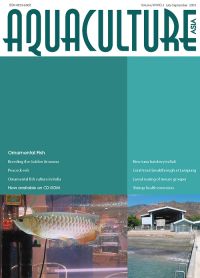
Ornamental fish farming in India. Tilapia for Indian aquaculture? Peri-urban food production in southeast Asia. Socio-economic consequences of shrimp farming in Andhra Pradesh. Breeding techniques for golden arowana Scleropages formosus. Captive breeding of peacock eel Macrognathus aculeatus. Substrate-based aquaculture systems. Extension in shrimp health management - experiences from India. Treatment of disease in freshwater shrimps and crabs in China. Larval rearing techniques for humpback grouper Cromileptes altivelis.
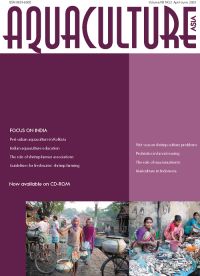
Peri-urban aquaculture in Kolkata. Diffusion and adoption of shrimp farming technologies. Aquaculture education in India. Information system on fish germplasm resources in China. Freshwater crustacean aquaculture in China. The role of macronutrients. Innovations by Bengal farmers. Scientific guidelines for freshwater prawn farmers in India. Status of mariculture in Indonesia. Use of probiotics in larval rearing. Problems in shrimp culture during the wet season.
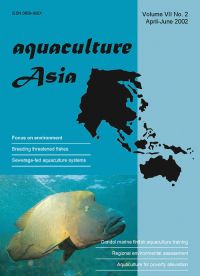
Prawn farm energy audits. Freshwater fish farming and poverty alleviation in Bangladesh. Artificial propagation for conservation of endangered species. Sewerage-fed aquaculture systems of Kolkata. Rice-fish farming in India. The use of lime, gypsum, alum and potassium permanganate in water quality management. Fish gene technology research in China. Low-salinity shrimp farms. Seed production of Clarius batrachus. Supplying good-quality seed for sustainable aquaculture and more.
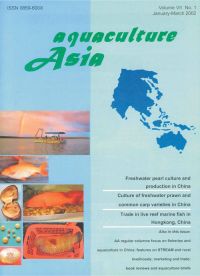
Chemical residues. Live reef fish trade in Hong Kong. Barramundi farming in Australia. Freshwater pearl and prawn production in China. Status of common carp varieties under culture in China. Induced spawning of Pangasius sutchi. Cambodian farmers innovate cost-effective variations on Chinese hatcheries. Genes and fish. Improving rural livelihoods in Cambodia, Vietnam, Nepal and the Philippines through the STREAM Initiative. Marine finfish news, book reviews and more.
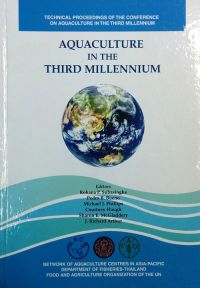
This volume, the third major publication arising from the Conference on Aquaculture in the Third Millennium, contains the information essential to conduct well-informed discussion of sustainable aquaculture development - both at the Conference, as well as after. The information provide basic reference points on the progress, direction and magnitude of aquaculture changes, and the factors associated with these changes, within global, regional, sectoral, thematic and technical perspectives.
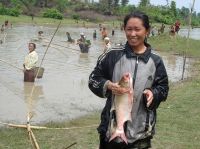
Culture-based fisheries (CBF) are practices to enhance fish stocks in waters that don't have enough natural recruitment to sustain a fishery. CBF practices are usually applied in small water bodies such as village dams and irrigation reservoirs. Fish growth is driven by the natural productivity of the waters. Usually there is no feeding and the fish are left to forage on natural food supplies. Ownership and management of the stock distinguish CBF as form of extensive aquaculture.
Ths paper enumerates different carp integrated farming systems being prevalent in Asia along with successful case studies indicating potential and constraints of such systems. It recommends to integrate carp farming with agriculture and irrigation, livestock farming, sewage utilisation and water pollution control not only to increase the productivity of land and water and improve the economic conditions of poor farmers but also to maintain health and hygiene of the rural poor and city dwellers alike.
This document briefly describes the status of the aquaculture in the Regional Aquaculture Lead Centre for Thailand circa 1981, in terms of available species and research priorities. Work was conducted on air-breathing catfish Clarias batrachus, snakehead Channa striatus, giant freshwater prawn Macrobrachium rosenbergii, silver barb Puntius gonionotus, snakeskin gourami Trichogaster pectoralis, mussels Perna viridis and oysters Crassostrea spp. Includes brief descriptions of culture methods prevalent for these species at the time.