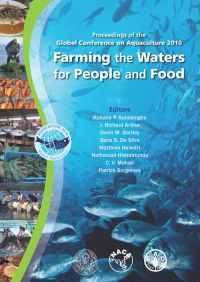
Global Conference on Aquaculture 2010

The conference was organised by FAO, the Thai Department of Fisheries and NACA and held in the Mövenpick Resort and Spa, Phuket, Thailand, 22-25 September. The conference was the third in a series of aquaculture development conferences, following on from the Conference on Aquaculture in the Third Millennium held in Bangkok 2000, and the FAO Technical Conference on Aquaculture, held in Kyoto 1976.

The programme included seven regional and global reviews on aquaculture development, nine plenary and invited guest lectures, and twenty expert panel discussions across six thematic sessions. This audio collection represents the entire conference proceedings.

Creative Commons Attribution.
Related

Podcasts & videos

NACA publishes audio and video recordings of presentations from technical workshops and conferences. You may listen or view the presentations via the player within the website, or download them for later use. Our audio files are in mp3 format, while video files are in mp4.

In this collection

Global aquaculture development since 2000: Progress made in implementing the Bangkok Declaration and Strategy for Aquaculture Development Beyond 2000

This keynote presentation elaborates the achievements made in aquaculture globally during the past decade, in keeping with the Bangkok Declaration and Strategy, which brought the aquaculture sector to the current level. It has been recognised that the principles and strategies advocated by the Kyoto Declaration on Aquaculture in 1976, the Code of Conduct for Responsible Fisheries in 1995, and the Bangkok Declaration and Strategy in 2000 have served well the process and goals of aquaculture development.

Aquaculture development in Africa: Current status and future prospects

This review covers aquaculture development in sub-Saharan Africa. The bulk of the production (93 percent) is from freshwater and is predominantly the culture of the indigenous and ubiquitous species of tilapias and African catfishes. In 2007 catfish contributed about 49 percent of the total production, and interest in the culture of the species for domestic markets, intra- and inter-regional trade and exports overseas is still growing in several countries.

Aquaculture development in Asia-Pacific: Current status and future prospects

The Asia-Pacific region continues to lead in aquaculture production. The dominance of the region in the global aquaculture scene is also exemplified by the Asia-Pacific being the leading producer of the major cultured commodities viz. finfish, molluscs, shrimp and seaweed, and nine out of ten of the current leading aquaculture-producing countries being from the region. Among the countries in the region, China has continued to maintain its dominance in aquaculture production.

Aquaculture development in Europe: current status and future prospects

This review covers aquaculture development in Europe. In Europe, aquaculture generally has a marginal contribution to national economies and employment. Extensive and semi-intensive systems employ more people per unit production than modern intensive systems. arming systems, technologies and species are very diverse in Europe. Significant research and development has focused on improving the efficiency of production systems and the quality of the produced fish, while mitigating environmental impact.

Aquaculture development in Latin America and Carribbean: Current status and future prospects

This review covers aquaculture development in Latin America and the Caribbean Region. Current norms and market conditions tend to discourage the participation of small-scale farmers in this industry, implying that there is a need for governmental help in providing technology and technical assistance to these producers including management, market and marketing, financial aspects, logistic, etc. that commonly become the soft spots that have made past support efforts fail for most part.

Aquaculture development in the Near East: Current status and future prospects

This review covers aquaculture development in the Near East and North Africa. The main driving forces responsible for the expansion of the sector have included an increased public health awareness and interest in fish products, the passing of enabling policies driven by the need for consolidating domestic fish supply, compensating for declining capture fishery landings, strengthening the livelihood of rural communities and supporting food security programmes.

Aquaculture development in North America: current status and future prospects

This review covers the status and trends in aquaculture development in North America including the nations of Canada and the United States of America. It is organised by thematic areas including the social and economic background of the region; resources, services and technologies; aquaculture and environment; markets and trade; contribution of aquaculture to food security, social and economic development; external pressures on the sector; the role of shared information, research, networking and governance.

Global aquaculture development: a comprehensive analysis

Global aquaculture has not grown evenly around the world. There are marked intra and inter-regional and country variations in a number of areas, such as production level, species composition, farming systems and producer profile. This presentation reviews patterns in global aquaculture development, including regional development, species cultivated, industry composition, research effort, trade and governance issues. As the sector further expands, intensifies and diversifies it should make efforts to address sustainability in a transparent manner.

Plenary discussion of the regional and global aquaculture reviews presented at the Global Conference on Aquaculture 2010

Plenary discussion of the regional and global aquaculture reviews presented at the Global Conference on Aquaculture 2010.

Resources, technologies and services for future aquaculture: a needs assessment for sustainable development

Aquaculture is frequently criticised for having a negative impact on the environment, which tends to overshadow its contributions to fighting hunger and alleviating poverty. This presentation reviews some of the needs to enhance the sustainability of the sector including knowledge of the basic biology of cultured species and immune systems of aquatic animals, the role of microflora in the production biology of aquatic systems, domestication, and integration of aquaculture practices with fisheries management. 

Sector management and governance in aquaculture: an overview

Sustainability of the sector implies technical feasibility, economic viability, environmental integrity and social licence. A sustainable aquaculture sector will benefit every member of society because of its associated invaluable environmental and social amenities. This review examines countries’ recent experiences and the role that aquaculture has played in improving socio-economic growth and development, and to discuss how governance instruments and effective partnership amongst stakeholders can lead to enhanced aquaculture’s net benefits to society.

Improving aquaculture governance: what is the status and who is responsible for what?

There is a consensus that modern aquaculture has a business orientation, similar to any small or medium-sized enterprise. For resources to be invested, there must be an enabling economic environment and secure property rights. However, there must also be controls to curb short-sighted business behaviour that damages the ecology or society. This presentation examines aquaculture governance from a global perspective, looking at its current status and the role of governments and stakeholders.

Responsible use of resources for sustainable aquaculture

Over the past decade, new, environmentally sound technologies and resource-efficient farming systems have been developed, and the integration of aquaculture into coastal area and inland watershed management plans has been achieved, but are still not widespread. These aquaculture ecosystems are highly productive, semi-intensive enterprises that are water and land efficient, and are net energy and protein producers that follow design principles similar to those used in the fields of agroecology and agroecosystems.

Aquaculture and socio-economic growth and development: enabling policies and partnership for improved benefits

This presentation builds on countries’ recent experiences to review the role of aquaculture in countries’ socio-economic growth and development, and discusses how institutional arrangements can lead to aquaculture’s enhanced net benefits to society. Aquaculture growth has recently been slowing down, and the sector is facing various resource, environmental, economic, knowledge and institutional constraints. Population growth, economic expansion and increasing preference for healthy food are expected to sustain the demand for aquaculture products.

Novel and emerging technologies: can they contribute to improving aquaculture sustainability?

This presentation reviews the role of emerging technologies in aquaculture. In genetics and breeding, the pace of advancement and innovation has been increasing exponentially. Improvements in aquatic animal health are coming from new technologies and improved management strategies. Nutritional research has focused on shifting from formulations based on ingredients to strategies based on nutrient availabilities and requirements. Production systems technology advancements are also contributing to sustainable industry expansion.

Investment, insurance and risk management for aquaculture development

Risk and uncertainty associated with returns from investment in aquaculture to be an important constraint on aquaculture investment. Attention is given in this paper to identifying the factors that contribute to risk and uncertainty in aquaculture and methods of specifying the risk and uncertainty involved. It is found that there is limited practical scope for the extension of insurance markets in aquaculture, and most farmers will have to rely on other means to manage risk.

Providing high quality feeds for aquaculture and getting out of the fish meal trap: opportunities and challenges

If the aquaculture sector is to maintain its current average growth rate of 8 to 10 percent per year to 2025, the supply of nutrient and feed inputs will have to grow at a similar rate. Feed-fed aquaculture production is largely dependent upon capture fisheries for dietary protein and lipid. Sustainability of the aquaculture sector is likely to be linked with the supply of animal and plant proteins, oils and carbohydrate sources for aquafeeds.

Is feeding fish to feed people a viable practice for aquaculture development?

It is an undisputable fact that modern farming of carnivorous fish and shrimp uses more fish as feed than is produced as finfish or shrimps; that is, the ratio between fish used and fish obtained is higher than one. The author shows that industrial fishing for forage species brings about a net contribution of foodfish supplies, without causing a systematic collapse of the exploited forage species.

Maintaining environmental integrity through responsible aquaculture: constraints, opportunities and challenges

Aquaculture is today considered the only viable option for meeting the increasing future demand for fish and seafood products. There are concerns that unconstrained sectoral expansion and intensification, coupled with its ecological and social impacts, globalisation and fluctuation of markets and resources, climate change may have undesirable impacts on the resilience of social-ecological systems. Aquaculture makes demands on, but also can provide a range of ecosystem services.

Responding to market demands and challenges: making aquaculture a competitive food producing sector for the benefit of world consumers

The aquaculture industry globally is characterised by an endemic cyclicity that goes beyond good or bad management and affects good companies and bad. This presentation aims to address the boom and bust phenomenon in the industry by examining some of the solutions that can help smooth out its cyclicity. The role of information gathering, management and analysis for decision making is discussed. The presentation includes a brief review of the global market for aquaculture products.