Australia

Australia's involvement in NACA.

Creative Commons Attribution.

Related

NACA member governments

NACA member governments are: Australia, Bangladesh, Cambodia, China, Hong Kong SAR, India, Indonesia, I.R. Iran, Kingdom of Saudi Arabia, Korea (DPR), Lao PDR, Malaysia, Maldives, Myanmar, Nepal, Pakistan, Philippines, Sri Lanka, Thailand and Vietnam.

In this collection

The environmental management of shrimp farming in Australia

In Australia, strict Commonwealth and state environmental regulations have constrained development of shrimp farming. A high level of resources, relative to the size and value of the industry, has been devoted to collaborative research on the environmental management of shrimp farming in Australia. The research findings are being used to provide a scientific basis for discharge license requirements and are incorporated into an advanced geographic information and decision support system in order to improve site selection and aquaculture planning.

Quarterly Aquatic Animal Disease Report, April-June 2005

This report, the 28th in the series, contains information about the aquatic animal health status of seventeen states in the Asia-Pacific region. The foreword discusses the need for improved surveillance and transparent reporting of aquatic animal disease.

Quarterly Aquatic Animal Disease Report, January-March 2005

This report, the 27th in the series, contains information about the aquatic animal health status of fifteen states in the Asia-Pacific region. The foreword discusses identification of regional expertise in aquatic animal health, in terms of experts, resource centres and reference laboratories.

Report on indigenous participation in aquaculture - the Pacific experience, Sydney, Australia, 27-28 September 2004

The workshop Indigenous Participation in Aquaculture – the Pacific Experience was held as a day-and-a-half session in the Australasian Aquaculture 2004, Sydney, 27–28 September 2004. The workshop promoted exchange of information and experiences between researchers, government representatives and industry involved in aquaculture development in the Pacific. The workshop recognised the increasing interest in aquaculture as an industry that can provide benefits for indigenous communities in Australia as well as the Pacific Islands.

Quarterly Aquatic Animal Disease Report, October-December 2004

This report, the 26th in the series, contains information about the aquatic animal health status of fifteen states in the Asia-Pacific region. The foreword discusses responsible movement of live aquatic animals in the context of health and quarantine issues.

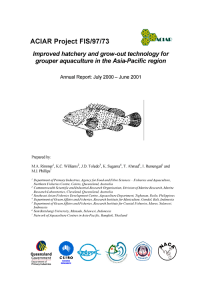
Improved hatchery and grow-out technology for grouper aquaculture in the Asia-Pacific region: Annual report 2000-2001 ACIAR Project FIS/97/73

This is the annual report 2000-2001 of the ACIAR Project FIS/97/73 Improved hatchery and grow-out technolgy for grouper aquaculture in the Asia-Pacific region. The report describes progress by research partners in development of larval rearing, grow-out diet development, and collaboration via the Asia-Pacific Marine Finfish Aquaculture Network. It also provides an indicative research workplan for the year ahead and future plans for the network.

Quarterly Aquatic Animal Disease Report, July-September 2004

This report, the 25th in the series, contains information about the aquatic animal health status of fifteen states in the Asia-Pacific region. The foreword discusses the outcomes of the third meeting of the Asia Regional Advisory Group on Aquatic Animal Health.

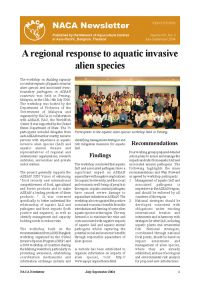
NACA Newsletter Volume XIX, No. 3, July-September 2004

In this issue:

A regional response to aquatic invasive alien species. 6th Symposium on Diseases in Asian Aquaculture. Indonesia plan EC PREP seafood trade study. NACA Website: Guide to member services. Preparing and responding to health emergencies. New publication: Marine Finfish Aquaculture Magazine. STREAM Agreement with MOF Vietnam on Communications. STREAM Agreement with NAFEC Vietnam on Livelihoods Approaches. NACA-NACEE Cooperation. Training and study tours.

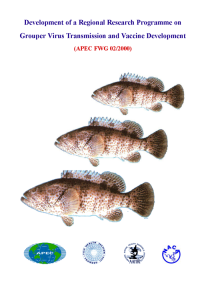
Development of a Regional Research Programme on Grouper Virus Transmission and Vaccine Development

These are the proceedings of a workshop, funded by the APEC Fisheries Working Group Project 02/2000. The project developed a framework with nine major research components: Health and production at hatcheries, regional collaborative disease resource centers, regional disease monitoring and surveillance, improving regional diagnostic capabilities, responsible trans-boundary movement, farm health management, vaccines and vaccination, funding mechanisms and establishment of an ad-hoc working group.

Quarterly Aquatic Animal Disease Report, April-June 2004

This report, the 24th in the series, contains information about the aquatic animal health status of seventeen states in the Asia-Pacific region. The foreword discusses capacity building to prevent, prepare for an respond to aquatic animal health emergencies.

Quarterly Aquatic Animal Disease Report, January-March 2004

This report, the 23rd in the series, contains information about the aquatic animal health status of twenty states in the Asia-Pacific region. The foreword discusses a project on Capacity and Awareness Building on Import Risk Analysis for Aquatic Animals, funded by the APEC Fisheries Working Group.

Mud crab aquaculture in Australia and Southeast Asia

To review mud crab aquaculture in Australia and Southeast Asia, ACIAR funded a scoping study, followed by a workshop to review the study and discuss status and problems in different regions of Australia and Southeast Asia. The primary conclusion from the scoping study, verified by workshop discussion, was that the substantial crab farming operations which exist throughout Southeast Asia are still mainly based on wild caught crablets.

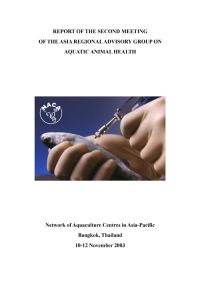
Report of the second meeting of the Asia Regional Advisory Group on Aquatic Animal Health, 10-12 November 2003

The Asia Regional Advisory Group on Aquatic Animal Health meets annually to discuss regional health issues including emerging disease threats. This report includes a review of regional disease status circa 2003, global and regional disease reporting arrangements, global issues and standards, progress in implementation of the the Regional Technical Guidelines on Health management for the Responsible Movement of Live Aquatic Animals, identification and designation of regional aquatic animal health resources and regional and international cooperation.

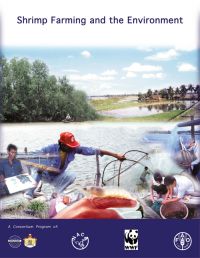
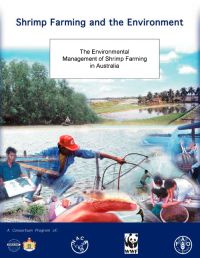
Shrimp Farming and the Environment

This collection of publications originates from the International Consortium Program on Shrimp Farming and the Environment, which was implemented by the World Bank, the Network of Aquaculture Centres in Asia-Pacific (NACA), the World Wildlife Fund (WWF), the Food and Agriculture Organization of the United Nations (FAO), and the United Nations Environment Programme (UNEP). The consortium supported 35 complementary case studies prepared by more than 100 researchers in more than 20 shrimp farming countries.

Quarterly Aquatic Animal Disease Report, October-December 2003

This report, the 22nd in the series, contains information about the aquatic animal health status of seventeen states in the Asia-Pacific region. The foreword discusses the role of disease surveillance programmes and issues realted to the OIE Aquatic Animal Health Standards Commission.

Quarterly Aquatic Animal Disease Report, July-September 2003

This report, the 21st in the series, contains information about the aquatic animal health status of sixteen states in the Asia-Pacific region. The foreword discusses the outcomes of the second meeting of the Asia Regional Advisory Group on Aquatic Animal Health.

Report of the Second STREAM Regional Conference, Tagaytay City, the Philippines, 8-10 June 2003

The Second STREAM Regional Conference was held in Tagaytay City, Philippines, from 8-10 June 2003 with the participation of 23 people from Australia, Cambodia, India, Nepal, Philippines, Thailand, Vietnam and Yunnan Province of China. Following a regional overview of STREAM’s themes, country partners, donors and funding, and activities, participants visited four “stations” on the themes of livelihoods, institutions, policy development, and communications, working in groups representing National Coordinators, Communications Hub Managers, and Partners. STREAM operations were discussed.

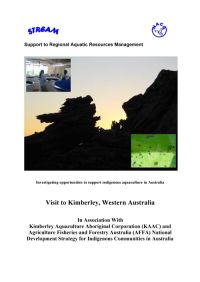
Investigating opportunities to support indigenous aquaculture in Australia

The NACA STREAM Initiative has been working with issues relating to livelihoods, policy and institutional development and communications throughout Asia-Pacific. Recently this has included work in India with indigenous communities supporting people to have a voice in policy making processes. There appear to be some parallels between this work and the objectives of Kimberley Aquaculture Aboriginal Corporation and also the Agriculture Fisheries and Forestry Australia Indigenous Aquaculture Unit, National Aquaculture Development Strategy for Indigenous Communities in Australia.

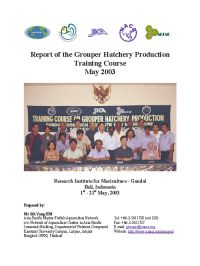
Report of the Grouper Hatchery Production Training Course, May 2003

This report documents a training course that was held at the Research Institute for Mariculture, Bali, Indonesia in May 2003. The course covered both theoretical aspects of grouper husbandry via lectures and practical hands-on work in a grouper hatchery, including broodstock management, tank preparation egg collection, live feed production, health management, harvesting and transport and visits to commmercial grouper and milkfish hatcheries, grow-out facilities, markets and exporters.

Quarterly Aquatic Animal Disease Report, April-June 2003

This report, the twentieth in the series, contains information about the aquatic animal health status of nineteen states in the Asia-Pacific region. The editorial discusses health risks associated with trans-boundary movement of live aquatic animals and the role of risk analyses.