NACA member governments are: Australia, Bangladesh, Cambodia, China, Hong Kong SAR, India, Indonesia, I.R. Iran, Kingdom of Saudi Arabia, Korea (DPR), Lao PDR, Malaysia, Maldives, Myanmar, Nepal, Pakistan, Philippines, Sri Lanka, Thailand and Vietnam.
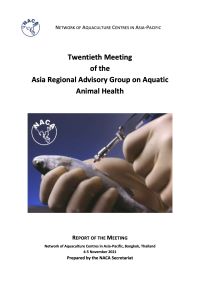
This report summaries the proceedings of the 20th meeting of the Regional Advisory Group on Aquatic Animal Health, held 4-5 November 2021. The meeting discussed: Progress on NACA’s Asia Regional Aquatic Animal Health Program; updates from the OIE Aquatic Animal Health Standards Commission; aquaculture biosecurity; Progressive Management Pathway for Improving Aquaculture Biosecurity activities relevant to Asia; a systematic approach for quantifying biosecurity measures in aquaculture; aquatic animal health strategy; updates on the OIE Regional Collaboration Framework on Aquatic Animal Health; and updates on the QAAD Reporting and Disease List.
The University of Stirling has been awarded funds by the British Council to provide funding for four Early Academic Fellowships for Women in STEM. These fellowships will be 6-12 months in duration. The scholarships are available to women who are passport holders and permanent residents of India, Pakistan, Bangladesh, Nepal and Sri Lanka. For further information please visit the University of Stirling website. The deadline for submissions is 31 March 2022.
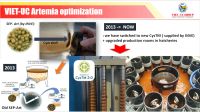
Videos from our recent webinar Status of the use of Artemia cysts in fish and crustacean hatcheries around the world are now available on NACA's Youtube channel. Please consider subscribing for more technical aquaculture content!
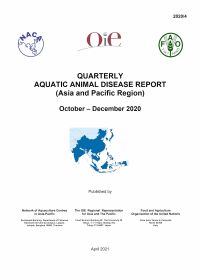
The 88th edition of the Quarterly Aquatic Animal Disease Report contains information from thirteen governments. The foreword provides an announcement on the new format for the Aquatic Animal Disease Report from January 2021 onwards.
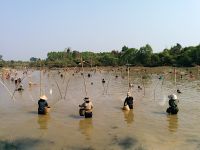
Join us on 31 May for a free webinar on Culture-based fisheries for rural development, with leading experts from the Asian region. Culture-based fisheries (CBF) are practices to enhance fish stocks in waters that don't have enough natural recruitment to sustain a fishery. CBF practices are usually applied in small water bodies such as village dams and irrigation reservoirs. Fish growth is driven by the natural productivity of the waters, foraging on natural food supplies. The simplicity and low capital requirements of CBF make it easy for farming communities to learn and adopt.
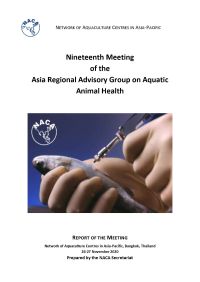
This report summarises the proceedings of the 19th meeting of the Advisory Group, held 26-27 November 2020 via video conference. The group's role includes reviewing disease trends and emerging threats in the region, identifying developments in global aquatic disease issues and standards, evaluating the Quarterly Aquatic Animal Disease Reporting Programme and providing guidance on regional strategies to improve aquatic animal health management.
The 87th edition of the Quarterly Aquatic Animal Disease Report contains information from fifteen governments. The foreword discusses the 19th Meeting of the Asia Regional Advisory Group on Aquatic Animal Health, held 26-27 November 2020.
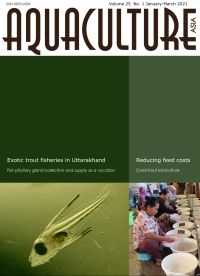
Exotic trout fisheries resources and potentialities in Uttarakhand; Scenario of captive production of Clarias magur in India; Strategies to reduce feed cost by improving gut health and nutrient utilisation of fish in aquaculture; Fish pituitary gland collection and supply as a vocation in West Bengal, India; Coral trout Plectropomus leopardus aquaculture research and fingerling production in Indonesia; Smartphone app improving smallholder shrimp farming practices in Bangladesh; NACA Newsletter.
The Shrimp Farming BD App contains information on improved technologies - from pond preparation through to harvest - and has a calculator that farmers can use to work out the quantities of chemicals, feeds and other inputs they need for their pond. Also incorporated is a Frequently Asked Questions (FAQ) page where users can find answers to common questions with a single click: and they can send specific technical questions to SAFETI specialists online and receive an answer back within hours. The app can also be used to post news messages, and a link to market prices is planned.
The 86th edition of the Quarterly Aquatic Animal Disease Report contains information from fifteen governments. The foreword provides a discussion of a webinar on decapod iridescent virus 1 (DIV1), held on 20 August 2020.
The 85th edition of the Quarterly Aquatic Animal Disease Report contains information from nine governments. The foreword provides a disease advisory concerning decapod iridescent virus 1 (DIV1), an emerging threat to the shrimp industry.
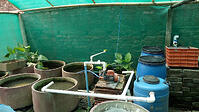
In pursuit of modernising fish culture practices, novel recirculatory aquaculture systems (RAS) have been introduced in semi-urban areas of West Bengal and other parts of India. While quite a few progressive fish farmers in India have adopted advanced, intensive and imported RAS systems featuring huge plant, other farmers have developed small and indigenous RAS systems that require comparatively low investment. This article discusses the design, principles, state-of-the-art and associated practical aspects of indigenous RAS technology as currently practiced in West Bengal and other places.
The 82nd edition of the Quarterly Aquatic Animal Disease report contains information from eleven governments. The foreword welcomes Dr Huang Jie, NACA's new Director General, a health specialist that has previously participated in the Asia-Pacific Regional Advisory Group on Aquatic Animal Health.
Two consultations were held back to back in Thailand from 5-7 November, namely the Consultation on Strengthening Governance of Aquaculture for Sustainable Development in Asia-Pacific and the Consultation on Demographic Changes in Fishing Communities in Asia. The consultations were held at the Centara Grand Hotel at Ladprao, Bangkok. The consultations were attended by 29 participants from 15 countries in the Asia-Pacific region. The consultations were jointly organised by FAO and NACA. Audio recordings are available of some presentations.
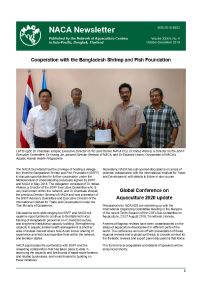
Cooperation with the Bangladesh Shrimp and Fish Foundation; Global Conference on Aquaculture 2020 update; Quarterly Aquatic Animal Disease Report, January-March 2019; A fresh look at inland fisheries and their role in food security and livelihoods; Tuskfish 2 Beta: Testers wanted; APAARI Regional Workshop on Underutilized Fish and Marine Genetic Resources and Their Amelioration; Joint Research Project on Utilization of Thailand Local Genetic Resources to Develop Novel Farmed Fish for Global Market; Impacts of climate change on fisheries and aquaculture.
First announcement: Global Conference on Aquaculture 2020, 26-30 October, Shanghai, China; Bangladesh delegation visits Thailand to study shrimp aquaculture; Expert Consultation on Development of Sustainable Aquaculture Guidelines, Rome; Report of the Seventeenth Meeting of the Asia Regional Advisory Group on Aquatic Animal Health; Quarterly Aquatic Animal Disease Report, October-December 2018; Tuskfish 2 Alpha: Testers wanted.
NACA and the Bangladesh Shrimp and Fish Foundation collaborated to organise a study tour programme focused on shrimp operations in Thailand for fourteen Bangladesh officers during 29 April to 2 May 2019. The study tour was supported by the Winrock Foundation and coordinated by Dr Cherdsak, the outgoing Director General of NACA. The group met with CP Executives, DOF-Thailand and Banjong Farm in Chachoengsao Province.
This report summarises the proceedings of the 17th meeting of the Advisory Group, held 13-14 November 2018 in Bangkok, Thailand. The group's role includes reviewing disease trends and emerging threats in the region, identifying developments in global aquatic disease issues and standards, evaluating the Quarterly Aquatic Animal Disease Reporting Programme and providing guidance on regional strategies to improve aquatic animal health management.
29th Governing Council Meeting held in Malé, Maldives; Proceedings of the Emergency Regional Consultation for Prevention and Management of Tilapia Lake Virus in the Asia-Pacific; NACA signs MOU on cooperation with the Bangladesh Shrimp and Fish Foundation; Aquaculture in China: Success Stories and Modern Trends; Quarterly Aquatic Animal Disease Report; Gender in Aquaculture and Fisheries 2018; International Training Course on the Biology and Pathology of Penaeid Shrimp; ASEAN-India Research Training Fellowships and more.
The EURASTiP Exchange Programme provides opportunities for industry, researchers and educators from Europe and south-east Asia to connect and gain new perspectives while sharing innvovative ideas to help develop long term partnerships. Bursaries of up to €3,000 per exchange are available (subject to eligibility criteria) to support international innovation and collaboration. The deadline for applications is 20 September 2018. For more information on how to apply please see the EURASTiP website.