NACA member governments are: Australia, Bangladesh, Cambodia, China, Hong Kong SAR, India, Indonesia, I.R. Iran, Kingdom of Saudi Arabia, Korea (DPR), Lao PDR, Malaysia, Maldives, Myanmar, Nepal, Pakistan, Philippines, Sri Lanka, Thailand and Vietnam.
This final report of the project “Strengthening Aquatic Animal Health Capacity and Biosecurity in ASEAN” contains two parts: A. Recommended Minimum Operational Requirements for Implementing National Aquatic Animal Health Strategies within ASEAN and B. ASEAN progress in the implementation of National Aquatic Animal Health Strategies. The report provides guidance for countries in ASEAN to implement key elements of national aquatic animal health strategies, and for monitoring progress of national strategy implementation in ASEAN member countries.
These standard operating procedures were developed to reduce the risk of spread of trans-boundary disease of aquatic animals through the movement of live food fish. The procedures are a set of documents for health certification and quarantine measures to be used by competent authorities in trade among ASEAN member countries. The procedures recognise the existing variation in capacity between ASEAN members and have been designed so that they can be implemented across varying policy and legal frameworks.
This report, the 37th in the series, contains information about the aquatic animal health status of fourteen states in the Asia-Pacific region. The foreword discusses emerging diseases in the region.
This report, the 36th in the series, contains information about the aquatic animal health status of fifteen states in the Asia-Pacific region. The foreword discusses recent activities in support of aquatic animal health in the region.
This report, the 35th in the series, contains information about the aquatic animal health status of fifteen states in the Asia-Pacific region. The foreword discusses mechanisms for recognition of emerging diseases in the Asia-Pacific region.
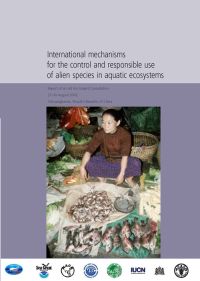
The use of alien species is a proven means to increase production and value from aquatic ecosystems. However, alien species are now recognised as one of the most significant threats to aquatic biodiversity. There are a range of international mechanisms that have been established to assist countries in meeting international obligations and responsibilities. Implementation is often difficult due to lack of awareness and problems with enforcement. Regional coordination of policies is needed for effective national management.
This report, the 34th in the series, contains information about the aquatic animal health status of fourteen states in the Asia-Pacific region. The foreword discusses efforts towards international harmonisation in aquatic animal health standards.
This report, the 33rd in the series, contains information about the aquatic animal health status of seventeen states in the Asia-Pacific region. The foreword discusses emerging diseases in the region.
MPEDA-NACA sustainable shrimp village demonstration programme. Inter-calibration of white spot syndrome virus (WSSV) PCR laboratories in India. Shrimp health management training. Rotary International/NACA meeting facility up at Koh Yao Noi. Tsunami-affected farmers train in marine cage aquaculture. Marine finfish aquaculture network at the APAN meeting in Singapore. Aquatic animal health policy workshops build consensus in ASEAN nations. Aquaculture Compendium released. Developments in establishing a conservation plan for the Mekong giant catfish. ROUNDTABLE: Exploring south-south cooperation opportunities in sustainable shrimp farming in West Africa, Conakry (Guinea). Technical missions to Cambodia and Lao PDR.
This manual provides guidelines for attaining better practices in culture-based fisheries, an emerging practice in rural areas in the Asian region. It deals with the principles of culture-based fishery practices, primarily based on relatively long-term experiences in Sri Lanka and Vietnam. It deals with the gross factors that are applicable to improving fish yields and therefore revenue; and sustaining culture based fisheries as a development activity in the long-term.
This report, the 32nd in the series, contains information about the aquatic animal health status of fifteen states in the Asia-Pacific region. The foreword discusses regional cooperation for promotion of aquatic animal health management.
This is the proceedings of the workshop on Building capacity to combat impacts of aquatic invasive alien species and associated trans-boundary pathogens in ASEAN countries, held in Penang, Malaysia, on the 12th-16th July 2004. The workshop built on the recommendations from a 2002 workshop organised by the Global Invasive Species Program and a 2003 workshop of countries sharing the Mekong watershed, in promoting awareness, coordination mechanisms and information exchange systems and identifying management and risk mitigation measures.
In this issue: Policy development as a theme and policy briefs as a genre. Decriminalising Cambodian family-scale fishers through a livelihoods approach to law reform. Longer pond leases in Orissa. One-stop Aqua Shop - a "one-window delivery" service center for aqua-farmers and fishers. Fisheries and aquaculture policy formulation process in Pakistan. Improving the international marine ornamental fish trade to sustain and improve the livelihoods of poor people involved in the trade. About the STREAM Journal. About STREAM.
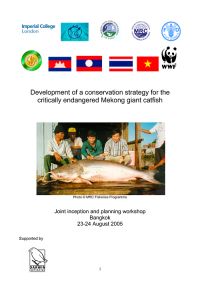
This is the report of an inception workshop for the Mekong Giant Catfish Working Group. The Mekong giant catfish Pangasianodon gigas is listed as critically endangered in the 2003 IUCN Red List. The purpose of the workshop was to exchange information on the current state of the Mekong giant catfish and the relevant conservation and research activities of key organisations, and to establish a joint planning process aimed at developing an overarching conservation strategy for the Mekong giant catfish.
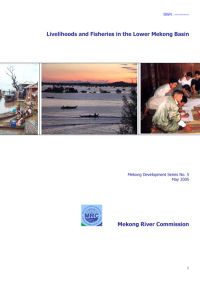
People who manage fisheries in the lower Mekong are beginning to think of themselves as a community within a common river basin. This is a different way of thinking; managing fisheries is no longer seen as an isolated activity but as a part of the life of people who live along the river. Previously, fisheries managers might have thought of their job as safeguarding or increasing fish production, but now they must share in the effort to alleviate poverty.
This report, the 27th in the series, contains information about the aquatic animal health status of fifteen states in the Asia-Pacific region. The foreword discusses identification of regional expertise in aquatic animal health, in terms of experts, resource centres and reference laboratories.
This report, the 24th in the series, contains information about the aquatic animal health status of seventeen states in the Asia-Pacific region. The foreword discusses capacity building to prevent, prepare for an respond to aquatic animal health emergencies.
This is the report of the “BFAR/NACA-STREAM/FAO Workshop on Livelihoods Approaches and Analysis” held in Iloilo City, Philippines from 24-28 November 2003. The main purpose of the workshop was to develop and document mechanisms for training in livelihoods approaches and analysis, and to build national capacity to conduct livelihoods analysis. The workshop in Iloilo was the first in a series which will take place in other countries in the region.
This report describes the national-level requirements for data collection and sharing mechanisms for fisheries co-management in Cambodia. It presents the findings from a thorough literature review and workshops, group and individual interviews. Community fisheries in Cambodia are at a very early stage of development, and the exact management responsibilities are still poorly understood by many stakeholders. This report relates the information needs voiced by participants in this study.
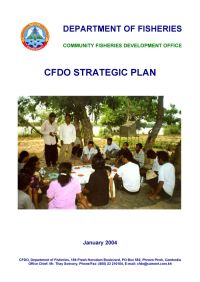
In October 2000 the government of Cambodia announced a major change in fisheries management policy. The core elements of the new policy are the reduction of fishing lot concession areas by 56%, the broader participation of fishing communities in the management of fisheries and a focus on the efficient, sustainable and equitable use of the living aquatic resources. This document details the Strategic Plan for the CFDO in the Department of Fisheries (DoF) based on its mandate.