NACA member governments are: Australia, Bangladesh, Cambodia, China, Hong Kong SAR, India, Indonesia, I.R. Iran, Kingdom of Saudi Arabia, Korea (DPR), Lao PDR, Malaysia, Maldives, Myanmar, Nepal, Pakistan, Philippines, Sri Lanka, Thailand and Vietnam.
The first ever Regional Training Course on Culture-based Fisheries in Inland Waters was held at Nha Trang University from 30 October to 8 November. The objective of the course was to provide participants with the skills to assist local communities to plan and manage culture-based fisheries. These practices are an example of a relatively simple and low cost technology that can deliver nutritional and economic benefits to rural communities, which often have few livelihood options.
Since 2009, tilapia aquaculture has been threatened by mass die-offs in Israel and Ecuador, which have been caused by a novel Orthomyxo-like (RNA) virus named Tilapia lake virus. This has been reported as a newly emerging virus that causes syncytial hepatitis of tilapia. An emergency regional consultation was held in Guangzhou, China from 27-28 September 2017 to discuss and plan actions on the overall prevention and management of this disease.
A regional consultation on aquaculture feed production and use in Asia-Pacific was held from 7-9 March 2017. The consultation reviewed the current situation of aquaculture feed production and use, sourcing of ingredients, policy and research needs. This collection contains audio recordings of the technical presentations made by experts, international organisations, the private sector and governments in the region. The report of the consultation is in press and will be made available for download in due course.
The China Aquatic Products Processing and Marketing Alliance will convene Asia Pacific Aquaculture Expo (June 30-July 2, 2017) and Global Aquaculture Summit (June 29-July 1, 2017) in Fuzhou City, China. The Asia Pacific Aquaculture Expo is the only aquaculture themed exhibition in China, covering the whole industry chain from feed, seed, to machinery and products, while the Global Aquaculture Summit is China's top aquaculture conference and enjoys a high level of international participation.
Recently, we released a warning of TiLV in Thailand and an improved RT-PCR detection methodology. The Fish Health Platform in Centex, BIOTEC/Mahidol University has also obtained positive test results for TiLV in other Asian countries where it has not yet been reported. Many countries have been translocating tilapia fry/fingerlings prior to and even after the description of TiLV. We have prepared a map listing countries with confirmed reports of TiLV infections and 43 other countries that we believe have imported infected fish.
The 15th meeting of the Asia Regional Advisory Group on Aquatic Animal Health; a regional consultation on responsible production and use of feed in aquaculture; a report on the Giant Prawn 2017 conference; a preview of the new NACA website; and new initiatives on a very serious emerging issue - reducing the human and animal health risks from development of anti-microbial resistance in the aquaculture industry.
The development of resistant strains of disease-causing microorganisms is an important health issue of global concern. When microbes such as bacteria, fungi, parasites, and viruses become resistant to antimicrobial substances, the diseases they may cause become more difficult or impossible to treat. Resistance is developed by the indiscriminate use of antimicrobials and places human health at risk. The discovery of antibiotics revolutionised medicine, creating a belief that a 'magic bullet' had finally been found to control bacterial diseases. Antibiotics, a class of antimicrobial agents, kill or inhibit the growth of bacteria, but they have no significant effect on other types of microorganisms such as viruses.
China is the world's largest producer of aquaculture feeds. With the development of aquaculture, the feed industry has inevitably faced some challenges in promoting update of commercial feeds, pollution, use of trash fish, fish meal and fish oil issues, provision of accurate nutrition and feeding, antibiotic residues, food safety, and so on. In order to balance economic and environmental issues the Chinese Government released its 13th Five-year Plan last year. Trends and policy changes relevant to aquaculture are discussed.
The rapid development of the Chinese aquaculture has stimulated the development of a significant feed industry. Fishmeal imports have remained relatively static as formulations have improved and due to substantial culture of filter-feeding species. Representative species have been selected for systematic nutritional studies to determine their requirements and the efficiency of feed ingredients. These studies are being used to develop a database on nutritional requirements and bioavailability of feed ingredients to aid efficient feed formulation design.
The Asia Regional Advisory Group on Aquatic Animal Health meets annually to discuss regional health issues including emerging disease threats. This report includes a review of regional disease status circa 2016, global and regional disease reporting arrangements, global issues and standards, progress in implementation of the the Regional Technical Guidelines on Health management for the Responsible Movement of Live Aquatic Animals, identification and designation of regional aquatic animal health resources and regional and international cooperation.
The 15th meeting was held from 21-23 November 2016, in Bangkok, Thailand. A special session was held on addressing the use of anti-microbial substances in aquaculture and the development of anti-microbial resistance. This is an issue of global concern for both human and animal health, and it had been addressed by a resolution at FAO’s Thirty-ninth Conference in June 2015. The meeting reviewed in detail the status of aquatic animal disease in the region.
The Asia Regional Advisory Group on Aquatic Animal Health meets annually to discuss regional health issues including emerging disease threats. This report includes a review of regional disease status circa 2015, global and regional disease reporting arrangements, global issues and standards, progress in implementation of the the Regional Technical Guidelines on Health management for the Responsible Movement of Live Aquatic Animals, identification and designation of regional aquatic animal health resources and regional and international cooperation.
This publication is the major output of a regional programme jointly implemented by FAO and NACA in 2015 to document and disseminate successful practices that contribute to the sustainable intensification of aquaculture in the Asia-Pacific region. Twelve practices are described that contribute to at least one of the following: Improved production and resource use efficiency (land, water, feed, energy); improved environmental benefits; strengthened economic viability and farmers' resilience; and improved social acceptance and equity.
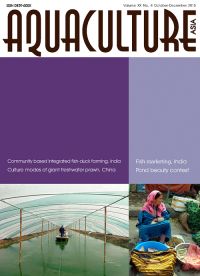
Aquaculture feed supply chain attracting scrutiny. Pond beauty contest, Ram Kumar and social development. Culture modes of giant freshwater prawn in Yangtze River Delta for early harvest. Fish marketing in Kashmir, India - a case study of Srinagar. Community-based integrated fish-duck farming: A boon for rural development in agro-climatic conditions of Assam, India. Gastropod and bivalve fishery of Kakinada Bay, Andhra Pradesh, India: Management and conservation issues.
A Regional Proficiency Testing Program for Aquatic Animal Disease Diagnostic Laboratories in Asia-Pacific was developed to strengthen diagnostic capability across Asia. This capability was identified as a requirement to facilitate the sanitary safety of trade in aquatic animal products. The program provided 41 laboratories across the Asia-Pacific with the opportunity to assess their diagnostic performance for 10 regionally significant aquatic animal pathogens, and to adapt or modify practices where necessary to improve.
Due to the world’s rapidly growing population, which is expected to peak somewhere around 9.5 billion, food production will need to be massively increased over the next few decades. This increase must be achieved without further degrading the environment. The unit environmental footprint of food production must be significantly reduced from where it is today. This concept, termed sustainable intensification, applies as much to aquaculture as it does to other agricultural sectors.
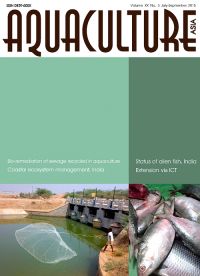
Changes to the magazine and website. Status of alien fish species farming and it's implications for Andhra Pradesh, India. Bridging the research-extension-farmer-input and market linkage gap in coastal aquaculture through application of ICT. Bio-remediation of domestic sewerage recycled in aquaculture: A Central Institute of Freshwater Aquaculture model. Role of family farming in marine and coastal ecosystem management in India. Conservation of fish genetic resources: An introduction to the state fishes of India.
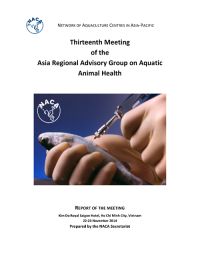
The Asia Regional Advisory Group on Aquatic Animal Health meets annually to discuss regional health issues including emerging disease threats. This report includes a review of regional disease status circa 2014, global and regional disease reporting arrangements, global issues and standards, progress in implementation of the the Regional Technical Guidelines on Health management for the Responsible Movement of Live Aquatic Animals, identification and designation of regional aquatic animal health resources and regional and international cooperation.
In this paper, the culture-based fisheries in lakes are presented, with special reference to mandarin fish and mitten crab stocking in lakes in China. The stocking rate of mandarin fish is determined by food consumption rates, which are mainly related to water temperature and fish size, and prey fish productivity. A bioenergetics model of mandarin fish was established to predict the growth and consumption of prey fish in stocked lakes.