NACA member governments are: Australia, Bangladesh, Cambodia, China, Hong Kong SAR, India, Indonesia, I.R. Iran, Kingdom of Saudi Arabia, Korea (DPR), Lao PDR, Malaysia, Maldives, Myanmar, Nepal, Pakistan, Philippines, Sri Lanka, Thailand and Vietnam.
The 3rd International Symposium on Aquaculture and Fisheries Education (ISAFE3), a triennial event of the Asian Fisheries Society (AFS), will be held from 16-18 May 2018 in Mumbai, India. The theme of the symposium is "Fisheries education for Sustainable Blue Economy. The symposium is being organised by the ICAR-Central Institute of Fisheries Education in collaboration with the Indian Fisheries Association and AFS Indian Branch. Online registration is now open. Abstract submission will close on 31 March.
This collection contains video recordings of the lectures from the Regional Training Course on Culture-based Fisheries in Inland Waters, held at Nha Trang University, Vietnam. The objective of the course was to provide participants with the skills to assist local communities to plan and manage culture-based fisheries; a relatively simple and low cost technology that can deliver nutritional and economic benefits to rural communities with few livelihood options. The course was sponsored by the United Nations University Fisheries Training Programme.
The 75th edition of the Quarterly Aquatic Animal Disease Report contains information from 14 governments. The foreword discusses the 10th Symposium on Disease in Asian Aquaculture, and the 11th Technical Group Meeting and election of a new Executive Committee for the Fish Health Society (2018-2020).
The first ever Regional Training Course on Culture-based Fisheries in Inland Waters was held at Nha Trang University from 30 October to 8 November. The objective of the course was to provide participants with the skills to assist local communities to plan and manage culture-based fisheries. These practices are an example of a relatively simple and low cost technology that can deliver nutritional and economic benefits to rural communities, which often have few livelihood options.
The 74th edition of the Quarterly Aquatic Animal Disease Report contains information from 15 governments. The foreword describes an Emergency Regional Consultation for Prevention and Management of Tilapia Lake Virus (TiLV) in the Asia-Pacific region.
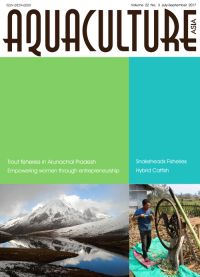
Regional network on culture-based fisheries and stock enhancement; trout fisheries in the uplands of Arunachal Pradesh - resources and opportunities; empowering young Indian women through entrepreneurship development - opportunities and constraints; a view on murrel (snakehead) fisheries in India; hybrid catfish Clarias batrachus x Heteropneustes fossilis produced by farmers in West Bengal, India; Backyard fish based pig farming using low-cost feed in Arunachal Pradesh - a success story; NACA Newsletter.
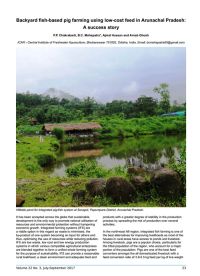
In the north-east hill region of India, integrated fish farming is one of the best alternatives for improving livelihoods as most of the houses in rural areas have access to ponds and livestock. Among livestock, pigs are a popular choice, particularly for the tribal population of the region, who account for a major portion of the population. Pigs can fit into diverse systems of management, and can be reared on a wide variety of waste materials.
Among the freshwater catfishes, magur (Clarias batrachus) is in great demand in eastern and north-eastern India; it is revered as highly nutritious and therapeutic in nature. During May-June 2016, Sri Sayer Mohammad Sarkar, an experienced magur breeder and seed producer, has achieved success in producing induced-bred hybrid seed of Heteropneustes fossilis and Clarias batrachus. His breeding protocol and experiences in nursery and growout of hybrid catfish are shared in this article.
Murrels (snakeheads) are the third most important group of freshwater fishes in India after carps and catfishes. Murrels are the most common and dominant group of air breathing freshwater fishes and are highly regarded as food fish. Murrels have a pair of cavities in the pharynx that have folded linings, richly supplied with blood vessels for taking in air. These organs enable these fishes to survive out of water for a few hours or migrate from one pool to another.
Women’s entrepreneurship can be a boon for sustainable utilisation of resources, food security and employment generation. Women entrepreneurship can be defined as the process, in which she thinks to set up a business, gathering all the resources necessary to manage a business venture, provide employment to others and to make a profit along the way while minimising risk while initiating, organising and running a business enterprise.
Since 2009, tilapia aquaculture has been threatened by mass die-offs in Israel and Ecuador, which have been caused by a novel Orthomyxo-like (RNA) virus named Tilapia lake virus. This has been reported as a newly emerging virus that causes syncytial hepatitis of tilapia. An emergency regional consultation was held in Guangzhou, China from 27-28 September 2017 to discuss and plan actions on the overall prevention and management of this disease.
The potential for augmentation of fish production and fish-based eco-tourism in Arunachal Pradesh are immense. The landscape of the state is characterised by lofty mountains with snow-clad peaks, dense forests, turbulent streams and a rich diversity of flora and fauna. We review the potential of some of the lakes in the region to support trout fisheries for both recreational fishing and eco-tourism, with a view to providing job opportunities for highland communities.
28th NACA Governing Council, Dhaka, Bangladesh; register for the First Regional Training Course on Culture-based Fisheries; 11th Indian Fisheries and Aquaculture Forum, Kochi, 21-24 November; audio recordings for regional feed consultation now available; tilapia lake virus; Proceedings of the International Symposium on Aquatic Animal Health and Epidemiology for Sustainable Asian Aquaculture; ICAR-CIBA launch "Vanami Shrimpapp", a mobile app on Pacific white shrimp (Penaeus vannamei) farming; Pakistan officials train on aquaculture certification.
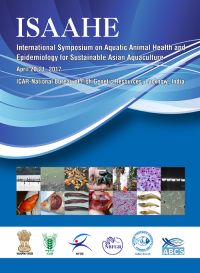
These are the proceedings of a symposium convened by the ICAR National Bureau of Fish Genetic Resources, Lucknow, India, from 20-21 April 2017. The symposium included presentations from national and international experts on aquatic animal epidemiology and related disciplines to address a range of risk factors that catalyse horizontal spread of disease, spread of transboundary pathogens and increased disease susceptibility, thereby contributing to strengthening of surveillance efforts, especially in the Indian context.
The 73rd edition of the Quarterly Aquatic Animal Disease Report contains information from 14 governments. The foreword provides a disease advisory on tilapia lake virus (TiLV), an emerging threat to farmed tilapia in the Asia-Pacific region.
A regional consultation on aquaculture feed production and use in Asia-Pacific was held from 7-9 March 2017. The consultation reviewed the current situation of aquaculture feed production and use, sourcing of ingredients, policy and research needs. This collection contains audio recordings of the technical presentations made by experts, international organisations, the private sector and governments in the region. The report of the consultation is in press and will be made available for download in due course.
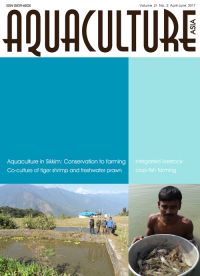
Inspiring story of aquaculture in Sikkim - a journey from conservation to farming; farming of scampi and tiger shrimp together - a case study from West Bengal; Labeo pangusia - a candidate for diversification of hill aquaculture; sustainability of an integrated livestock-fish-crop farming system as a small scale enterprise; sustainable coastal aquaculture in India; potential scope and prospects of domestic fish market in Chhattisgarh.
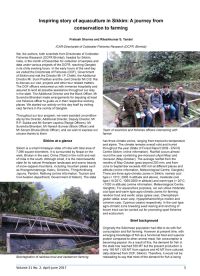
Sikkim is a small Himalayan state of India with three climatic zones ranging from tropical to temperate to alpine. The moderate-cool and warm agro-climatic zones are suitable for farming rainbow trout and exotic carp species, while brown trout hatchery and ranching can be conducted in the alpine areas. We report on the status of exotic carp and trout farming in Sikkim including farming practices, constraints faced by local farmers and possible solutions.
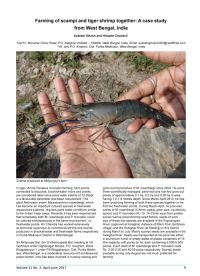
We report on an Indian farmer co-culturing tiger shrimp Penaeus monodon and the giant freshwater prawn, Macrobrachium rosenbergii. The farm utilises wild-caught riverine seed, stocked at a relatively low density and fed on a Macrobrachium pellet which P. monodon also accepts.
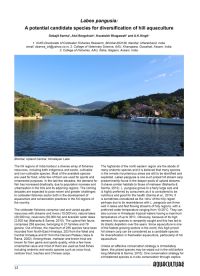
Labeo pangusia is a highly prized hill stream carp found mainly in the deeper pools of upland streams. Heavy fishing pressure has led to depletion of wild populations in recent years and the species is likely to become threatened if a conservation strategy is not developed. We report on an investigation into the reproductive biology of this species and on the result of successful induced breeding trials.