NACA member governments are: Australia, Bangladesh, Cambodia, China, Hong Kong SAR, India, Indonesia, I.R. Iran, Kingdom of Saudi Arabia, Korea (DPR), Lao PDR, Malaysia, Maldives, Myanmar, Nepal, Pakistan, Philippines, Sri Lanka, Thailand and Vietnam.
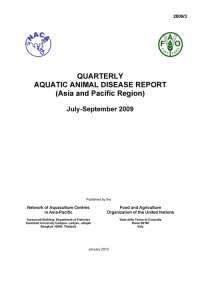
This report, the 46th in the series, contains information about the aquatic animal health status of sixteen states in the Asia-Pacific region. The foreword discusses important emerging diseases in the region and the outcomes of the 8th meeting of the Asia Regional Advisory Group on Aquatic Animal Health.
Mussel farming initiatives in North Kerala, India. Selective study on availability of indigenous fish with ornamental value in West Bengal. Aquaculture livelihoods centre in Aceh, Indonesia. e-Sagu Aqua - an innovative information and communication technology model for transfer of technology for aquaculture. Freshwater pearl crop: An emerging enterprise in the Indian subcontinent. Preliminary risk assessment of Pacific white shrimp (P. vannamei) introduced to Thailand for aquaculture. Black gill disease of lobster and more.
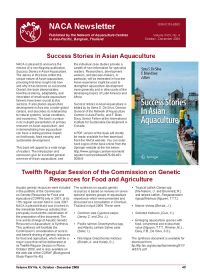
Success Stories in Asian Aquaculture. Twelfth Regular Session of Commission on Genetic Resources for Food and Agriculture. Training of trainers programme will strengthen small scale farmer competitiveness in ASEAN. Workshop on development of better management practices for catfish farming in the Mekong Delta organised in Vietnam. Vulnerability & adaption of climate change impacts on catfish farming - case study Can Tho, Vietnam. NACA welcomes Dr Nigel Abery, Coordinator of the Adaption of aquaculture to climate change project. EU supports better management practices for responsible aquaculture. Myanmar delegation visits CIFA to study aquaculture.
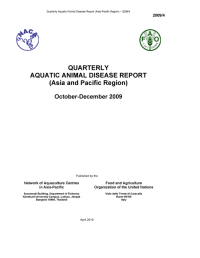
This report, the 45th in the series, contains information about the aquatic animal health status of sixteen states in the Asia-Pacific region. The foreword discusses the Sanitary and Phytosanitary (SPS) Agreement and its relationship to the OIE Aquatic Animal Health Standards.
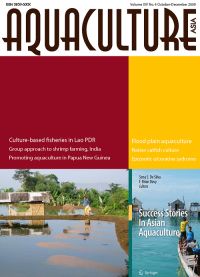
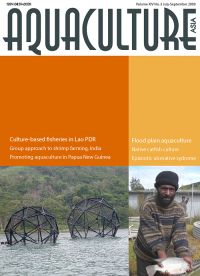
Community management and revenue sharing practices of culture-based fisheries in Lao PDR. Floodplain aquaculture in Bangladesh. Promoting small-scale inland aquaculture in Papua New Guinea. Group approaches to shrimp farming: The key to sustainability. Native catfish culture - a technology package for farmers. Influence of salinity in the growth of the black clam Villorita cyprinoides. EUS in Asia and Africa. Offshore opportunities for artisinal aquaculture. Grouper aquaculture in Brazil. NACA Newsletter.
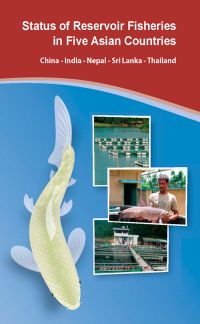
Reservoir fish fauna, fisheries production and management methods, amongst others factors, differ widely. The differences in fish yield between reservoirs and/or between countries cannot be easily understood and are unlikely to be determined by individual parameters or characteristics. This volume takes stock of the current management practices with a view to utilising this knowledge to develop and or evolve appropriate national and or regional strategies for sustained development of reservoirs fisheries.
This report, the 44th in the series, contains information about the aquatic animal health status of fifteen states in the Asia-Pacific region. The foreword discusses national aquatic animal health strategies.
This report, the 43rd in the series, contains information about the aquatic animal health status of fifteen states in the Asia-Pacific region. The foreword discusses emerging amphibian diseases in the region.
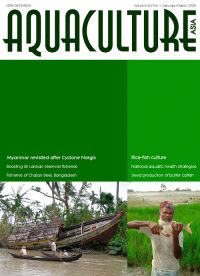
Myanmar revisited. Harvesting, traditional preservation and marketing of fishes of Chalan Beel, Bangladesh. Role of community in production and supply of larger, quality fingerlings. Can rice-fish farming provide food security in Bangladesh? Nutritional and food security for rural poor through multi-commodity production from a lake of eastern Uttar Pradesh. Emerging boost in Sri Lankan reservoir fish production. Farming the freshwater prawn Macrobrachium malcolmnsonii. Breeding and seed production of catfish Ompok pabda.
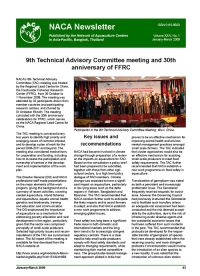
9th Technical Advisory Committee meeting and 30th anniversary of FFRC. Training Workshop on the Use of Molecular Genetics in Conservation held at USM, Malaysia. Japan International Award for NACA Staff. Consortium on freshwater finfish genetics and breeding. Shrimp Farming eNews. Seventh Meeting of the Asia Regional Advisory Group on Aquatic Animal Health. Sri Lankans learn pisciculture at CIFA. India's Central Institute for Freshwater Aquaculture observes 33rd Foundation day.
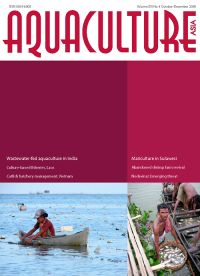
An increasingly secure future for wastewater-fed aquaculture in Kolkata, India? First culture-based fisheries growth cycle in Lao PDR is overhwelmingly encouraging. Revival of abandoned shrimp farms in Andhra Pradesh. Growth of industries linked with aquaculture in Kolleru Lake area, India. Applications of nutritional biotechnology in aquaculture. Technical and management aspects of catfish hatcheries in Vietnam. Asian seabass farming. Mariculture development opportunities in southeast Sulawesi, and much more.
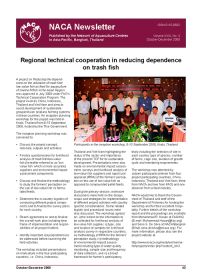
Regional technical cooperation in reducing dependence on trash fish. Culture, capture conflicts in Indonesian reservoirs: Phase 2. Progress on the IFC/NACA ACEH Shrimp Project. Indian shrimp farmer societies succeed through better management practices. Multidisciplinary situation appraisal of mangrove ecosystems in Thailand. New CIFA Director appointed. FAO Glossary of Aquaculture.
This report, the 41st in the series, contains information about the aquatic animal health status of sixteen states in the Asia-Pacific region. The foreword discusses emerging crustacean diseases.
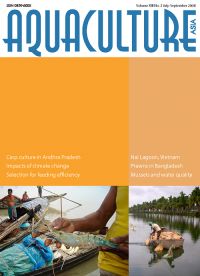
Possible improvements to carp culture in Andhra Pradesh. Aquaculture and environmental issues in the region of Nai Lagoon, Vietnam. Selection potential for feed efficiency in farmed salmonids. Freshwater prawn broodstock concern in Bangladhesh hatcheries. Production of Cirrhinus molitorella and Labeo chrysophekadion for culture-based fisheries in Lao PDR: Nursery and grow-out. Mussel farming: Alternate water monitoring practice. Use of poultry by-product meals in pelleted feed for humpback grouper Cromileptes altivelis.
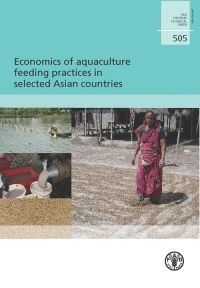
This technical paper provides an analysis of the economic implications of, and the reasons for, adopting various feeding practices for different fish species and aquaculture systems in Asia. The systems studied include extensive/traditional, semi-intensive and intensive farms for a number of different species including sutchi and pangasiid catfishes (Bangladesh and Viet Nam), hybrid catfish (Thailand), carp polyculture (India and China), prawn and milkfish polyculture (the Philippines).
From integrated carp polyculture to intensive monoculture in the Pearl River Delta, China. Better management practices for Vietnamese catfish. Ipomoea aquatica - an aquaculture friendly macrophyte. Status of fisheries and aquaculture development in Pakistan. The changing face of post-grad education in aquaculture: Contributing to soaring production and sustainable practices. Hatchery management in Bangladesh. Production of Cirrhinus molitorella and Labeo chrysophekadion for culture-based fisheries in Lao PDR and much more.
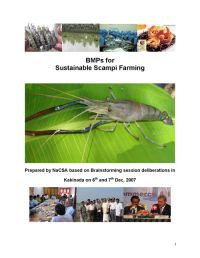
This manual provides practical advice on good management practices for sustainable freshwater prawn (scampi) farming in India. The manual covers general principles of sustainable farming, relevant legal issues including for hatcheries, land and water use, impact on natural habitats, hatchery, nursery and growout management, and environmental and social responsibility. The manual was developed via a multi-stakeholder consultation held at the Head Office of the National Centre for Sustainable Aquaculture (NaCSA), Kakinada, 6-7 December 2007.
This report, the 39th in the series, contains information about the aquatic animal health status of fifteen states in the Asia-Pacific region. The foreword discusses the 7th Symposium on Diseases in Asian Aquaculture.
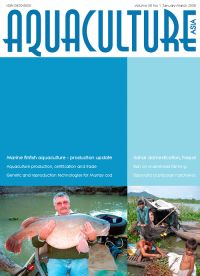
Developing guidelines for sustainable freshwater aquaculture planning in Vietnam. Aquaculture production, certification and trade for small-scale farmers. Backyard hatcheries for crustaceans in Thailand. Alternative carp species for diversification in India. Genetic and reproduction technologies for aquaculture and fisheries management of Murray cod. Status of sahar domestication in Nepal. Comparative advantage analysis of shrimp production in Asia. Strategies to improve the livelihoods of the rural poor, Vietnam, and more.
This is the report of a five-day training workshop was to build capacity and awareness of relevant stakeholders in the areas of aquatic epidemiology, risk analysis, surveillance and emergency preparedness. The long term objective was to support implementation of national strategies for better aquatic animal health management with a focus on improved surveillance, reporting, early response, emergency preparedness, risk analysis, certification and quarantine.