NACA member governments are: Australia, Bangladesh, Cambodia, China, Hong Kong SAR, India, Indonesia, I.R. Iran, Kingdom of Saudi Arabia, Korea (DPR), Lao PDR, Malaysia, Maldives, Myanmar, Nepal, Pakistan, Philippines, Sri Lanka, Thailand and Vietnam.
The visit was to plan the proposed case studies, the State-level Workshops and the consensus-building process of the DFID NRSP Research Project R8100 entitled “Investigating Improved Policy on Aquaculture Service Provision to Poor People”. Meetings were held with GVT staff, jankars and farmers from communities in villages in Orissa, Jharkhand and West Bengal, and officials of Departments of Fisheries in Orissa, West Bengal and Jharkhand. Meetings were also held with GVT, ICAR and the Fisheries Commission.
To organise, to form a union, to become an alliance, is a fundamental of human social behaviour. Farming is one of the earliest examples of sustained collective livelihood. This missive relates some early exciting experiences of associations of farmers that are emerging from amongst tribal communities, which constitute some of the most disadvantaged in India, and the work that these organisations and other partners have made towards poverty alleviation through support for aquaculture.
The three State-level Workshops were held in West Bengal, Jharkhand and Orissa in October 2002. The aim and objectives of the workshops were to contribute to “giving people a voice” in policy-making processes that have an impact on their livelihoods, to understand a process for transacting institutional and policy change, to provide feedback on case studies and to review emerging “indicators of change” and provide input into the subsequent Stakeholders Workshop.
This paper is about a process and practice which is bringing representatives of tribal communities in three Indian states together with district, state and national government officials, around the issue of aquaculture services provision. The project comprises a series of visits, fieldwork, workshops, case studies, a consensus-building process, literature research and documentation. Among its aims are building shared understandings of government services provision among recipients, implementers and policy-makers, and facilitating an equitable dialogue towards policy change.
The workshop objectives were to understand a process for transacting institutional and policy change, provide feedback to “finalise” six case studies which document experiences of rural aquaculture services provision from the perspectives of representative recipient and provider groups, to review emerging “indicators of progress” to feed into a consensus-building process and to provide input into a subsequent Policy Review Workshop. It contributed to giving people a voice in policy-making processes that have an impact on their livelihoods.
There are many “stakeholders” involved in the development of schemes to support tribal people to undertake aquaculture. These should include tribal people, researchers, policy-makers and others. Stakeholders often face a situation in which different people have conflicting views. Such differences can be over the appropriate goals of a scheme, the types of outcomes, who should be helped and in what way, or the merit and worth of particular activities.
The six case studies published here grew in concept and content throughout the Project period. To follow the progress of the Case Studies, excerpts have been taken from previous Project documents, and adapted for the purpose of showing how they changed from an initial idea to the form in which they appear here and were presented finally at the Policy Review Workshop in Noida, Delhi, in April 2003. Each of the studies is different in focus and format.
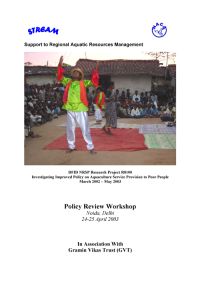
The aim of the Policy Review Workshop, as with all project activities, was “contributing to ‘giving people a voice’ in policy-making processes that have an impact on their livelihoods”. The workshop objectives included: Through six case studies, stakeholder statements and a street-play, understand the experiences of rural aquaculture services provision from the perspectives of recipients and providers; review the process for transacting policy change and lessons learnt; and make recommendations for policy change based on project outcomes.
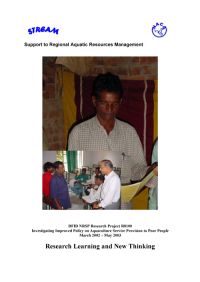
This report, at the request of NRSP, highlights “research learning and new thinking” arising from project R8100. It considers the project’s process from a strategic viewpoint, which is summarised in a conceptual matrix. The main features of the process’s overall strategy considered in more detail are a strategy for bringing through the voices of poor people – described as facilitated advocacy, with the role played by the project being one of “making it easier for people to speak for themselves”.
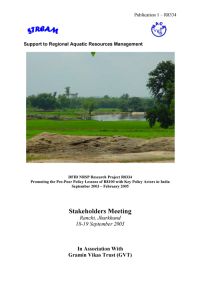
The meetings and this document discuss the lessons learnt by project R8100 and consider how the follow on project might take these forward. This document combines the minutes of the Delhi meetings and the Stakeholder meeting in Ranchi, and captures as stories the summary of project R8100 and the visit to Jabarrah. The objectives of R8334 are presented, with comments on these recorded, and the project flow chart and proposed revisions to it are included.
Three consecutive State-level Communications Strategy Workshops were held in the capitals of Jharkhand, Orissa and West Bengal states. The aim of the workshops, as with all project activities, was to “contribute to ‘giving people a voice’ in policy-making processes that have an impact on their livelihoods.” The specific objectives were to review and orient participants to the project’s four outputs and to draft a state-level communications strategy, including ideas for a monitoring and evaluation process.
The feasibility of integrated aquaculture in seasonal water bodies in rainfed farming areas of Eastern India was assessed in on-farm trials. Fry of Indian major carps: Catla, mrigal, rohu, common carp, and silver barb, and advanced fingerlings of Indian major carps were raised to marketable size. Key factors for the success of aquaculture in seasonal water bodies are access to credit, production enhancing inputs and water bodies that hold water for more than 120 days of the year.
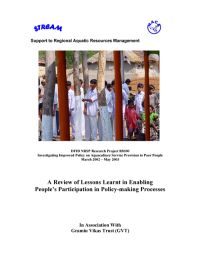
Development approaches are constantly evolving, acting on and utilising lessons learnt from past experiences. As a result, “good governance” approaches are currently topical, an intrinsic component of which is how rural poor people can participate in policy-making processes. By reviewing lessons learnt, and considering these with examples from within and outside India, an indication can be given of the most appropriate ways to begin to affect policy, although a specific blueprint will not be suggested.
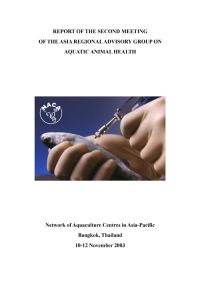
This report, the 23rd in the series, contains information about the aquatic animal health status of twenty states in the Asia-Pacific region. The foreword discusses a project on Capacity and Awareness Building on Import Risk Analysis for Aquatic Animals, funded by the APEC Fisheries Working Group.
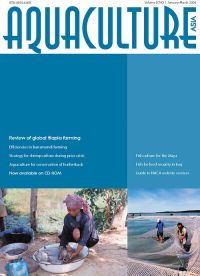
Aquaculture and food security in Iraq. Natural breeding in captivity - conservation of the threatened freshwater featherback Notopterus notopterus. Culture of Penaeus japonicus. Enzymes for sustainable aquaculture. Review of global tilapia farming practices. Fish culture in Yucatan, Mexico. Shrimp farm project planning, preparation and implementation. Coping with low shrimp prices. Efficiencies in barramundi culture. The innovative contributions of women in aquaculture. Marine finfish section. What's new on the web. Aquaculture calendar.
The Asia Regional Advisory Group on Aquatic Animal Health meets annually to discuss regional health issues including emerging disease threats. This report includes a review of regional disease status circa 2003, global and regional disease reporting arrangements, global issues and standards, progress in implementation of the the Regional Technical Guidelines on Health management for the Responsible Movement of Live Aquatic Animals, identification and designation of regional aquatic animal health resources and regional and international cooperation.
The present case studies concentrated on three sites, Kandaleru in Andhra Pradesh, Dhigirpar in West Bengal and Brahmagiri in Orissa. The three sites are markedly differentbut have a common feature that all three mainly are concerned with small farmers groupings. Earlier shrimp farming failures owing to the overexploitation of the ecosystem, by overstocking and consequent high inputs, resulting in degradation of the environment, diseases and eventual collapse, have alerted all shrimp farm groups to be wary.
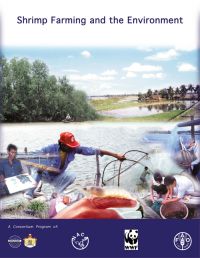
This collection of publications originates from the International Consortium Program on Shrimp Farming and the Environment, which was implemented by the World Bank, the Network of Aquaculture Centres in Asia-Pacific (NACA), the World Wildlife Fund (WWF), the Food and Agriculture Organization of the United Nations (FAO), and the United Nations Environment Programme (UNEP). The consortium supported 35 complementary case studies prepared by more than 100 researchers in more than 20 shrimp farming countries.
The Expert Consultation on Aquaculture Education in the Asia-Pacific was held in, Vietnam, 2000. The consultation was the final activity of APEC project FWG/02/99 “Collaborative Aquaculture Education Program”. This report gives the findings and papers presented to the Expert Consultation, including the follow-up recommendations for establishing an Aquaculture Educational Consortium, in the form of a network, comprising academic and training institutions in the Asia and Oceania regions.
The sixteen papers in this volume were largely based on the data from a survey of more than 5,000 shrimp and close to 6,000 carp farms in sixteen countries and territories in the Asia-Pacific region. They provide an economic and technical efficiency of production analysis for Asian shrimp and carp farming systems. This survey was conducted under the ADB/NACA regional study and workshop on aquaculture sustainability and the environment (RETA 5534).