India

India's involvement in NACA.

Creative Commons Attribution.

Related

NACA member governments

NACA member governments are: Australia, Bangladesh, Cambodia, China, Hong Kong SAR, India, Indonesia, I.R. Iran, Kingdom of Saudi Arabia, Korea (DPR), Lao PDR, Malaysia, Maldives, Myanmar, Nepal, Pakistan, Philippines, Sri Lanka, Thailand and Vietnam.

In this collection

State-level communications strategy workshops: West Bengal, Jharkhand and Orissa, 2003

Three consecutive State-level Communications Strategy Workshops were held in the capitals of Jharkhand, Orissa and West Bengal states. The aim of the workshops, as with all project activities, was to “contribute to ‘giving people a voice’ in policy-making processes that have an impact on their livelihoods.” The specific objectives were to review and orient participants to the project’s four outputs and to draft a state-level communications strategy, including ideas for a monitoring and evaluation process.

Carp production in seasonal water bodies in Eastern India

The feasibility of integrated aquaculture in seasonal water bodies in rainfed farming areas of Eastern India was assessed in on-farm trials. Fry of Indian major carps: Catla, mrigal, rohu, common carp, and silver barb, and advanced fingerlings of Indian major carps were raised to marketable size. Key factors for the success of aquaculture in seasonal water bodies are access to credit, production enhancing inputs and water bodies that hold water for more than 120 days of the year.

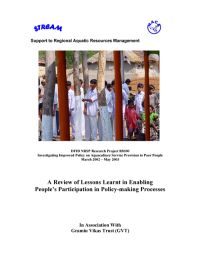
A review of lessons learnt in enabling people's participation in policy-making processes

Development approaches are constantly evolving, acting on and utilising lessons learnt from past experiences. As a result, “good governance” approaches are currently topical, an intrinsic component of which is how rural poor people can participate in policy-making processes. By reviewing lessons learnt, and considering these with examples from within and outside India, an indication can be given of the most appropriate ways to begin to affect policy, although a specific blueprint will not be suggested.

Quarterly Aquatic Animal Disease Report, January-March 2004

This report, the 23rd in the series, contains information about the aquatic animal health status of twenty states in the Asia-Pacific region. The foreword discusses a project on Capacity and Awareness Building on Import Risk Analysis for Aquatic Animals, funded by the APEC Fisheries Working Group.

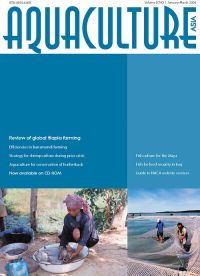
Aquaculture Asia Magazine, January-March 2004

In this issue:

Aquaculture and food security in Iraq. Natural breeding in captivity - conservation of the threatened freshwater featherback Notopterus notopterus. Culture of Penaeus japonicus. Enzymes for sustainable aquaculture. Review of global tilapia farming practices. Fish culture in Yucatan, Mexico. Shrimp farm project planning, preparation and implementation. Coping with low shrimp prices. Efficiencies in barramundi culture. The innovative contributions of women in aquaculture. Marine finfish section. What's new on the web. Aquaculture calendar.

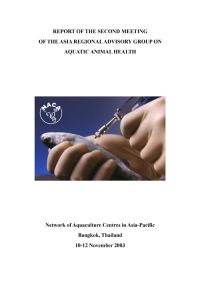
Report of the second meeting of the Asia Regional Advisory Group on Aquatic Animal Health, 10-12 November 2003

The Asia Regional Advisory Group on Aquatic Animal Health meets annually to discuss regional health issues including emerging disease threats. This report includes a review of regional disease status circa 2003, global and regional disease reporting arrangements, global issues and standards, progress in implementation of the the Regional Technical Guidelines on Health management for the Responsible Movement of Live Aquatic Animals, identification and designation of regional aquatic animal health resources and regional and international cooperation.

Case studies in India on the role of small farmer groups and associations in sustainable shrimp aquaculture management (abstract)

The present case studies concentrated on three sites, Kandaleru in Andhra Pradesh, Dhigirpar in West Bengal and Brahmagiri in Orissa. The three sites are markedly differentbut have a common feature that all three mainly are concerned with small farmers groupings. Earlier shrimp farming failures owing to the overexploitation of the ecosystem, by overstocking and consequent high inputs, resulting in degradation of the environment, diseases and eventual collapse, have alerted all shrimp farm groups to be wary.

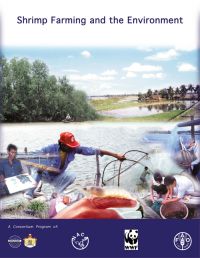
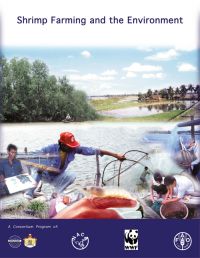
Shrimp Farming and the Environment

This collection of publications originates from the International Consortium Program on Shrimp Farming and the Environment, which was implemented by the World Bank, the Network of Aquaculture Centres in Asia-Pacific (NACA), the World Wildlife Fund (WWF), the Food and Agriculture Organization of the United Nations (FAO), and the United Nations Environment Programme (UNEP). The consortium supported 35 complementary case studies prepared by more than 100 researchers in more than 20 shrimp farming countries.

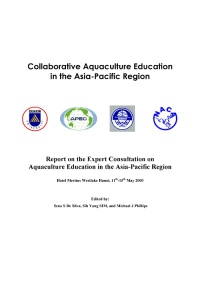
Report of the Expert Consultation on Aquaculture Education in the Asia-Pacific, Hanoi, Vietnam, 11-15 May 2000

The Expert Consultation on Aquaculture Education in the Asia-Pacific was held in, Vietnam, 2000. The consultation was the final activity of APEC project FWG/02/99 “Collaborative Aquaculture Education Program”. This report gives the findings and papers presented to the Expert Consultation, including the follow-up recommendations for establishing an Aquaculture Educational Consortium, in the form of a network, comprising academic and training institutions in the Asia and Oceania regions.

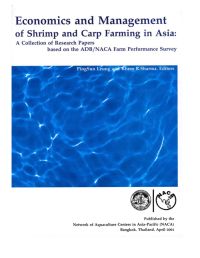
Economics and Management of Shrimp and Carp Farming in Asia

The sixteen papers in this volume were largely based on the data from a survey of more than 5,000 shrimp and close to 6,000 carp farms in sixteen countries and territories in the Asia-Pacific region. They provide an economic and technical efficiency of production analysis for Asian shrimp and carp farming systems. This survey was conducted under the ADB/NACA regional study and workshop on aquaculture sustainability and the environment (RETA 5534).

STREAM Journal Volume 2, No. 4, October-December 2003

In this issue: An experience with group formation in Jabarrah, West Bengal. Aquaculture self-help groups in rural West Bengal. Lessons learned for Fulwar Toli from an exposure visit to Jabarrah. Livelihood intervention by Fish Farmers Development Agency - a success story from Mayurbhanj, Orissa. Understanding of assets-based livelihoods through participatory rural appraisal to eliminate hunger. Poverty ranking tools in PRA - experiences of EIRFP in addressing vulnerability. This edition is also available in Vietnamese, Khmer, Ilonggo and Oriya.

Quarterly Aquatic Animal Disease Report, October-December 2003

This report, the 22nd in the series, contains information about the aquatic animal health status of seventeen states in the Asia-Pacific region. The foreword discusses the role of disease surveillance programmes and issues realted to the OIE Aquatic Animal Health Standards Commission.

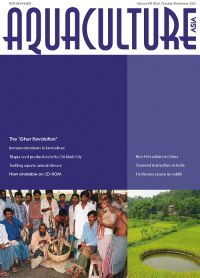
Aquaculture Asia Magazine, October-December 2003

In this issue:

Freshwater prawn Macrobrachium nobilii for rural nutrition. Snapshots of a socially responsible farm in Sri Lanka. Introduction of rainbow trout in Nepal. Tilapia seed production in Ho Chi Minh City, Vietnam. Seaweed mariculture - scope and potential in India. Growth enhancement of carp and prawn through dietary suppliementation with salt. Fertilisation and water quality management in small ponds. The "Gher Revolution". Exercising responsibilities to tackle aquatic animal disease. Immunostimulants in aquaculture.

Quarterly Aquatic Animal Disease Report, July-September 2003

This report, the 21st in the series, contains information about the aquatic animal health status of sixteen states in the Asia-Pacific region. The foreword discusses the outcomes of the second meeting of the Asia Regional Advisory Group on Aquatic Animal Health.

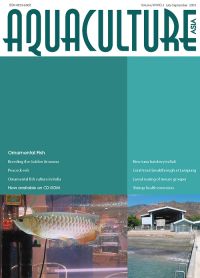
Aquaculture Asia Magazine, July-September 2003

In this issue:

Ornamental fish farming in India. Tilapia for Indian aquaculture? Peri-urban food production in southeast Asia. Socio-economic consequences of shrimp farming in Andhra Pradesh. Breeding techniques for golden arowana Scleropages formosus. Captive breeding of peacock eel Macrognathus aculeatus. Substrate-based aquaculture systems. Extension in shrimp health management - experiences from India. Treatment of disease in freshwater shrimps and crabs in China. Larval rearing techniques for humpback grouper Cromileptes altivelis.

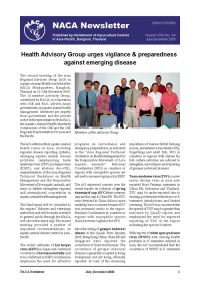
NACA Newsletter Volume XVIII, No. 3-4, July-December 2003

In this issue:

Health Advisory Group urges vigilance and preparedness against emerging disease. New Zealand farmer helps train Asian aquaculturists. Mr Junaidi Che Ayub. Global Aquaculture Discussion Forum, Dhaka, Bangladesh. STREAM Conducts Livelihood Capacity-building in the Philippines, India. MPEDA/NACA shrimp farmer workshop held in Andhra Pradesh, India. Learning by Doing - Fisheries and Adaptive Learning. NACA cooperation expanded to shrimp health management in Vietnam. 150 people trained in Q3-Q4, 2003. International Symposium on Freshwater Prawns Held at Kochi, India. Developing an online aquaculture community for NACA.

Report of the Second STREAM Regional Conference, Tagaytay City, the Philippines, 8-10 June 2003

The Second STREAM Regional Conference was held in Tagaytay City, Philippines, from 8-10 June 2003 with the participation of 23 people from Australia, Cambodia, India, Nepal, Philippines, Thailand, Vietnam and Yunnan Province of China. Following a regional overview of STREAM’s themes, country partners, donors and funding, and activities, participants visited four “stations” on the themes of livelihoods, institutions, policy development, and communications, working in groups representing National Coordinators, Communications Hub Managers, and Partners. STREAM operations were discussed.
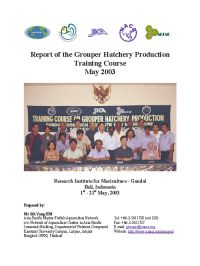
Report of the Grouper Hatchery Production Training Course, May 2003

This report documents a training course that was held at the Research Institute for Mariculture, Bali, Indonesia in May 2003. The course covered both theoretical aspects of grouper husbandry via lectures and practical hands-on work in a grouper hatchery, including broodstock management, tank preparation egg collection, live feed production, health management, harvesting and transport and visits to commmercial grouper and milkfish hatcheries, grow-out facilities, markets and exporters.

Quarterly Aquatic Animal Disease Report, April-June 2003

This report, the twentieth in the series, contains information about the aquatic animal health status of nineteen states in the Asia-Pacific region. The editorial discusses health risks associated with trans-boundary movement of live aquatic animals and the role of risk analyses.

Aquaculture Asia Magazine, April-June 2003

In this issue:

Peri-urban aquaculture in Kolkata. Diffusion and adoption of shrimp farming technologies. Aquaculture education in India. Information system on fish germplasm resources in China. Freshwater crustacean aquaculture in China. The role of macronutrients. Innovations by Bengal farmers. Scientific guidelines for freshwater prawn farmers in India. Status of mariculture in Indonesia. Use of probiotics in larval rearing. Problems in shrimp culture during the wet season.