NACA member governments are: Australia, Bangladesh, Cambodia, China, Hong Kong SAR, India, Indonesia, I.R. Iran, Kingdom of Saudi Arabia, Korea (DPR), Lao PDR, Malaysia, Maldives, Myanmar, Nepal, Pakistan, Philippines, Sri Lanka, Thailand and Vietnam.
This report, the 45th in the series, contains information about the aquatic animal health status of sixteen states in the Asia-Pacific region. The foreword discusses the Sanitary and Phytosanitary (SPS) Agreement and its relationship to the OIE Aquatic Animal Health Standards.
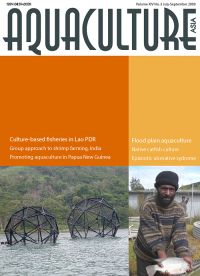
Community management and revenue sharing practices of culture-based fisheries in Lao PDR. Floodplain aquaculture in Bangladesh. Promoting small-scale inland aquaculture in Papua New Guinea. Group approaches to shrimp farming: The key to sustainability. Native catfish culture - a technology package for farmers. Influence of salinity in the growth of the black clam Villorita cyprinoides. EUS in Asia and Africa. Offshore opportunities for artisinal aquaculture. Grouper aquaculture in Brazil. NACA Newsletter.
Lao PDR becomes the 18th member of NACA at the 20th GCM. Vietnamese catfish farmers visit Andhra Pradesh, India. Global Conference on Aquaculture 2010. Expert Meeting on the Use and Exchange of Aquatic Genetic Resources. Culture, capture conflicts: sustaining fish production and livelihoods in Indonesian reservoirs. Regional Grouper Hatchery Training Course, 11 - 31 October 2009. Sri Lankan group trained in cage culture in Thailand. First step towards the creation of a network of aquaculture centres in the Americas.
This report, the 44th in the series, contains information about the aquatic animal health status of fifteen states in the Asia-Pacific region. The foreword discusses national aquatic animal health strategies.
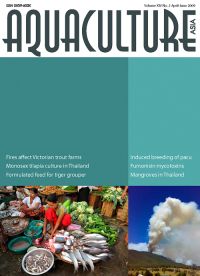
GLOBALGAP standard in Thai shrimp farms: Mission (im)possible? The Victorian trout industry and the bushfires. Small-scale aquaculture in the Ayeyarwady Delta, Myanmar. The history, status and future prospects of monosex tilapia culture in Thailand. Mangroves of Nakhon Si Thammaarat Province in Souther Thailand. Induced breeding of pacu Piaractus brachypomus in captivity. Fumosins - mycotoxins of increasing importance in fish. Microsatellite DNA markers, a fisheries perspective. Formulated feed for tiger grouper grow out.
This report, the 43rd in the series, contains information about the aquatic animal health status of fifteen states in the Asia-Pacific region. The foreword discusses emerging amphibian diseases in the region.
An increasingly secure future for wastewater-fed aquaculture in Kolkata, India? First culture-based fisheries growth cycle in Lao PDR is overhwelmingly encouraging. Revival of abandoned shrimp farms in Andhra Pradesh. Growth of industries linked with aquaculture in Kolleru Lake area, India. Applications of nutritional biotechnology in aquaculture. Technical and management aspects of catfish hatcheries in Vietnam. Asian seabass farming. Mariculture development opportunities in southeast Sulawesi, and much more.
This report, the 41st in the series, contains information about the aquatic animal health status of sixteen states in the Asia-Pacific region. The foreword discusses emerging crustacean diseases.
Possible improvements to carp culture in Andhra Pradesh. Aquaculture and environmental issues in the region of Nai Lagoon, Vietnam. Selection potential for feed efficiency in farmed salmonids. Freshwater prawn broodstock concern in Bangladhesh hatcheries. Production of Cirrhinus molitorella and Labeo chrysophekadion for culture-based fisheries in Lao PDR: Nursery and grow-out. Mussel farming: Alternate water monitoring practice. Use of poultry by-product meals in pelleted feed for humpback grouper Cromileptes altivelis.
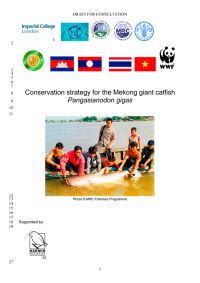
This is a draft conservation strategy for the Mekong giant catfish prepared under the project Development of a conservation strategy for the critically endangered Mekong giant catfish, released for public consultation. The strategy considers the population and legal status, conservation vision and goals, factors affecting the wild population and outlines a conservation strategy. The document also considers monitoring, research and adaptive management and implementation issues given the transboundary and multi-institutional nature requirements for effective implementation.
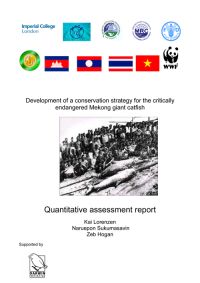
This report provides a quantitative assessment of the conservation of the Mekong giant catfish, Pangasianodon gigas, and an evaluation of the likely effectiveness of different conservation options. The report conisders the history of fisheries exploitation and environmental change, the estimated wild population size of P. gigas, the role of captive populations held by the Thailand Department of Fisheries and interactions with cultured fish. It makes a series of recommendations for conservation of this species.
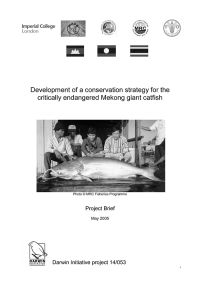
This is a brief of a project to develop an overarching conservation strategy for the Mekong giant catfish integrating supportive breeding with harvest and habitat management. This will involve (1) quantitative assessment of population status based on existing information, (2) quantitative assessment of the likely effectiveness of different conservation measures (3) review and improvement of captive breeding procedures; (4) promotion of appropriate adaptive policies for the further development of the strategy; and (5) definition of an overall conservation strategy.
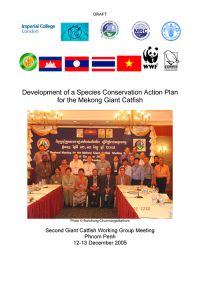
This is the report of the Second Mekong Giant Catfish Working Group Meeting, held in Phnom Penh 12-13 November 2005, under the project Development of a conservation strategy for the critically endangered Mekong giant catfish. The purpose of the workshop was to review existing knowledge on Mekong giant catfish, identify future conservation and research priority activities, and to continue the joint planning process aimed at developing an overarching conservation strategy.
From integrated carp polyculture to intensive monoculture in the Pearl River Delta, China. Better management practices for Vietnamese catfish. Ipomoea aquatica - an aquaculture friendly macrophyte. Status of fisheries and aquaculture development in Pakistan. The changing face of post-grad education in aquaculture: Contributing to soaring production and sustainable practices. Hatchery management in Bangladesh. Production of Cirrhinus molitorella and Labeo chrysophekadion for culture-based fisheries in Lao PDR and much more.
The primary objective of this manual is to provide guidelines for attaining better practices in culture-based fisheries, an emerging practice in rural areas in the Asian region. It deals will the principles of culture-based fishery practices, primarily based on relatively long-term experiences in Sri Lanka and Vietnam. It is not only targeted at researchers per se, but also at stakeholders at the grass root levels, as well as planners and policy developers.
This report, the 38th in the series, contains information about the aquatic animal health status of seventeen states in the Asia-Pacific region. The foreword discusses the OIE/NACA Regional Workshop on Aquatic Animal Health.
A different form of dumping: The need for a precautionary approach for yet another new species for shrimp farming in Asia. Sustainable livelihoods of pangus farming in Bangladesh. Business approach to national broodstock centres in Vietnam. Freshwater aquaculture in Myanmar. Traditional carp culture in Central Europe. Egg and larval quality in sand bass Psammoperca weigiensis. Effect of protein and lipid level of growth performance of tiger grouper Epinephelus fuscoguttatus.
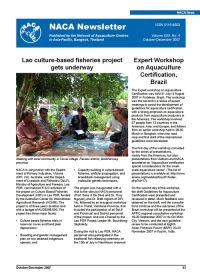
Lao culture-based fisheries project gets underway. Expert Workshop on Aquaculture Certification, Brazil. Strategies for Development of Asian Reservoir and Lake Fisheries Management. EUS identified as cause of fish kills in Africa. NACA seeks shrimp farm specialists for assignments in Indonesia. FDA detains five species of farm-raised seafood from China. 7th Symposium on Diseases in Asian Aquaculture. Aquafeed Horizons Asia 2008. Scientists join fight against frog diseases. Artificial propagation of snow trout Schizothorax zarudnyi by Iranian experts. NACA keynotes three international meetings. Culture, capture conflicts project review, Indonesia. Sign up to the coldwater aquaculture Yahoo! Tech Group. Website publishing and administration training, Vietnam. Aquatic Animal diseases Significant to Asia-Pacific: Identification Field Guide.
This final report of the project “Strengthening Aquatic Animal Health Capacity and Biosecurity in ASEAN” contains two parts: A. Recommended Minimum Operational Requirements for Implementing National Aquatic Animal Health Strategies within ASEAN and B. ASEAN progress in the implementation of National Aquatic Animal Health Strategies. The report provides guidance for countries in ASEAN to implement key elements of national aquatic animal health strategies, and for monitoring progress of national strategy implementation in ASEAN member countries.
These standard operating procedures were developed to reduce the risk of spread of trans-boundary disease of aquatic animals through the movement of live food fish. The procedures are a set of documents for health certification and quarantine measures to be used by competent authorities in trade among ASEAN member countries. The procedures recognise the existing variation in capacity between ASEAN members and have been designed so that they can be implemented across varying policy and legal frameworks.