NACA member governments are: Australia, Bangladesh, Cambodia, China, Hong Kong SAR, India, Indonesia, I.R. Iran, Kingdom of Saudi Arabia, Korea (DPR), Lao PDR, Malaysia, Maldives, Myanmar, Nepal, Pakistan, Philippines, Sri Lanka, Thailand and Vietnam.
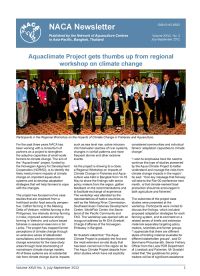
Aquaclimate Project gets thumbs up from regional workshop on climate change. Developing climate resilient aquaculture: The Aquaclimate Project. Regional framework for cooperation on climate change. Emergency regional consultation on shrimp early mortality syndrome, 9-10 August, Bangkok. Regional study/workshop on adoption of aquaculture assessment tools for sustainability. Regional proficiency testing for aquatic animal disease diagnostic laboratories.
The recordings in this collection are the annual progress reports of NACA's regional lead centres in Thailand, China and the Philippines. The presentations were made at the 23rd NACA Governing Council Meeting, which was held in Siem Reap, 27-29 May 2011, hosted by the Government of Cambodia. The Governing Council is NACA's peak policy body, which meets annually to review the organisation's activities and set priorities for the year ahead.
This report, the 56th in the series, contains information about the aquatic animal health status of fifteen states in the Asia-Pacific region. The foreword discusses a case definition for acute hepatopancreatic necrosis syndrome ("early mortality syndrome") in cultured shrimp in Asia.
The Asia Regional Advisory Group on Aquatic Animal Health meets annually to discuss regional health issues including emerging disease threats. This report includes a review of regional disease status circa 2011, global and regional disease reporting arrangements, global issues and standards, progress in implementation of the the Regional Technical Guidelines on Health management for the Responsible Movement of Live Aquatic Animals, identification and designation of regional aquatic animal health resources and regional and international cooperation.
This report, the 55th in the series, contains information about the aquatic animal health status of fourteen states in the Asia-Pacific region. The foreword discusses acute hepatopancreatic necrosis syndrome ("early mortality syndrome") in cultured shrimp in Asia.
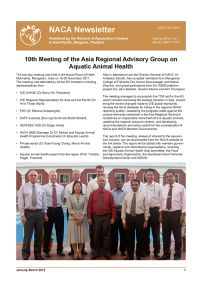
10th Meeting of the Asia Regional Advisory Group on Aquatic Animal Health. Flood. Shrimp Price Study, Phase III: Case studies in Vietnam, Indonesia and Bangladesh. The Sultanate of Oman Embarks on Aquaculture Development. FAO Technical Guidelines on Use of Wild Fish as Feed in Aquaculture. New issue of Asian Fisheries Science and Asian Fisheries Society on Facebook.
This report, the 54th in the series, contains information about the aquatic animal health status of fourteen states in the Asia-Pacific region. The foreword discusses emerging aquatic animal diseases in the region, including acute hepatopancreatic necrosis disease and scale-drop syndrome.
The Colombo Declaration is a commitment to regional cooperation in aquaculture development for food security, nutrition and economic development in Asia. It was developed and agreed on by delegations from 18 states at a ministerial-level meeting held in Colombo, Sri Lanka, 28-29 July 2011.
This report, the 5rnd in the series, contains information about the aquatic animal health status of thirteen states in the Asia-Pacific region. The foreword discusses the 8th Symposium on Diseases in Asian Aquaculture.
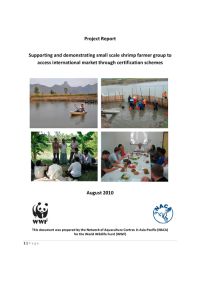
This project was conducted to demonstrate small scale shrimp farmer group access to international markets through certification schemes. This project proved that small-scale farmers organised into groups, can improve their technical capacities, and achieve access to markets. This achievement was the result of strong partnerships with producers, private sector and government agencies assisting to develop a sustainable business model for small scale aquaculture. Cost of compliance was found to be a significant barrier to entry.
The recordings in this collection are the annual progress reports of NACA’s regional lead centres in India, Thailand, China and the Philippines, plus a summary of NACA’s progress over the past five years and a special address by Professor E.G. Silas. The presentations were made at the 22nd NACA Governing Council Meeting in Cochi, Kerala, from 9-11 May 2011, India.
Small-scale farmers face many challenges in the face of globalisation. Ever-increasingly competition, increasingly strict food safety and evironmental standards, and a growing regulatory burden can make it difficult for small farmers to survive. A cluster or cooperative approach can help farmers achieve economies of scale to remain competitive.
Cost and logistical constraints can be barriers to the inclusion of small-scale farmers in aquaculture certification schemes. Adopting a cluster-based approach, where groups of adjacent farms are certified together, can facilitate the participation of small-scale producers maintain their access to markets. Group-based certification can also assist with extension and implementation of better management practices required to achieve certification and compliance monitoring.
International requirements on food safety, traceability, animal health and welfare and social responsibility are increasingly stringent. The burden of compliance and the cost of certification are particularly heavy for small scale farmers who are often excluded by the limited resources at their disposal. Working in groups can help small scale farmers attain economies of scale necessary to address compliance issues and participate in certification schemes, improving their competitive position.
The Asia Regional Advisory Group on Aquatic Animal Health meets annually to discuss regional health issues including emerging disease threats. This report includes a review of regional disease status circa 2010, global and regional disease reporting arrangements, global issues and standards, progress in implementation of the the Regional Technical Guidelines on Health management for the Responsible Movement of Live Aquatic Animals, identification and designation of regional aquatic animal health resources and regional and international cooperation.
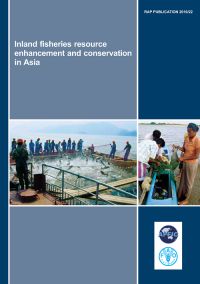
This regional review study is an effort to promote improved inland fisheries management under the Code of Conduct for Responsible Fisheries. It covers ten Asian countries with significant inland capture fisheries, namely Bangladesh, China, India, Indonesia, the Republic of Korea, Myanmar, Nepal, Sri Lanka, Thailand and Viet Nam. The papers were presented and discussed at a regional workshop held from 8-11 February 2010 in Pattaya, Thailand. Audio recordings of the presentations are also available for download.