NACA member governments are: Australia, Bangladesh, Cambodia, China, Hong Kong SAR, India, Indonesia, I.R. Iran, Kingdom of Saudi Arabia, Korea (DPR), Lao PDR, Malaysia, Maldives, Myanmar, Nepal, Pakistan, Philippines, Sri Lanka, Thailand and Vietnam.
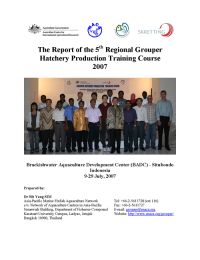
The 5th Regional Grouper Hatchery Training Course was another success with all participants is pleased with the overall training activities and field trips. A total of 17 participants from eight countries attended the training course which was hosted by the Brackishwater Aquaculture Development Centre, Situbondo, Indonesia. Participants were able to involve in the broodstock activities for giant grouper, in additional to the tiger and humpback groupers, and attended field trips to backyard hatcheries and export facilities.
This is the report of the project Application of PCR for improved shrimp health management in the Asian region. The training programme included two training workshops that were designed to provide a good understanding of PCR methodology, laboratory practices and trouble shooting in detection of both DNA and RNA viruses. The workshops were followed by by two rounds of an anonymous PCR inter-calibration or ring testing exercise to allow laboratories to gauge their own performance.
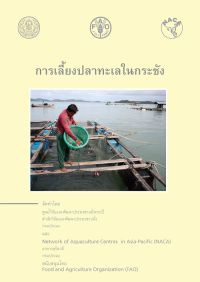
This training manual (in Thai language) provides guidance in marine finfish cage aquacutlure techniques. It is geared towards giving small-scale farmers a solid technical grounding that will enable them to improve their farm productivity and reduce losses through understanding of markets and economic factors, better farm siting. and improved feeding, handling and stock management practices. This knowledge will help the trainees and other fish farmers to improve their productivity and profitability while also reducing their risk profile.
This report, the 37th in the series, contains information about the aquatic animal health status of fourteen states in the Asia-Pacific region. The foreword discusses emerging diseases in the region.
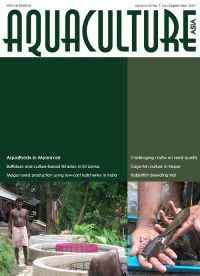
Buffaloes in favour of culture-based fisheries in Sri Lanka. Aquafeeds in Myanmar: A change from farm-made to factory-made feeds. Challenging myths about seed quality and potential benfits to the rural poor. Catfish Clarius batrachus production using low cost hatcheries. Cage fish culture and livelihoods in the mid-hill lakes of Pokhara, Nepal. Marine fish hatchery training. Rabbitfish Siganus guttatus breeding and larval rearing. Vietnamese extension manual on culture-based fisheries.
In 2006 the COFI Sub-Committee on Aquaculture noted that many non-governmental certification schemes have resulted in higher costs for producers without delivering significant benefits to small-scale producers. An international round of consultations were commissioned to discuss the development of globally accepted certification guidelines for aquaculture production, which could provide more guidance and serve as a basis for harmonisation and mutual recognition. This is the report of the first consultation workshop, held in Bangkok, March 2007.
This report, the 36th in the series, contains information about the aquatic animal health status of fifteen states in the Asia-Pacific region. The foreword discusses recent activities in support of aquatic animal health in the region.
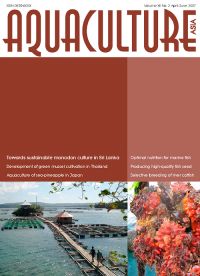
Sustainable black tiger shrimp farming in Sri Lanka. An economic analysis of Persian sturgeon stock enhancement. Aquaculture and environmental sustainability in Thailand: Food or financial security? Cage fish culture - successful income generation in manmade reservoir Kulekhani, Nepal. Diversification of rice farming alleviates poverty in a Bangladesh village. Sea-pineapple aquaculture in Japan. Green mussel cultivation in Thailand. Selective breeding for growh and fillet yield in Vietnamese catfish. Producing quality fish seed in rural Asia.
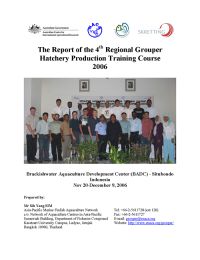
This report describes a training course on grouper hatchery protocols that was held in Indonesia in 2006. A total of 20 participants from 13 countries attended the training course which was hosted by the Brackishwater Aquaculture Development Centre, Situbondo. Participants came from Australia, Hong Kong, Indonesia, India, Malaysia, Maldives, Myanmar, Philippines, Qatar, Saudi Arabia, Singapore, Thailand and Vietnam.
This report, the 35th in the series, contains information about the aquatic animal health status of fifteen states in the Asia-Pacific region. The foreword discusses mechanisms for recognition of emerging diseases in the Asia-Pacific region.
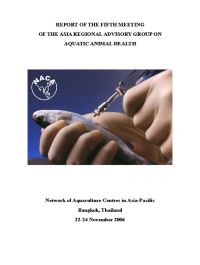
The Asia Regional Advisory Group on Aquatic Animal Health meets annually to discuss regional health issues including emerging disease threats. This report includes a review of regional disease status circa 2006, global and regional disease reporting arrangements, global issues and standards, progress in implementation of the the Regional Technical Guidelines on Health management for the Responsible Movement of Live Aquatic Animals, identification and designation of regional aquatic animal health resources and regional and international cooperation.
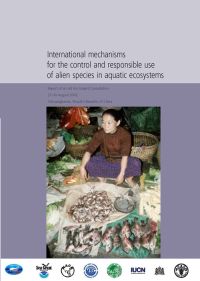
The use of alien species is a proven means to increase production and value from aquatic ecosystems. However, alien species are now recognised as one of the most significant threats to aquatic biodiversity. There are a range of international mechanisms that have been established to assist countries in meeting international obligations and responsibilities. Implementation is often difficult due to lack of awareness and problems with enforcement. Regional coordination of policies is needed for effective national management.
This report, the 34th in the series, contains information about the aquatic animal health status of fourteen states in the Asia-Pacific region. The foreword discusses efforts towards international harmonisation in aquatic animal health standards.
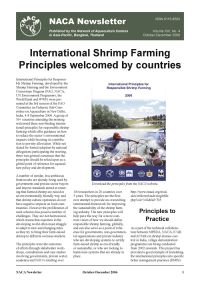
International shrimp farming principles welcomed by countries. Discussions on the establishment of a "Mahseer R&D Centre". Microsatellite DNA markers for mahseer are now available. First study on genetic variation of the critically endangered Mekong giant catfish. IMNV found in Asia-Pacific. Thailand and US to jointly install tsunami wave sensors. Co-management in aquaculture explored at APFIC Forum. Virus may control Australia's feral carp problem. A milestone in India's sustainable shrimp farming efforts. Fish introduction in India: Status, challenges and potentials. 8th Asian Fisheries Forum. STREAM Update. Website management training to support Thai Post-tsunami Rehabilitation website.
This report, the 33rd in the series, contains information about the aquatic animal health status of seventeen states in the Asia-Pacific region. The foreword discusses emerging diseases in the region.
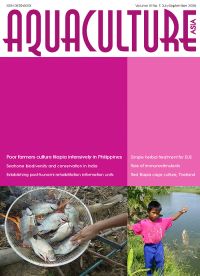
Resources and biodiversity of seahorses and their need for conservation in India. Captive breeding of pangasid catfish Pangasius pangasius. Establishment of post-tsunami rehabilitation information units in Thailand. Poor farmers culture tilapia intensively in ponds in Central Luzon, Philippines. Simple herbal treatment for treatment of EUS in snakehead. DNA vaccination in health management. The role of immunostimulants. Red tilapia cage culture in central Thailand. Quality improvement of farmed fish in Iranian markets.
This paper provides an overview of seafood consumption production in southeast Asia circa 2006. It forecasts a need for aquaculture to expand area under culture and intensity; highlights the potential for fishmeal to constrain growth, and identifies a trend towards cultivation of high-value species. Sources for the review included a regional synthesis of aquaculture developed for a regional workshop in 2005, a review of marine finfish hatchery development and a regional survey of cage fish culture.
This report, the 32nd in the series, contains information about the aquatic animal health status of fifteen states in the Asia-Pacific region. The foreword discusses regional cooperation for promotion of aquatic animal health management.
This is the proceedings of the workshop on Building capacity to combat impacts of aquatic invasive alien species and associated trans-boundary pathogens in ASEAN countries, held in Penang, Malaysia, on the 12th-16th July 2004. The workshop built on the recommendations from a 2002 workshop organised by the Global Invasive Species Program and a 2003 workshop of countries sharing the Mekong watershed, in promoting awareness, coordination mechanisms and information exchange systems and identifying management and risk mitigation measures.
This report, the 31st in the series, contains information about the aquatic animal health status of fourteen states in the Asia-Pacific region. The foreword discusses recent activities to strengthen aquatic animal health management in ASEAN.