Technical publications

NACA publishes technical papers and manuals for a wide variety of farming systems and related environmental and social issues. Many of these provide guidance on better management practices with a view to improving crop outcomes and on-farm resource utilisation efficiency. By using inputs such as feed and power more efficiently, farmers can simultaneously improve their profitability and environmental performance.

Creative Commons Attribution.
Related

Publications

NACA publishes a wide range of aquaculture publications including technical manuals, workshop proceedings, better practice guidelines and several serials including Aquaculture Asia Magazine, the NACA Newsletter and the Quarterly Aquatic Animal Disease Report. To keep up to date with developments you could consider subscribing to our RSS feed

In this collection

Basic overview of the regulatory procedures for authorisation of veterinary medicines with emphasis on residues in food animal species

This report presents a précis of the regulatory procedures for authorisation of veterinary medicines in Europe and the USA. In particular it concentrates upon the requirements for consumer safety in regard to presence of residues of veterinary medicines in the edible tissues of food animal species. In both Europe and the USA the regulations in regard to veterinary residues and consumer safety require that countries wishing to export into those markets demonstrate equivalent standards to the domestic requirements.

Report of the Emergency Disease Control Task Force on a Serious Disease of Koi and Common Carps in Indonesia, June 2002

An Emergency Disease Control Task Force on a Serious Disease of Koi and Common Carps in Indonesia was organised by NACA in June 2002. The Task Force conducted an emergency assessment of the disease situation in July through field and laboratory examinations of collected samples. The Task Force collected information about the disease occurrence. Koi herpes virus was detected from all case samples which indicates that it may have played a role in the observed mortalities.

Information access survey Western Visayas, Philippines, June 2003

The aim of this report is to provide brief profiles of the main stakeholders within the aquatic resources and fisheries sectors in Western Visayas, to describe their access to information, and the communication between and within stakeholder groups, organisations and institutions within the sector. The report goes on to identify current needs and key action points which might maximise efficient communication.

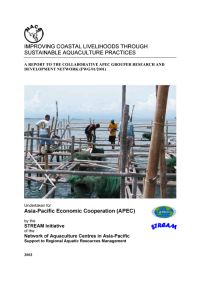
Improving coastal livelihoods through sustainable aquaculture practices: Full report

Wild-harvest fisheries for live reef fish are largely over-exploited or unsustainable. Sustainable aquaculture – such as that of groupers – is one option for meeting increasing demand for reef fish as well as potentially maintaining livelihoods of coastal communities. This report draws upon secondary literature, media sources and four diverse case studies from at-risk reef fisheries, to frame a strategy for encouraging sustainable aquaculture as an alternative to destructive fishing practices. It was commissioned by the APEC Secretariat.

Facilitating a diversity of voices to influence policy

This paper is about a process and practice which is bringing representatives of tribal communities in three Indian states together with district, state and national government officials, around the issue of aquaculture services provision. The project comprises a series of visits, fieldwork, workshops, case studies, a consensus-building process, literature research and documentation. Among its aims are building shared understandings of government services provision among recipients, implementers and policy-makers, and facilitating an equitable dialogue towards policy change.

Case studies: Investigating improved policy on aquaculture service provision to poor people

The six case studies published here grew in concept and content throughout the Project period. To follow the progress of the Case Studies, excerpts have been taken from previous Project documents, and adapted for the purpose of showing how they changed from an initial idea to the form in which they appear here and were presented finally at the Policy Review Workshop in Noida, Delhi, in April 2003. Each of the studies is different in focus and format. 

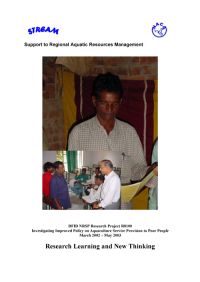
Research learning and new thinking

This report, at the request of NRSP, highlights “research learning and new thinking” arising from project R8100. It considers the project’s process from a strategic viewpoint, which is summarised in a conceptual matrix. The main features of the process’s overall strategy considered in more detail are a strategy for bringing through the voices of poor people – described as facilitated advocacy, with the role played by the project being one of “making it easier for people to speak for themselves”.


Carp production in seasonal water bodies in Eastern India

The feasibility of integrated aquaculture in seasonal water bodies in rainfed farming areas of Eastern India was assessed in on-farm trials. Fry of Indian major carps: Catla, mrigal, rohu, common carp, and silver barb, and advanced fingerlings of Indian major carps were raised to marketable size. Key factors for the success of aquaculture in seasonal water bodies are access to credit, production enhancing inputs and water bodies that hold water for more than 120 days of the year.

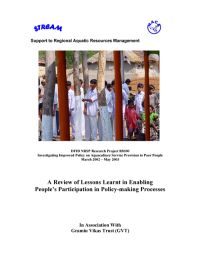
A review of lessons learnt in enabling people's participation in policy-making processes

Development approaches are constantly evolving, acting on and utilising lessons learnt from past experiences. As a result, “good governance” approaches are currently topical, an intrinsic component of which is how rural poor people can participate in policy-making processes. By reviewing lessons learnt, and considering these with examples from within and outside India, an indication can be given of the most appropriate ways to begin to affect policy, although a specific blueprint will not be suggested.

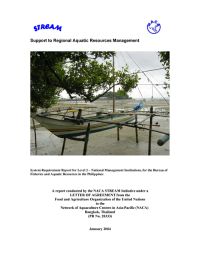
System requirements report for level 2 - national management institutions

This System Requirement Report describes national level requirements for data collection and sharing mechanisms for fisheries co-management in the Philippines. It also provides a broad picture of the following for the national fisheries management level in the Philippines.

Aquatic resources in the Philippines and the extent of poverty in the sector

This report presents an overview of the state of aquatic resources in the Philippines, its performance and importance in the Philippine economy, and explores the situation of poverty in the "aquatic resources sector." The report describes the policy environment that guides the action of key actors in the sector. A general analysis of some trends in relation to factors that keep the poor from participating and benefiting from aquatic resource management is also provided.

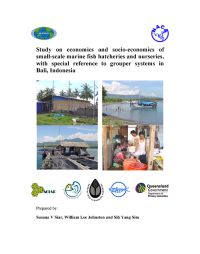
Study on economics and socio-economics of small-scale marine fish hatcheries and nurseries with special reference to grouper systems in Bali, Indonesia

The main objectives of the study were to describe the development of the small-scale or back yard multispecies hatcheries and their economic structure and benefits to the farmers and local community in Bali, Indonesia. The social and economic impact of the back yard multi-species hatchery systems were analysed and details of the benefit of this system to the community described. The strengths and weaknesses of the back yard multi-species hatchery system are described.

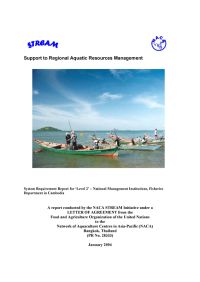
System requirements report for 'level 2' - national management institutions, Fisheries Department in Cambodia

This report describes the national-level requirements for data collection and sharing mechanisms for fisheries co-management in Cambodia. It presents the findings from a thorough literature review and workshops, group and individual interviews. Community fisheries in Cambodia are at a very early stage of development, and the exact management responsibilities are still poorly understood by many stakeholders. This report relates the information needs voiced by participants in this study.

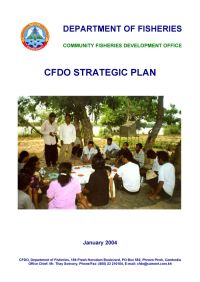
Community Fisheries Development Office Strategic Plan

In October 2000 the government of Cambodia announced a major change in fisheries management policy. The core elements of the new policy are the reduction of fishing lot concession areas by 56%, the broader participation of fishing communities in the management of fisheries and a focus on the efficient, sustainable and equitable use of the living aquatic resources. This document details the Strategic Plan for the CFDO in the Department of Fisheries (DoF) based on its mandate.

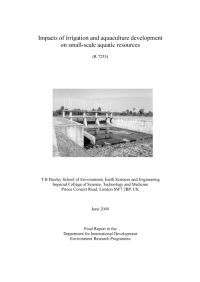
Impacts of irrigation and aquaculture development on small-scale aquatic resources

Small-scale aquatic resources play an important but poorly quantified role in the livelihoods of rural people in many developing countries, and are also important reservoirs of biological diversity. We conducted a field study in Southern Laos to quantify small-scale aquatic resource, and to assess the impacts of (small-to medium
scale) irrigation and aquaculture development on these resources.

Some thoughts on international trade in aquaculture products and human development

Small-scale and subsistence fisheries, and aquaculture, play important roles in the livelihoods of many rural people throughout the region, although the significance is often hidden in national, regional and international statistics. With the fishery sector as an important sector for human development in Asia, an understanding of the array of stakeholders involved, and indeed ensuring their better participation in policy setting processes and trade discussions, is necessary to bring a more human development-oriented dimension to trade policy.

Mixed shrimp farming-mangrove forestry models in the Mekong Delta: Termination report

The goal of this project was to optimise the economic yield from mixed shrimp aquaculture-mangrove forestry farming systems in Ca Mau Province, Vietnam, in a sustainable manner. Specific objectives were to investigate factors controlling the yields of shrimp and wood from shrimp farming-mangrove systems, experiment with shrimp pond and mangrove forest management to evaluate different culture options, identify improved practices and assist government to transfer the results of the project to the wider coastal farming community.

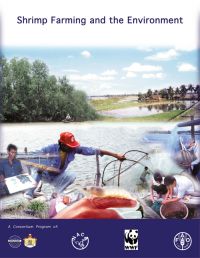
Shrimp Farming and the Environment

This collection of publications originates from the International Consortium Program on Shrimp Farming and the Environment, which was implemented by the World Bank, the Network of Aquaculture Centres in Asia-Pacific (NACA), the World Wildlife Fund (WWF), the Food and Agriculture Organization of the United Nations (FAO), and the United Nations Environment Programme (UNEP). The consortium supported 35 complementary case studies prepared by more than 100 researchers in more than 20 shrimp farming countries.

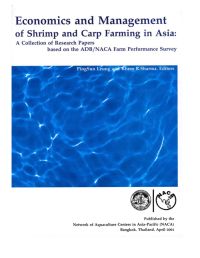
Economics and Management of Shrimp and Carp Farming in Asia

The sixteen papers in this volume were largely based on the data from a survey of more than 5,000 shrimp and close to 6,000 carp farms in sixteen countries and territories in the Asia-Pacific region. They provide an economic and technical efficiency of production analysis for Asian shrimp and carp farming systems. This survey was conducted under the ADB/NACA regional study and workshop on aquaculture sustainability and the environment (RETA 5534).

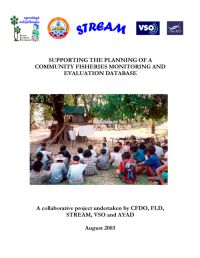
Supporting the planning of a community fisheries monitoring and evaluation database

Knowledge of community fisheries and their capacity is a pre-requisite for co-management. This report illustrates the development of a pilot data collection, sharing and interrogation mechanisms for key information in support of co-management, identifying information requirements and procedures for the transmission and sharing of information between relevant stakeholders. A combination of focus group interviews with the community committee and village leaders, and participatory rural appraisal was used as a means of information compilation.