Ornamentals

Farming of ornamental fish, crustaceans and plants for ornamental purposes.

Creative Commons Attribution.

Related

Subject tags

A collection of subject tags relating to technical matters.

In this collection

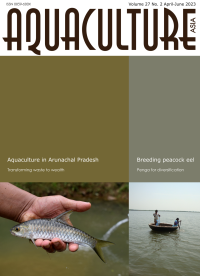
Aquaculture Asia Magazine, April-June 2023

In this issue:

Aquaculture and fisheries perspectives in Arunachal Pradesh; Present status of medium saline ‘bheri’ fishery and integrated mangrove-aquaculture in West Bengal, India: A short study: Part 2; Transforming waste to wealth: An onsite demonstration of transforming fish waste into fish fertiliser to tribal communities of Jharkhand; Innovative fish sale improved livelihoods at Jurala dam in Telangana, India; Pengba, Osteobrama belangeri – a candidate species for diversification in aquaculture; First report on successful captive breeding of peacock eel, Macrognathus aral; NACA Newsletter.

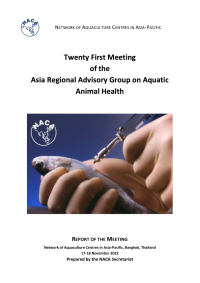
Report of the 21st Asia Regional Advisory Group on Aquatic Animal Health

This report summaries the proceedings of the 21st meeting of the Regional Advisory Group on Aquatic Animal Health, held 17-18 November 2022. The role of the group is to review trends in disease and emerging threats in the region, identify developments in global disease issues and standards, to evaluate the Quarterly Aquatic Animal Disease Reporting Program and to provide guidance on regional strategies to improve aquatic animal health management.

FAO/NACA workshop to developing a regional strategy for aquatic organism health using progressive management pathways

On 28-29 November FAO and NACA collaborated on a virtual workshop to develop a regional strategy for aquatic organism health, using a progressive management pathway for improving aquaculture biosecurity. The workshop was held under the auspices of the project “Responsible use of fisheries and aquaculture resources for sustainable development component 3: Biosecurity and health management”. The workshop involved 31 experts from 16 countries, including national focal points, FAO and NACA. The objectives of the workshop were to: Present and analyse country responses to a self-assessment survey on biosecurity and health management capacity and performance; to provide guuidance to country participants on conducting a SWOT analysis; and to prepare a detailed plan for Phase II of the initiative.

Aquaculture Asia Magazine, July-September 2022

In this issue:

Dynamics of small-scale aquaculture development in India: A review; Green water technology as an essential support to larval rearing of hilsa shad; Collection of freshwater molluscs and sale of meat by women in Purba Medinipur, West Bengal, India; A success story of ornamental fish farming as a tool for alternative livelihood of tribal women in Keonjhar District, Odisha, India; Recent trends in seed production of stinging catfish, Heteropneustes fossilis, in India; NACA Newsletter.
A success story of ornamental fish farming as a tool for alternative livelihood of tribal women in Keonjhar District, Odisha, india

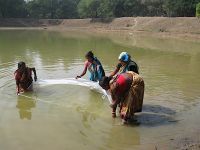
In Odisha, India, ornamental fish farming, culture and seed production are being utilised by self help groups to provide livelihoods for poor people in rural communities. The objective of self help groups is to sustainably increase the income of poor families to bring them above the poverty line. This is being achieved through a process of social mobilisation, training and capacity building, and provision of some necessary facilities. This article documents the evolution of ornamental fish farming by the Pragati Self Help Group in Bhatunia Village.

Reported Aquatic Animal Diseases in the Asia-Pacific Region during the First Quarter of 2022

With the implementation of the new aquatic animal disease reporting in the Asia Pacific region from January 2021, and in lieu of the published QAAD Reports (last issue published was 4th quarter of 2020), NACA is publishing reported aquatic animal diseases submitted by countries in the Asia-Pacific region.  This report covers the fourth quarter of 2021 and the original and updated reports can be accessed from the QAAD page.

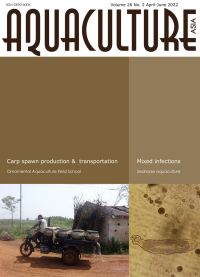
Aquaculture Asia Magazine, April-June 2022

In this issue:

  • Ornamental Aquaculture Field School: A new extension approach
  • State of the art of carp spawn production and transportation at Ramsagar, Bankura District, West Bengal, India
  • Seahorse aquaculture: A new paradigm of commercial activity
  • Mixed infections in tropical freshwater fish culture systems: A potential emerging threat for successful aquaculture
  • NACA Newsletter

Ornamental Aquaculture Field School: A new extension approach

The Farmer Field School approach is promoted by FAO as an alternative technology dissemination mechanism to the top-down extension methods in south-east Asian countries. In order to utilise the potential of the farmer field school approach for aquaculture, ICAR-CIFA has piloted Aquaculture Field Schools (AFS) in several states in India. AFS are schools without walls to improve the decision-making capacity of the farmers and facilitate cross-learning opportunities. It is a participatory extension methodology whereby fish farmers are allowed to choose the methods of aquaculture production through discovery-based approaches. 

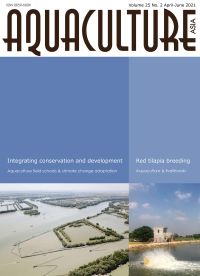
Aquaculture Asia Magazine, April-June 2021

In this issue:

Integrated taxonomy, conservation and sustainable development: Multiple facets of biodiversity; A note on 100th birth anniversary of the late Dr Hiralal Chaudhuri; Aquaculture field schools supporting mangroves for climate change adaptation of Indonesian milkfish-shrimp farmers; An insight to red tilapia breeding and culture: A farmer advisory; Aquaculture for livelihoods and food security in North-western India; NACA Newsletter.
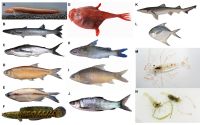
Integrated taxonomy, conservation and sustainable development: Multiple facets of biodiversity

Focussed explorations from the ICAR-National Bureau of Fish Genetic Resources (NBFGR), an organisation mandated for cataloguing of genetic resources of India include surveys of various ecosystems ranging from fauna of deep sea to the high-altitude regions of the Himalaya, falling under diverse biogeographic zones and unexplored regions of the country, including North-eastern India, Western Ghats, Lakshadweep and the Andaman and Nicobar Islands. This article describes the results of these efforts, which include discovery of 14 new fish species and six new distribution records between 2015 to 2020.

Report of the Nineteenth Meeting of the Asia Regional Advisory Group on Aquatic Animal Health

This report summarises the proceedings of the 19th meeting of the Advisory Group, held 26-27 November 2020 via video conference. The group's role includes reviewing disease trends and emerging threats in the region, identifying developments in global aquatic disease issues and standards, evaluating the Quarterly Aquatic Animal Disease Reporting Programme and providing guidance on regional strategies to improve aquatic animal health management.

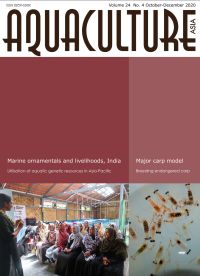
Aquaculture Asia Magazine, October-December 2020

In this issue:

Framework for participatory linkage of marine ornamentals germplasm conservation to livelihoods: Is community aquaculture an inclusive option? Induced breeding of farm-bred and pond-raised critically endangered peninsular carp, Hypselobarbus pulchellus; A way forward for utilisation of aquatic genetic resources in Asia-Pacific: Synthesis from deliberations during the Regional Workshop on Underutilized Fish and Marine Genetic Resources and their Amelioration 2019; Cast nets: The dominant active fishing gear in the Kashmir Valley; Moyna model of major carp farming in Purba Medinipur District, West Bengal, India; NACA Newsletter.
Framework for participatory linkage of marine ornamentals germplasm conservation to livelihoods: Is community aquaculture an inclusive option?

Exploratory surveys conducted on pristine reef islands has revealed hidden diversity with discovery of two shrimp species new to science, Periclimenella agattii and Urocaridella arabianensis and range extensions for Thor hainanensis and Argeiopsis inhacae. A hands-on training in marine ornamental shrimp rearing was organised at Agatti Island, Lakshadweep during March 2020 to develop a core mass of entrepreneurs to participate in community aquaculture. Another initiative has established a live germplasm resource centre for clownfish, which has ten species conserved in captivity. This facility also serves as a master breeding facility to produce seed for use in a community aquaculture program.

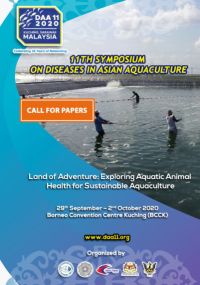
11th Symposium on Diseases in Asian Aquaculture, Kuching, Malaysia

The 11th Symposium on Diseases in Asian Aquaculture (DAA11) marks 30 years since the Fish Health Section - Asean Fisheries Society (FHS-AFS) establishment and it will be celebrated in Malaysia. Local hosts, the Department of Fisheries Malaysia (DOF) under the Ministry of Agriculture and Agro-based Industry together with the Ministry of Modernisation of Agriculture, Native Land and Regional Development Sarawak (MANRED) will be organising the event in cooperation with the FHS-AFS.

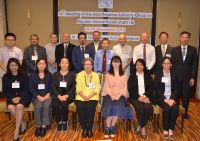
18th Meeting of the Asia Regional Advisory Group on Aquatic Animal Health

The Advisory Group (AG) is a body of technical experts that meets annually to provide advice to NACA member governments on aquatic animal health management. The group is drawn from academia, the private sector and government. The role of the AG is to review disease trends in the region, identify emerging threats and developments in global aquatic disease issues and standards, evaluate the Quarterly Aquatic Animal Disease Reporting Programme operated by NACA/FAO/OIE and regional governments, and to provide guidance on strategies to improve aquatic animal health management. This year’s meeting took place from 18-19 November at the Amari Don Muang Airport Hotel in Bangkok.

Report of the Seventeenth Meeting of the Asia Regional Advisory Group on Aquatic Animal Health

This report summarises the proceedings of the 17th meeting of the Advisory Group, held 13-14 November 2018 in Bangkok, Thailand. The group's role includes reviewing disease trends and emerging threats in the region, identifying developments in global aquatic disease issues and standards, evaluating the Quarterly Aquatic Animal Disease Reporting Programme and providing guidance on regional strategies to improve aquatic animal health management.

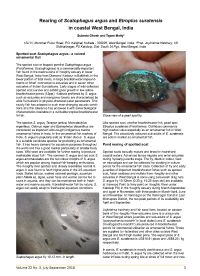
Rearing of Scatophagus argus and Etroplus suratensis in coastal West Bengal, India

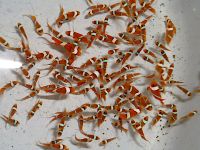
In the ornamental fish markets of India, the euryhaline spotted scat Scatophagus argus and pearlspot Etroplus suratensis are popularly sold as ornamental fish. This article describes the nursing of wild-caught spotted scat seed and in-pond breeding of pearlspot to produce marketable sized fish at the Joykrishna hatchery and fish seed farm, located in the Hooghly River estuarine zone in coastal West Bengal, India. The fish are reared in brackishwater ponds for commercial utilisation as ornamental fish, supplying Hyderabad and other cities.

Prospects of ornamental fish culture in seasonal water bodies of upper Assam

India’s share of the international ornamental fish trade is marginal but has been able to show consistent growth over the years. Of the total ornamental fishes traded by India, approximately 85% are native fishes sourced from the Western Ghats and North East India. The aquaculture of native fishes in seasonal water bodies can play a role in both conservation and generation of livelihoods. Imparting knowledge regarding ornamental fish trade and establishing market linkages is required to further develop the industry.

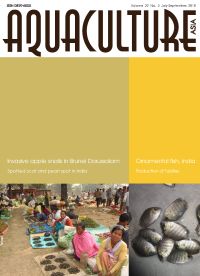
Aquaculture Asia Magazine, July-September 2018

In this issue:

Rearing of spotted scat and pearlspot in coastal West Bengal, India; harvesting Eurayle ferox (makhana) from wetland fisheries of Assam; prospects of ornamental fish culture in seasonal water bodies in Assam; production of tubifex, a new dimention in aquaculture in feeding juvenile fish; invasive apple snails in Brunei Darussalam; aquaculture trends and opportunities in Sindh, Pakistan; NACA Newsletter.

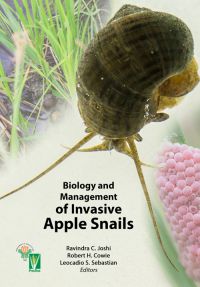
Biology and Management of Invasive Apple Snails

Apple snails have become a major pest of wetland rice in much of Southeast Asia. Two species are involved, Pomacea canaliculata and P. maculata. One or both of these species have become widely established not only in many parts of Southeast Asia but also in other parts of the world. This book provides an update on research into the biology, management and use of apple snails and highlights the need to prevent further spread of these species.