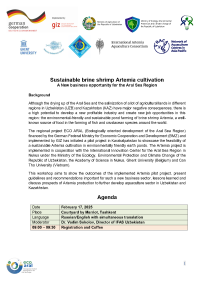
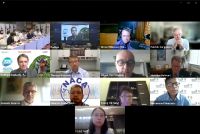
Although the drying up of the Aral Sea and the salinisation of a lot of agricultural lands in different regions in Uzbekistan (UZB) and Kazakhstan (KAZ) have major negative consequences, there is a high potential to develop a new profitable industry and create new job opportunities in this region: the environmental-friendly and sustainable pond farming of brine shrimp Artemia, a wellknown source of food in the farming of fish and crustacean species around the world. This workshop aims to show the outcomes of the implemented Artemia pilot project, present guidelines and recommendations important for such a new business sector, lessons learned and discuss prospects of Artemia production to further develop aquaculture sector in Uzbekistan and Kazakhstan.
The first ever IAAC conference was a free half day event held in Ostend, Belgium on 9 September, as a prelude to Larvi 2024, which ran from 9-12 September. The conference featured twelve presentations introducing the IAAC and providing an overview of many of the issues surrounding Artemia, including management of salt lakes habitats that still provide the bulk of global Artemia supplies, Artemia biodiversity, hatching optimisation, and aquaculture of Artemia biomass in tanks and ponds. Video recordings of most will be posted shortly (the programme below will be updated with links). Video recordings of the presentations are now available on the NACA YouTube channel.
The first IAAC Members’ Meeting was held in the afternoon following the IAAC Conference. The proceedings involved two panel discussions, by the Academic Sector and Private Sector respectively. The panels included remote members participating via Zoom.
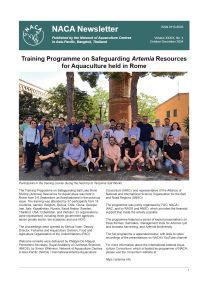
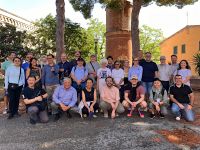
The Training Programme on Safeguarding Salt Lake Brine Shrimp (Artemia) Resources for Aquaculture was held in Rome from 2-6 September. The course was attended by 37 participants from 15 countries. The programme was jointly organised by FAO, NACA / IAAC, and by RAOS and ANSO, which provided the financial support that made the activity possible. The programme featured a series of expert presentations on three themes: Salt lakes, management tools for Artemia cyst and biomass harvesting, and Artemia biodiversity. The full programme is appended below, along with links to the video recordings of the presentations on NACA’s YouTube channel.
The first conference of the International Artemia Aquaculture Consortium (IAAC) will be organised on 9 September as part of the same premises as the Larvi '24 Conference, in Ostend, Belgium. This is a hybrid event, with participation possible both in person and online via Zoom. In the morning session (open to all larvi participants), the following IAAC members will give presentations: Yeong Yik Sung (Malaysia), Patrick Sorgeloos (Belgium), Simon Wilkinson (Thailand), Sui Liying (China), Stephanie De Vos (Belgium), Brad Marden (USA), Phil Brown (USA), Yathish Ramena (USA) and David Johanson (Belgium). A detailed programme will be available shortly. Participation in the IAAC conference is free, but people attending in person are requested to indicate your interest to attend it on the Larvi registration form. The Zoom link for virtual participants will be announced shortly.
5 June 2024 | Van Stappen, G., Sorgeloos, P. & Rombaut, G. (eds.) | 3448 Downloads
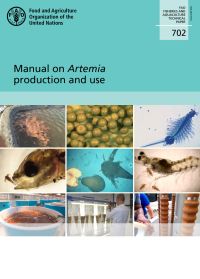
This FAO publication on brine shrimp is a manual for all those who are using Artemia or have an interest in this organism, whether as a source of live food in the hatchery, as a model organism in research, or for other purpose. It is intended for those who wish to update their knowledge on its biology, production or its use, but also for those who want to learn about Artemia for the first time. This manual presents in a concise form essential information on Artemia biology and the most important natural cyst resources that find their way to the aquaculture market. It also provides detailed information on general principles and practical procedures to produce Artemia in ponds and in tank systems. Finally, the manual offers a compilation of state-of-the-art guidelines and methodologies related to the use of this crucial live food organism in aquaculture.
Kingdom of Saudi Arabia joins NACA; Applications for the position of Director General, NACA; NACA awarded the Aziz-Ul Haq Rural Development Medal; Training Course on Risk Analysis in the Aquaculture Value Chain held in Bangkok; Free FAO publication: Genetic management of Indian major carps; 7th International Symposium on Cage Aquaculture in Asia; PhD scholarships: Shanghai Ocean University PhD Programme 2024; WAS Journal Special Issue: Global Conference on Aquaculture Millennium +20 Thematic Reviews; Seminar on Artemia Research and Production: Videos; Reported aquatic animal diseases in the Asia-Pacific Region during the first quarter of 2023.
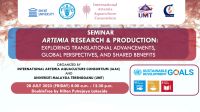
A Seminar on Artemia research and production was held on 28 July 2023 in Putrajaya, Malaysia, in conjunction with the first meeting of the International Artemia Aquaculture Consortium Steering Committee. Video recordings of the technical presentations are available below. The programme included: NACA's role with the International Artemia Aquaculture Consortium; Brine shrimp Artemia culture and research in Malaysia; Production and use of Artemia in Iran; UGent Laboratory of Aquaculture and Artemia Reference Center; AR-ARC actions towards sustainable utilization of Artemia resources; Artemia pond production: Pros and cons; and Feeding 9 billion by 2050: Embracing Artemia in nourishing a growing world
Artemia side event at the FAO Sub-Committee on Aquaculture, Mexico; Great Salt Lake Brine Shrimp Fishery Meets MSC’s Fishery Standard; Reported Aquatic Animal Diseases in the Asia-Pacific Region during the Fourth Quarter of 2022; Report of the 21st Asia Regional Advisory Group on Aquatic Animal Health; Thai Fish Project; NACA participates in Coordinating Working Parties on Fisheries Statistics; NACA signs MOU with Cagayan Valley R&D Consortium; Shrimp Summit, 24-26 July, Ho Chi Minh City, Vietnam.
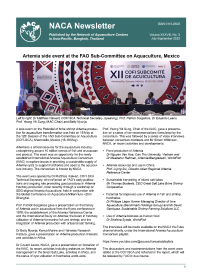
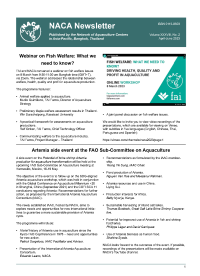
Webinar on fish welfare: What we need to know? Artemia side event at the FAO Sub-Committee on Aquaculture; Handbook for Artemia pond culture in Bangladesh; NACA YouTube channel: @aquacultureasia; Reported aquatic animal diseases in the Asia-Pacific region during the third quarter of 2022; 13th Asia-Pacific Marine Biotechnology Conference, 2-6 October 2023, Australia; Global Seafood Trade Fair, 28-30 June, Guangzhou, China.
On 28-29 November FAO and NACA collaborated on a virtual workshop to develop a regional strategy for aquatic organism health, using a progressive management pathway for improving aquaculture biosecurity. The workshop was held under the auspices of the project “Responsible use of fisheries and aquaculture resources for sustainable development component 3: Biosecurity and health management”. The workshop involved 31 experts from 16 countries, including national focal points, FAO and NACA. The objectives of the workshop were to: Present and analyse country responses to a self-assessment survey on biosecurity and health management capacity and performance; to provide guuidance to country participants on conducting a SWOT analysis; and to prepare a detailed plan for Phase II of the initiative.
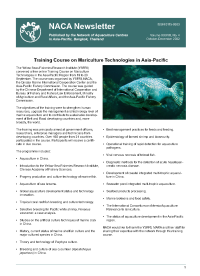
Training Course on Mariculture Technologies in Asia-Pacific; FAO/NACA Virtual Workshop on Aquaculture Transformation in Asia and the Pacific Region; Belt & Road Forum for International Freshwater Fishery Industry Innovation; 8th Global Conference on Gender in Aquaculture and Fisheries, 21-23 November; Reported Aquatic Animal Diseases in the Asia-Pacific Region during the First Quarter of 2022; International Training Course on Biology and Pathology of the Penaeid Shrimp 2022; Angkasa Putra inaugurated as first President of the South-East Asian Fisheries and Aquaculture Student Association; Artemia webinars: Video recordings of technical presentations available.
Dynamics of small-scale aquaculture development in India: A review; Green water technology as an essential support to larval rearing of hilsa shad; Collection of freshwater molluscs and sale of meat by women in Purba Medinipur, West Bengal, India; A success story of ornamental fish farming as a tool for alternative livelihood of tribal women in Keonjhar District, Odisha, India; Recent trends in seed production of stinging catfish, Heteropneustes fossilis, in India; NACA Newsletter.
Video recordings and the report of the webinar are now available. The International Artemia Aquaculture Consortium (IAAC) hosted a webinar on Management of the Artemia Resources of the Great Salt Lake, 5 May 2022, at 14:00 UTC. The purpose of the webinar was to familiarise participants with recent international developments in Artemia research cooperation, and to examine the Great Salt Lake as a case study in successful management of Artemia resources in a multi-stakeholder environment.
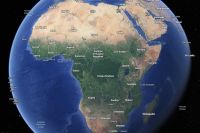
Video recordings and the report of the webinar are now available. The webinar, held on 4 May 2022, was necessitated by the fact that Artemia production has been ongoing on the continent for more than four decades, similar to Asia, but without any distinctive levels of success. Diverse levels of Artemia activities in different African countries were presented, to take stock of where the continent is, explore opportunities and address the various challenges impeding the production and utilisation of Artemia for improved livelihoods and overall aquaculture development in Africa.
Artemia remains a critical feed source for larval fish and crustaceans, underpinning the hatchery production phase for around 10 million tonnes of aquaculture. Yet around 90 percent of current Artemia cysts are wild harvested from salt lakes. There is a need to assure the sustainable supply of Artemia cysts to support hatchery production, from both wild and farmed sources. The International Artemia Aquaculture Consortium has been establihed to explore opportunities in the conservation of Artemia biodiversity, the development of science-based protocols for sustainable harvesting of wild sources, strain selection and selective breeding. NACA will host the consortium.
Annual consumption of Artemia is now estimated at 3,500 – 4,000 tonnes, underpinning the production of over 900 billion crustacean post larvae and fish fry. With approximately 90 percent of the current Artemia production harvested from inland salt lakes, the future of the hatchery industry could be at risk and requires urgent attention. The purpose of the workshop was to explore needs and opportunities for a new international initiative to guarantee a more sustainable provision of Artemia, both from natural sources and from controlled extractive Artemia farming integrated with salt production and other fish/crustacean aquaculture.