Better management practices

Improved management practices to generate better crop outcomes, environmental performance and profitability through improved resource utilisation efficiency.

Creative Commons Attribution.
Related

Subject tags

A collection of subject tags relating to technical matters.

In this collection

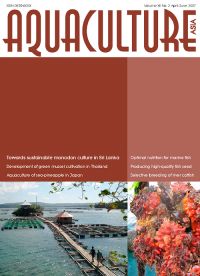
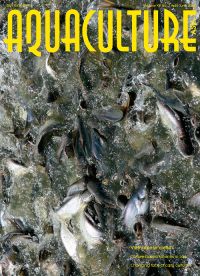
Aquaculture Asia Magazine, April-June 2008

In this issue:

From integrated carp polyculture to intensive monoculture in the Pearl River Delta, China. Better management practices for Vietnamese catfish. Ipomoea aquatica - an aquaculture friendly macrophyte. Status of fisheries and aquaculture development in Pakistan. The changing face of post-grad education in aquaculture: Contributing to soaring production and sustainable practices. Hatchery management in Bangladesh. Production of Cirrhinus molitorella and Labeo chrysophekadion for culture-based fisheries in Lao PDR and much more.

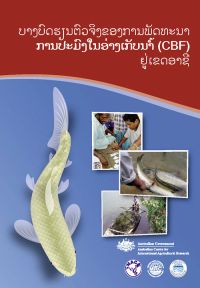
Better-practice approaches for culture-based fisheries development in Asia (Lao translation)

The primary objective of this manual is to provide guidelines for attaining better practices in culture-based fisheries, an emerging practice in rural areas in the Asian region. It deals will the principles of culture-based fishery practices, primarily based on relatively long-term experiences in Sri Lanka and Vietnam. It is not only targeted at researchers per se, but also at stakeholders at the grass root levels, as well as planners and policy developers.

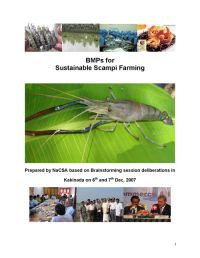
Better management practices for sustainable scampi (freshwater prawn) farming

This manual provides practical advice on good management practices for sustainable freshwater prawn (scampi) farming in India. The manual covers general principles of sustainable farming, relevant legal issues including for hatcheries, land and water use, impact on natural habitats, hatchery, nursery and growout management, and environmental and social responsibility. The manual was developed via a multi-stakeholder consultation held at the Head Office of the National Centre for Sustainable Aquaculture (NaCSA), Kakinada, 6-7 December 2007.

Guidelines for broodstock management, propagation and culture of semah, Tor douronensis and empurau, Tor tambroides

The Project 'Artificial propagation of empurau, Tor tambroides and semah, Tor douronensis, two species of commercial and conservation value to Sarawak, Malaysia' successfully achieved captive breeding and larval to fingerling rearing. An enhancement strategy for the long-term management of semah and empurau broodstock, and conservation of wild stocks, based on genetic findings is discussed. Guidelines on best husbandry management practices to ensure a supply of physically and genetically healthy quality seed are provided.

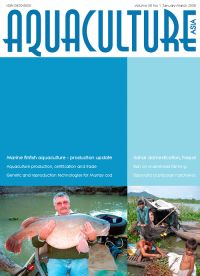
Aquaculture Asia Magazine, January-March 2008

In this issue:

Developing guidelines for sustainable freshwater aquaculture planning in Vietnam. Aquaculture production, certification and trade for small-scale farmers. Backyard hatcheries for crustaceans in Thailand. Alternative carp species for diversification in India. Genetic and reproduction technologies for aquaculture and fisheries management of Murray cod. Status of sahar domestication in Nepal. Comparative advantage analysis of shrimp production in Asia. Strategies to improve the livelihoods of the rural poor, Vietnam, and more.

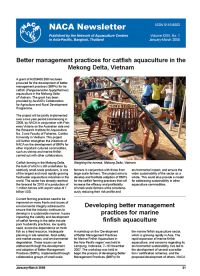
NACA Newsletter Volume XXIII, No. 1, January-March 2008

In this issue:

Better management practices for catfish aquaculture in the Mekong Delta, Vietnam. Developing better management practices for marine finfish aquaculture. Workshop on modelling carrying capacity for tropical finfish cage culture: Towards a consensus view. First comprehensive genetic management plan for Asian fish species: Mahseer. NACA and World Fisheries Trust sign agreement on collaboration. Fish Health Master Class. Second Workshop on Application of Molecular Genetic Techniques in Inland Fisheries and Aquaculture Management. Two new species of spiny eels described from Myanmar. Importance of species identification in conservation. Koh Yao Noi mangrove replanting in celebration of 80th birthday of His Majesty the King of Thailand. Responsible movement of live food finfish within ASEAN: Implementation workshop. Consultation on aquaculture certification guidelines. Strengthening regional mechanisms to maximise benefits to small-holder shrimp farmer groups adopting better management practices.

Guidelines for genetic management and conservation of empurau, Tor tambroides and semah, Tor douronensis

This document presents current status on genetic diversity of empurau and semah in Sarawak, Malaysia, including taxonomic status and a management guideline based on genetic data. Inadvertent mixing of the two species, especially during breeding, may lead to hybridisation, a threat to the genetic integrity of wild populations. Surveys on current status of genetic variability of empurau and semah are reported herein, and the results from which are used as baseline data for development of a genetic management plan.

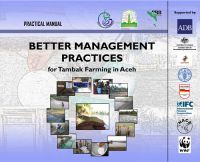
Practical Manual on Better Management Practices for Tambak Farming in Aceh

This practical manual provides better management practices for the farming of shrimp in tambak systems in Aceh, Indonesia. The manual addresses the formation of farmer groups, crop planning, and specifies better management practices. These include: Location of tambaks, design and construction of tambaks, pond preparation practices, shrimp seed selection and stocking practices, feed management practices, water management practices, health management practices, harvest and post-harvest handling practices, keeping records and improved marketing practices.

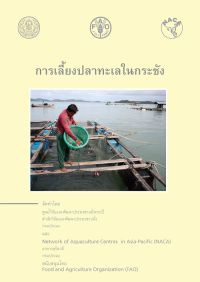
การเลี้ยงปลาทะเลในกระชัง (Training manual on marine finfish cage culture)

This training manual (in Thai language) provides guidance in marine finfish cage aquacutlure techniques. It is geared towards giving small-scale farmers a solid technical grounding that will enable them to improve their farm productivity and reduce losses through understanding of markets and economic factors, better farm siting. and improved feeding, handling and stock management practices. This knowledge will help the trainees and other fish farmers to improve their productivity and profitability while also reducing their risk profile.

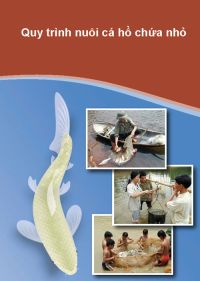
Quy trình nuôi cá hồ chứa nhỏ

Mục tiêu của cuốn sách nhằm cung cấp những chỉ dẫn cơ bản của CBF, một hình thức nuôi cá hiệu quả, đang được quan tâm nhiều ở các vùng nông thôn miền núi châu.

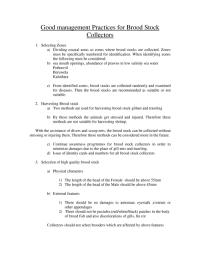
Good management practices for broodstock collectors

The National Aquaculture Development Authority of Sri Lanka (NAQDA) took several steps to regularise collectors of Penaeus monodon under the restructuring programme of the shrimp aquaculture industry in Sri Lanka. Regularisation of broodstock collectors is very imperative mitigate transmission of white spot disease. NAQDA developed these practices in consultation with the Department of Fisheries and Aquatic Resources, shrimp hatchery owners, broodstock suppliers, NARA, Wayamba environmental authority, Sri Lanka aquaculture development alliance and the consortium for shrimp aquaculture development.

Aquaculture Asia Magazine, April-June 2007

In this issue:

Sustainable black tiger shrimp farming in Sri Lanka. An economic analysis of Persian sturgeon stock enhancement. Aquaculture and environmental sustainability in Thailand: Food or financial security? Cage fish culture - successful income generation in manmade reservoir Kulekhani, Nepal. Diversification of rice farming alleviates poverty in a Bangladesh village. Sea-pineapple aquaculture in Japan. Green mussel cultivation in Thailand. Selective breeding for growh and fillet yield in Vietnamese catfish. Producing quality fish seed in rural Asia.

Presentations from The 3rd INDAQUA 2007, 11-13 January 2007, Chennai, India

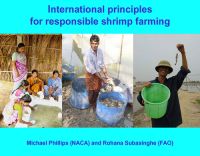
The Marine Products Export Development Authority (MPEDA) and the Network of Aquaculture Centres in Asia-Pacific (NACA) jointly hosted a special session on Better Management Practices (BMPs) at the 3rd INDAQUA 2007, 11-13 January 2007, Chennai, India. The presentations made in the session include i) International principles for responsible shrimp farming; ii) MPEDA-NACA Village demonstration programme, India; Aquaculture rehabilitation and implementation of BMPs in tsunami affected Aceh, Indonesia; and Markets, certification and traceability and small-scale farmers.

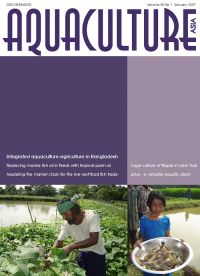
Aquaculture Asia Magazine, January-March 2007

In this issue:

Cage aquaculture of tilapia in Lake Taal, Philippines. Development and adoption of BMPs by farmer groups. Lotus - an aquatic plant of versatile qualities. Integrated aquaculture-agriculture systems in Bangladesh: Potential for sustainable livelihoods and nutrititional security of the rural poor. Spreadsheet model of the market chain for the live reef food fish trade. Regional Grouper Hatchery Production Training Course. Replacing marine fish oil in aquafeeds with tropical palm oil products. NACA Newsletter.

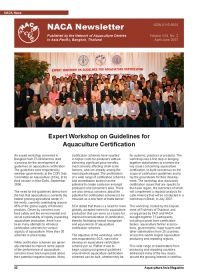
NACA Newsletter Volume XXII, No. 2, April-June 2007

In this issue:

Expert Workshop on Guidelines for Aquaculture Certification. Responsible movement of live food finfish within ASEAN: Cebu Workshop finalises the standard operating procedures. Information and capacity requirements for maintaining aquatic animal biosecurity identified. China-ASEAN efforts to minimise risk of spread of aquatic pathogens. National Centre for Sustainable Aquaculture inaugurated. NACA Better Management Practices program expands in Indonesia. Manual on Application of Molecular Tools in Aquaculture and Inland Fisheries Management. Research Needs to Sustain Asia-Pacific Aquaculture to 2025 and Beyond. Endemic freshwater finfish of Asia: Distribution and conservation status.

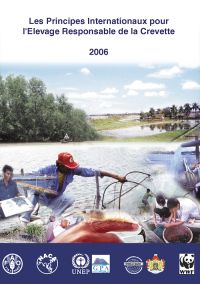
Principes Internationaux pour l'Elevage Responsable de la Crevette

L'élevage de la crevette est l’un des secteurs d'aquaculture le plus en essor dans beaucoup de régions du monde, il est également l’un des plus controversés. L'expansion rapide de ce secteur a généré, certes, des sources de revenus pour plusieurs pays, mais elle a été accompagnée par une préoccupation croissante sur les impacts environnemental et social. Les Principes Internationaux pour l'Elevage Responsable de la Crevette fournissent la base sur laquelle les parties prenantes peuvent collaborer pour un développement plus durable de l'élevage de crevette.

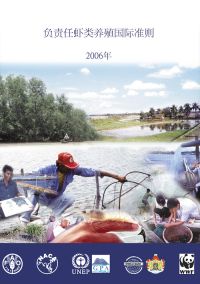
负责任虾类养殖国际准则

在世界许多地方,虾类养殖是水产养殖业增长最快,而且也是最具争 议的部门之一。这一部门的快速发展为许多国家创造了收入,但也伴随着 对环境和社会影响的忧虑。《负责任虾类养殖国际准则》在以更可持续的 方式发展虾类养殖方面为利益相关者之间开展合作提供了基础。《国际准 则》由虾类养殖与环境协作计划制定。该协作包括联合国粮食及农业组织 (粮农组织)、亚太水产养殖中心网、联合国环境规划署保护海洋环境免 受陆上活动污染全球行动纲领协调办公室、世界银行和世界自然基金会。

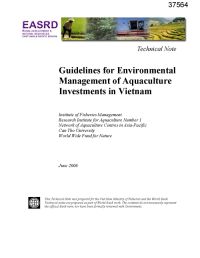
Guidelines for environmental management of aquaculture investments in Vietnam

This document provides an analysis of the environmental impacts and risks associated with aquaculture development in Viet Nam and guidance on better environmental management and monitoring for its future development. Part 1 provides a summary of the main findings, and guidelines for future development of the aquaculture sector. Part 2 provides the detailed case study findings. The guidelines presented in Part 1 are based on cases studies of all major aquaculture commodities in Viet Nam.

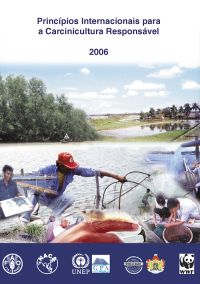
Princípios Internacionais para a Carcinicultura Responsável

O Cultivo de Camarão é um dos setores de mais rápido crescimento na aqüicultura em várias partes do mundo e também o mais controverso. A rápida expansão deste setor possibilitou a geração de renda para muitos países, entretanto, ela tem sido acompanhada por crescentes preocupações sobre seus impactos ambientais e sociais. Os Princípios Internacionais para a Carcinicultura Responsável provêm a base sobre a qual todas as partes interessadas poderão colaborar para um desenvolvimento mais sustentável do cultivo de camarão.

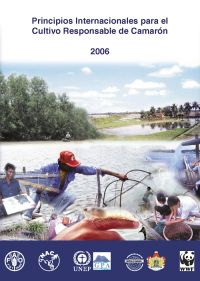
Principios Internacionales para el Cultivo Responsable de Camarón

El cultivo de camarón es uno de los sectores de la acuicultura de más rápido crecimiento y también uno de los más polémicos en muchas partes del mundo. La rápida expansión de este sector generó ingresos para muchos países, pero ha estado acompañada por preocupaciones crecientes relacionadas con sus impactos ambientales y sociales. Los Principios Internacionales para el Cultivo Responsable de Camarón proporcionan las bases sobre las cuales los diversos participantes pueden colaborar en pro de un desarrollo más sostenible de la camaronicultura.