Better management practices

Improved management practices to generate better crop outcomes, environmental performance and profitability through improved resource utilisation efficiency.

Creative Commons Attribution.
Related

Subject tags

A collection of subject tags relating to technical matters.

In this collection

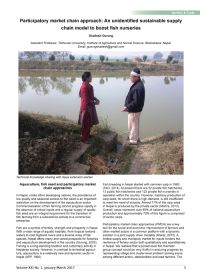
Participatory market chain approach: An unidentified sustainable supply chain model to boost fish nurseries

In Nepal, low quality and seasonal access to fish seed is an important restriction on the development of the aquaculture sector. Commercialisation of fish farming cannot progress rapidly in the absence of critical inputs and a regular supply of quality fish seed is an integral requirement for the transition of fish farming from a subsistence activity to a commercial enterprise. Participatory market chain approaches are a key tool for the social and economic improvement of farmers and market participants.

Regional consultation on responsible production and use of feeds in aquaculture

FAO, NACA and the Thai Department of Fisheries convened a Regional Consultation Responsible Production and Use of Feed and Feed Ingredients for Sustainable Growth of Aquaculture in Asia-Pacific in Bangkok, 7-9 March 2017. The objective of the consultation was to review the current status of aquaculture feed production and use, demand and supply, sourcing of ingredients, government policies and institutional support, ongoing progress and development gaps. The meeting brought together government and private sector representatives.

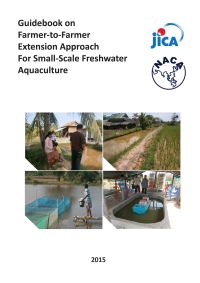
Development of a Guidebook on Farmer-to-Farmer Extension Approaches for Small-scale Aquaculture in the Asia-Pacific Region

The objectives of this project were to i) develop a guidebook in English on "Farmer-to-farmer extension approaches for small-scale aquaculture" and ii) to translate the developed guidebook into selected local dialects in Asia-Pacific and other regions (e.g. Africa). The project made use of the significant results from the JICA projects in Cambodia, Benin and other countries on farmer-to-farmer extension approaches on technology extension for small-scale farmers. The book is available in eleven languages (English, Arabic, Bahasa Indonesia, BurmeseFrenchKhmerLoatian, Malay, NepaliThai and Vietnamese.

Development of regional code of practice for movement of aquatic organisms in the lower Mekong basin

The objective of this project was to develop an agreed code of practice for the transboundary movement of aquatic organisms that feeds into the fisheries management strategy for the lower Mekong basin. The code of practice provides guidance on risk management and mitigation measures be taken into account for live aquatic animal imports or other transfers that are part of the established commercial practice, or those related to scientific study at research facilities.

Guidelines for hatchery production of Pa Phia fingerlings in Lao PDR

The objective of this manual was to provide basic guidelines for the hatchery production of Pa Phia (Labeo chrysophekadion) fingerlings. It includes information on managing and spawning broodstock, genetic guidelines, egg incubation, hatching larviculture and fry rearing. Although the guidelines were specifically developed for production of Pa Phia at government hatcheries in the Lao PDR, they may be applied to other, related, species and could be adopted and commercialised by the private sector hatcheries

Final Draft Code of Practice for Trans-boundary Movement of Aquatic Organisms in the Lower Mekong Basin

This Code of Practice is prepared to promote or ensure compliance to World Trade Organisation-Sanitary and Phytosanitary measures for the movement of live aquatic organisms in the Lower Mekong Basin. The goals of the Code are to achieve environmental protection and management, biodiversity conservation as well as prevention of spread of disease epizootics. Most of the points listed in this Code are based on the inputs of MRC Member Countries.

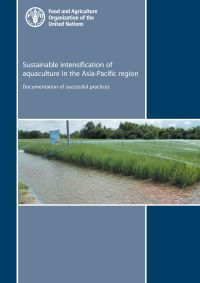
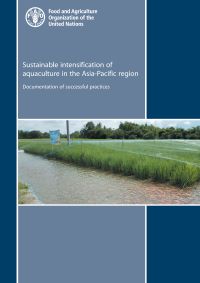
Sustainable intensification of aquaculture in the Asia-Pacific region: Documentation of successful practices

This publication is the major output of a regional programme jointly implemented by FAO and NACA in 2015 to document and disseminate successful practices that contribute to the sustainable intensification of aquaculture in the Asia-Pacific region. Twelve practices are described that contribute to at least one of the following: Improved production and resource use efficiency (land, water, feed, energy); improved environmental benefits; strengthened economic viability and farmers' resilience; and improved social acceptance and equity.

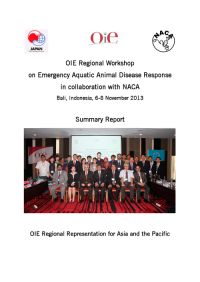
OIE Regional Workshop on Emergency Aquatic Animal Disease Response in Collaboration with NACA: Summary report

The workshop was held in Bali, Indonesia from 6 to 8 November 2013. The programme included reports on current aquatic animal disease situations in selected countries and presentations on the national aquatic animal health programmes of China, Japan and Korea. In addition, case studies on the molluscan diseases, shrimp diseases and finfish diseases were presented to facilitate the subsequent discussion on emergency response of those diseases in the national and regional level.

FAO support to small aquaculture farmers in Asia and the Pacific

Small aquaculture farm holders are experiencing some drastic changes, the shift from household consumption focused subsistent production to market oriented commercial production and external environment changes such as tightening governance on environment impacts control and resource allocation and increasingly stringent standard for food safety and quality. To adapt to the changes, the small-scale farmers need to intensify, diversify and commercialise production, which requires better management.

Implementation of better management practices through cluster management

Practices and people can be considered as two key ingredients to responsible aquaculture. Practices that are in conformity with national and international standards and requirements, ensure sustainability of the sector, ensure environment protection and integrity, enable social equity and respect ethical values and standards, consider human food safety concerns seriously and people who; are well informed, willing to change and ready to embrace practices for public good.

Aquaculture in a genetic plunge towards extinction?

Artisanal shrimp aquaculture is in a disease-induced crisis of lost production, into which are falling farms, gene pools adapted to farms, and small-hold farming as a way of life. Rising levels of inbreeding and an exceptionally strong, positive relationship between inbreeding and disease which is described here. The root cause is social: a nexus of human behavior in which breeders protect their intellectual property by generating inbreeding and farmers suffer the consequences.

Culture-based fisheries exchanges between Lao PDR and Cambodia

Under the ACIAR-funded project Culture-based fisheries development in Lao PDR and Cambodia a team from the Cambodian side of the project travelled to Lao PDR from 8-12 May. The exchange visits between the researchers and selected community leaders of both countries are a major component of the project, expected to facilitate networking and communication between the teams and to bring about an interchange of ideas and lessons learned.

NACA implements World Bank funded training program on good aquaculture practices

NACA was selected by the World Bank to implement a 6 day training program on "Good Aquaculture Practices" in Surabaya, Indonesia from 17-22 June 2013 under the on-going World Bank Global Food Safety Partnership initiative. The objective of this training was to deliver a certificate level food safety and supply chain management training program on design and implementation of good aquaculture practices through the supply chain including food safety management systems and HACCP.

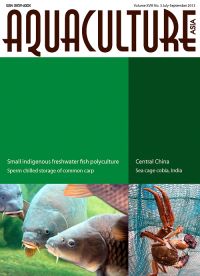
Aquaculture Asia Magazine, July-September 2013

In this issue:

A second trip to Hubei Province, central China. Sea cage growout of cobia Rachycentron canadum in the Gulf of Mannar. Culture of small indigenous fish species in polyculture with Indian major carps and high value crops along pond dykes. Study on sperm chilled storage of common carp Cyprinus carpio in Vietnam. Culture-based fisheries exchanges between Lao PDR and Cambodia. Culprit behind massive shrimp die-offs in Asia unmasked.

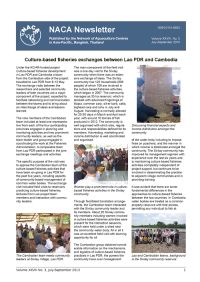
NACA Newsletter, Volume XXVIII, No. 3, July-September 2013

In this issue:

Culture-based fisheries exchanges between Lao PDR and Cambodia. Culprit behind massive shrimp die-offs in Asia unmasked. Presentations from the final technical consultation on EMS/AHPNS of shrimp available for download. Aquaculture certification workshop held in Viet Nam. Aquaculture in a genetic plunge towards extinction? NACA implements World Bank training program on Good Aquaculture Practices. Study tour on aquaculture and wetland management for delegation from Assam, India. Koh Yao Noi Tree Bank and mangrove replanting continues. Consistent fish names key to consumer confidence. We are hiring! Request for contributions: Global Advances in Ecology and Management of Golden Apple Snails (2nd edition).

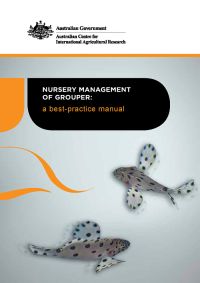
Nursery management of grouper: A best-practice manual

This manual provides practical guidelines for those engaged in the nursery culture of groupers in Indonesia as well as elsewhere in the tropics. It provides information on husbandry of groupers in the nursery phase, to reduce losses due to disease and cannibalism, and thus to increase the profitability of grouper nursing. The guidelines are derived from outcomes of ACIAR-funded research as well as other published information on grouper nursery management.

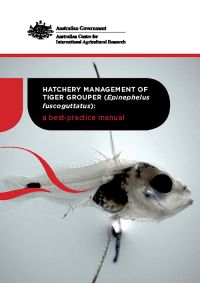
Hatchery management of tiger grouper (Epinephelus fuscoguttatus): A best-practice manual

This manual provides guidelines for the production of tiger grouper fingerlings. It outlines best-practice methods for broodstock maintenance, spawning, egg incubation and rearing of larvae through to 2–3 cm, fully metamorphosed juveniles. The guidelines have been developed from the outcomes of ACIAR-funded research, as well as from the experience of Indonesian, Philippine and Australian scientists and commercial hatchery operators, and published information. It provides an aid for improving the availability of grouper seed stock.

Public Sector Regulatory Systems for Ecosystems Based Management of Aquaculture - a GAP Analysis Tool

This document presents a tool in the form of an audit table that can be used to broadly screen and identify gaps in the management systems of government agencies responsible for regulating aquaculture. These gaps, once identified, can be a first step toward building regulatory frameworks that can better deliver on jurisdictional ecologically sustainable development and ecosystems approach to aquaculture objectives. The end product of an assessment is a report for consideration by decision makers.

Small farmers: Better practices and challenges in moving towards sustainability

Farmers organised as a cluster engage in collective planning, decision making and implementation of crop activities, using a participatory approach to accomplish their common goals. The evidence shows that if farmers can see benefits, particularly long-term benefits, they will change their farming practices under a variety of conditions and drivers. With provision of adequate support and services they can be part of the solution in moving aquaculture towards sustainability.

Regional Consultation on the Sustainable Intensification of Aquaculture in Asia-Pacific

The objective of the consultation was to develop a regional strategic policy framework to guide national governments and regional organisations in promoting sustainable intensification of aquaculture in the Asia-Pacific region. The consultation also identified priority actions and, where possible, practical measures for their implementation, focussing on intensifying aquaculture through more efficient use of resources and environmentally sound practices rather than by increasing inputs to the system.