Markets and trade

Content related to market access and trade issues.

Creative Commons Attribution.

Related

Subject tags

A collection of subject tags relating to technical matters.

In this collection

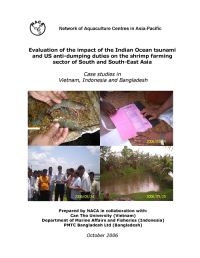
Evaluation of the impact of the Indian Ocean tsunami and US anti-dumping duties on the shrimp farming sector of South and South-East Asia

This report is the outcome of a study conducted by NACA to assess the impact of the 2004 Indian Ocean tsunami and of the introduction of US anti-dumping duties on the shrimp farming sectors of countries in the Asia-Pacific region, with special focus on the effect that these unusual events had on shrimp prices and stakeholders' livelihoods. The assessment was conducted by collecting data from a wide range of stakeholders involved with shrimp farming.

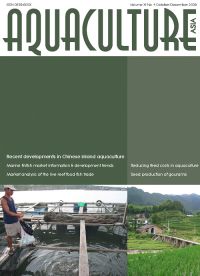
Aquaculture Asia Magazine, October-December 2006

In this issue:

Peter Edwards writes on rural aquaculture: Recent developments in Chinese inland aquaculture. Reducing feed costs in aquaculture: Is the use of mixed feeding schedules the answer for semi-intensive practices? Seed production technology of ornamental gouramis Colisa fasciata and C. lalia under captive conditions. Marine finfish market information and aquaculture development trends in selected locations in Indonesia and Malaysia. Market analysis of the live reef food fish trade.

Aquaculture in the Asia-Pacific and the outlook for mariculture in southeast Asia

This paper provides an overview of seafood consumption production in southeast Asia circa 2006. It forecasts a need for aquaculture to expand area under culture and intensity; highlights the potential for fishmeal to constrain growth, and identifies a trend towards cultivation of high-value species. Sources for the review included a regional synthesis of aquaculture developed for a regional workshop in 2005, a review of marine finfish hatchery development and a regional survey of cage fish culture.

Regional review on livelihood opportunities related to mariculture development

This report examines the role mariculture could play in reducing poverty and providing alternative livelihood opportunities for people living in coastal areas. This includes a review of the current status of coastal poverty, coastal livelihoods and vulnerabilities within the Asia-Pacific region and the experiences and examples of sustainable economic development through mariculture. This review then identifies key follow-up actions and recommends strategies for future pro-poor mariculture development.

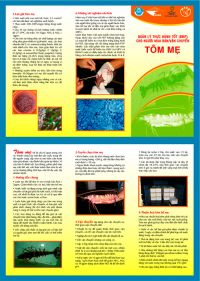
Leaflets on better management practices for Penaeus monodon in Vietnam

A series of leaflets on better management practices for Penaeus monodon shrimp aquaculture in Vietnam. The leaflets are available in both Vietnamese and English and cover: Broodstock management for suppliers, postlarvae selection and transportation for seed traders, shrimp seed quality, pond preparation, good pond management, shrimp health management.

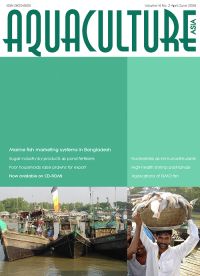
Aquaculture Asia Magazine, April-June 2006

In this issue:

High-health postlarvae a prerequisite for sustainability of the Indian shrimp industry. Broodstock and all-female scampi grow out ponds in south India. Genetically modified fish and potential applications. Rainbow trout farming in hill terraces of Nepal. Sugar industry by-products as plankton boosters and yield enhancers in carp culture. Growth and production of Penaeus monodon in low saline culture systems. Poor households raise prawns for export. Marine fish marketing in Bangladesh.

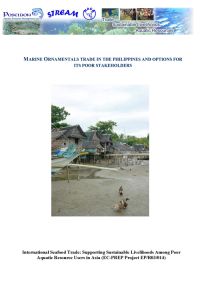
The international seafood trade: Marine ornamentals trade in the Philippines and options for its poor stakeholders

This report provides insight into the status of the marine ornamental fish trade in the Philippines, including policy environment, collection, distribution channels, markets and constraints. The report also reviews the livelihoods of poor stakeholders in market chains including economic and financial aspects, natural and physical resources, livelihood patterns, social structures. The report provides recommendations for policy makers and stakeholders in improving the livelihoods of poor stakeholders in marine ornamental fish collection and market chains and resource management.

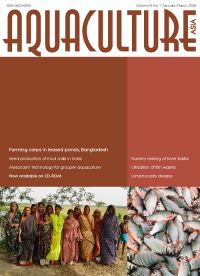
Aquaculture Asia Magazine, January-March 2006

In this issue:

Nursery rearing of silver barb Puntius goniotus. Artemia enrichment and biomasss production for larviculture. Seed production of mud crab Scylla serrata in India. Macrobrachium on the southwest coast of India. Fish wastes in urban and suburban markets of Kolkata: Problems and solutions. Groups of poor women farming carps in leased ponds, Bangladesh. Lymphocystis disease and diagnostic methods in China. Mesocosm technology advances grouper aquaculture in northern Australia.

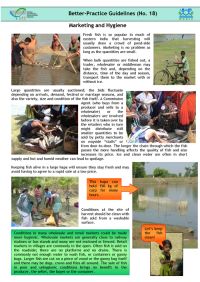
Better practice guidelines: Marketing and hygiene

Fresh fish is so popular in much of eastern India that harvesting will usually draw a crowd of pond side customers. Marketing is no problem so long as the quantities are small. When bulk quantities are fished out a trader, wholesaler or a middleman may take the fish and depending on the distance, time of the day and season, transport them to the market with or without ice.

The Indonesian ornamental fish trade: Case studies and options for improving livelihoods while promoting sustainability in Banggai and Banyuwangi

This report provides insight into the status of the marine ornamental fish trade in Indonesia, including policy environment, collection, chain of custody, distribution channels, markets and constraints. The report also reviews the livelihoods of poor stakeholders in market chains including economic and financial aspects, natural and physical resources, livelihood patterns, social structures. The report provides recommendations for policy makers and stakeholders in improving the livelihoods of poor stakeholders in marine ornamental fish collection and market chains.

The international seafood trade: The Vietnamese shrimp trade: Livelihoods analysis of stakeholders and market chain analysis

This report provides insight into the status of the shrimp trade in Vietnam, including policy environment, export capacity, production chain, distribution channels, markets and constraints. The report also reviews the livelihoods of poor stakeholders, including women, in shrimp market chains from input service supply, seed and broodstock supply, grow out, trade and processing. The report provides recommendations for policy makers and stakeholders in improving the livelihoods of poor stakeholders in shrimp market chains.
Aquaculture Asia Magazine, October-December 2005

In this issue:

Small-scale pond culture in Bangladesh. Issues and challenges in community-based aquaculture. Aquaculture as an action programme building confidence and self-worth. Transforming policy recommendations into pro-poor service provision. Grow out of spotted Babylon to marketable size in polyculture with seabass. Influence of economic conditions and global shocks on grouper markets. Status of cobia hatchery technology in Vietnam. Organic shrimp raceway system. Macrobrachium rosenbergii in Vembanad Lake. Management of monogenean parasites.

Report of the Study Program on Marine Aquaculture and Seafood Markets in Southern China

A study tour of seafood markets in southern China (Guangdong Province and Hong Kong SAR) was conducted in 2005. The programme provided participants with exposure to some of China's larges live marine seafood markets, provided insight on marine farming systems and management including major species and technologies, and provided participants with the opportunity to develop valuable business and scientific contacts with farmers, buyers, traders, industry groups and scientists.

Cultivo de Camarón y Medio Ambiente: Un programa en consorcio "Para analizar y compartir experiencias a fin de mejorar el manejo de la acuicultura de camarón en las áreas costeras"

Este reporte da detalles de las actividades y resultados del trabajo conducido bajo el Programa en Consorcio del Banco Mundial, NACA, WWF y FAO sobre “Cultivo de Camarón y el Medio Ambiente”. Este reporte sintetiza los resultados más importantes del programa del consorcio desde 1999 hasta marzo de 2002. Incluye los resultados de los talleres de usuarios que discutieron los resultados del programa, auspiciados por el Banco Mundial en Washington, DC, en marzo de 2002. 

Economics of better management practices for semi-intensive shrimp farms in Honduras and shrimp cooperatives in Nicaragua

Several stakeholder groups have formulated and recommended the implementation of better management practices (BMPs)aimed at improving production efficiency and/or ameliorating impacts of shrimp farming on the environment. In this study, an economic optimisation model with an environmental component was used to evaluate the effects of five specific BMPs on the profitability, optimal selection of management strategies, and net quantities of nutrients discharged by semi-intensive shrimp farms in Honduras and small-scale operations in Honduras and Nicaragua.

Aquaculture Development Beyond 2000: The Bangkok Declaration and Strategy

The main output of the International Conference on Aquaculture in the Third Millennium. The Declaration summarises the key impediments and opportunities in aquaculture development that are likely to arise over the next 20 years and provides strategic policy guidance for sustainable aquaculture development. The Declaration was adopted by conference participants in a plenary session.

Aquaculture Asia Magazine, October-December 2004

In this issue:

Captive breeding of vulnerable Indian carp Cirrhinus reba for conservation. Conservation of the Asiatic catfish Clarias batrachus through artificial propagation. A perspective on breeding and genetics of walking catfish in Thailand. Decline of wastewater-fed aquaculture in Hanoi. Artificial propagation of indigenous Tor species in Malaysia. Aquaculture of spotted babylon Babylonia areolata. First successful hatchery production of Napoleon wrasse Cheilinus undulatus. Trade and market trends in the live reef fish trade.

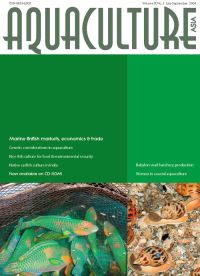
Aquaculture Asia Magazine, July-September 2004

In this issue:

Genetic considerations in fisheries and aquaculture with regards to biodiversity. Rice-fish culture for food and environmental security. Land-based aquaculture of spotted babylon Babylonia areolata in Thailand: Hatchery-based seedling operation. Shrimp health question and answer. Women in coastal aquaculture. Insights into live marine food fish markets in Asia. Farming practices, market chains and prices of marine finfish in Malaysia, Indonesia and Hong Kong.

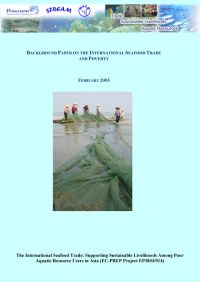
The international seafood trade: Supporting sustainable livelihoods among poor aquatic resource users in Asia

The purpose of this report is to provide an overview of the international seafood trade and poverty, with special reference to the trade in some selected marine products between Asia and the European Union. It represents Output 1 of the project “The International Seafood Trade: supporting sustainable livelihoods among poor aquatic resource users in Asia”, which was funded by the European Community's Poverty Reduction Effectiveness Programme (EC-PREP).

Aquatic resources in the Philippines and the extent of poverty in the sector

This report presents an overview of the state of aquatic resources in the Philippines, its performance and importance in the Philippine economy, and explores the situation of poverty in the "aquatic resources sector." The report describes the policy environment that guides the action of key actors in the sector. A general analysis of some trends in relation to factors that keep the poor from participating and benefiting from aquatic resource management is also provided.