Food Security, Safety and Certification

Food safety is a key concern for international trade in fish products. The constantly changing regulatory environment and safety requirements of importing countries pose a special challenge to small-scale aquaculture producers.

The programme assists members to assure the safety and quality of aquaculture products through the adoption of science-based better management practices. Policy issues concerning aquaculture certification and activities in market access are also addressed.

The programme focuses on assisting small-scale farmers to adapt to the changing trade and safety environment. Cluster-based management approaches and formation of farmer societies are promoted as practical mechanisms for implementation of better management practices.

Key activities

  • Evaluation of commodity-specific better management practices for meeting domestic and international food safety standards.
  • Facilitating establishment of national residue testing and monitoring programmes and sharing of information amongst member countries.
  • Improving access to markets by small-scale farmers.
  • Improving market development for low-cost aquaculture commodities.
  • Address biosecurity and associated human health issues regarding the consumption of fish and processed products.
  • Development of farmer groups and cluster-based certification concepts and methodologies.

Creative Commons Attribution.

Related

Subject tags

A collection of subject tags relating to technical matters.

In this collection

Report of the Seventeenth Meeting of the Asia Regional Advisory Group on Aquatic Animal Health

This report summarises the proceedings of the 17th meeting of the Advisory Group, held 13-14 November 2018 in Bangkok, Thailand. The group's role includes reviewing disease trends and emerging threats in the region, identifying developments in global aquatic disease issues and standards, evaluating the Quarterly Aquatic Animal Disease Reporting Programme and providing guidance on regional strategies to improve aquatic animal health management.

FAO and NACA to convene Global Conference on Aquaculture 2020

FAO and NACA have signed an agreement to convene a global conference on aquaculture in 2020. This will be the fourth conference in a series that began at the dawn of the industry in Kyoto, 1976. Aquaculture 2020 will be held late in the year in China. Arrangements, programme and partner details will be announced via the NACA website in due course.

Why fish and aquaculture?

Video presentation on the rationale for increased fish production and consumption.

First training course on culture-based fisheries held in Nha Trang, Vietnam

The first ever Regional Training Course on Culture-based Fisheries in Inland Waters was held at Nha Trang University from 30 October to 8 November. The objective of the course was to provide participants with the skills to assist local communities to plan and manage culture-based fisheries. These practices are an example of a relatively simple and low cost technology that can deliver nutritional and economic benefits to rural communities, which often have few livelihood options.

NACA Newsletter, Vol. XXXII, No. 3, July-September 2017

In this issue:

28th NACA Governing Council, Dhaka, Bangladesh; register for the First Regional Training Course on Culture-based Fisheries; 11th Indian Fisheries and Aquaculture Forum, Kochi, 21-24 November; audio recordings for regional feed consultation now available; tilapia lake virus; Proceedings of the International Symposium on Aquatic Animal Health and Epidemiology for Sustainable Asian Aquaculture; ICAR-CIBA launch "Vanami Shrimpapp", a mobile app on Pacific white shrimp (Penaeus vannamei) farming; Pakistan officials train on aquaculture certification.

NACA Newsletter, Vol. XXXII, No. 1-2, January-June 2017

In this issue:

The 15th meeting of the Asia Regional Advisory Group on Aquatic Animal Health; a regional consultation on responsible production and use of feed in aquaculture; a report on the Giant Prawn 2017 conference; a preview of the new NACA website; and new initiatives on a very serious emerging issue - reducing the human and animal health risks from development of anti-microbial resistance in the aquaculture industry.

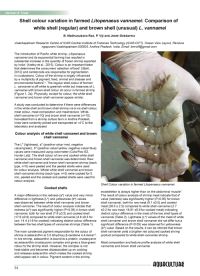
Shell colour variation in farmed Litopenaeus vannamei: Comparison of white shell (regular) and brown shell (unusual) L. vannamei

The regular shell colour of farmed Litopenaeus vannamei is off-white to greenish-white but instances of L. vannamei with brown-shell colour do occur in farmed shrimp. A study was conducted to determine if there were differences vis-à-vis shell colour, meat colour, meat composition and meat texture. White-shelled vannamei was determined to be better in terms of meat composition and texture profile but brown-shelled vannamei yielded a more brightly red-coloured cooked product.

Certification of fishmeal and fish oil in aquaculture feed production and utilisation

Due to the recent increase in aquaculture and the rising demand for marine ingredients for use in pelleted feeds, there is concern that aquaculture is contributing to the over-exploitation of fishing stocks. There is a growing need for aquaculture enterprises to be able to demonstrate responsible practices, including the source of any marine ingredients used in the compound feed. Responsible sourcing can be demonstrated by purchashing ingredients that have been approved under the IFFO RS standard.

Traceability of aquaculture products in relation to feed and feed ingredients

Concerns about the health and safety of consumers are the driving force for the enforcement of traceability systems for aquaculture products. DOF's strategy to improve food safety related to shrimp production is a “Farm-to-Table” approach. This has been implemented through the development of a Code of Conduct for the marine shrimp industry, establishment of Good Aquaculture Practices for hygienic shrimp production, and documentation requirements for movement of chemical agents and purchase of aquatic animals.

Perspectives on culture-based fisheries developments in Asia

This book is the proceedings of the “Regional Consultation on Culture-Based Fisheries Development in Asia”, held in Siem Reap, Cambodia, 21-23rd of October 2014, under the auspices of the Australian Centre for International Agricultural Research (ACIAR), the Mekong River Commission (MRC) and the Network of Aquaculture Centres in Asia-Pacific (NACA). The consultation was jointly organised by NACA and the Fisheries Administration of the Royal Government of Cambodia.

12th Technical Advisory Committee held in Cha-am, Thailand

The twelfth meeting of NACA’s Technical Advisory Committee (TAC) was held in the coastal town of Cha-am, Thailand from 9-12 March. The TAC meets every two years to review NACA’s rolling work programme and propose amendments to realign it with the current needs of member governments and to account for new and emerging issues. In proposing changes, the TAC prioritises issues of common concern to member governments where there are prospects for regional collaboration.

A further development of inland aquaculture: Toward poverty alleviation and food security in rural areas

Many attempts to extend small-scale inland aquaculture have been made so far in many parts of Asia and some parts of Africa. According to lessons learnt from these experiences, stable seed production is the most decisive factor to develop freshwater fish farming in poor rural areas. Seed production technology, with ensuring the supply of good quality brood stock, should firmly be built. Seed production will be highly commercialised, contributing to a growth of local economy.

NACA implements World Bank funded training program on good aquaculture practices

NACA was selected by the World Bank to implement a 6 day training program on "Good Aquaculture Practices" in Surabaya, Indonesia from 17-22 June 2013 under the on-going World Bank Global Food Safety Partnership initiative. The objective of this training was to deliver a certificate level food safety and supply chain management training program on design and implementation of good aquaculture practices through the supply chain including food safety management systems and HACCP.

Aquaculture Asia Magazine, July-September 2013

In this issue:

A second trip to Hubei Province, central China. Sea cage growout of cobia Rachycentron canadum in the Gulf of Mannar. Culture of small indigenous fish species in polyculture with Indian major carps and high value crops along pond dykes. Study on sperm chilled storage of common carp Cyprinus carpio in Vietnam. Culture-based fisheries exchanges between Lao PDR and Cambodia. Culprit behind massive shrimp die-offs in Asia unmasked.

NACA Newsletter, Volume XXVIII, No. 2, April-June 2013

In this issue:

Call for applications (2nd round): FK Norway South-South Aquaculture Professional Exchange Programme. AFSPAN field surveys underway! 4th Global Symposium on Gender in Aquaculture and Fisheries. An anti-viral treatment for healthier black tiger prawns. Jungle perch on the comeback trail. Nursery management of grouper: A best-practice manual (Indonesian translation). Hatchery management of tiger grouper (Epinephelus fuscoguttatus): A best-practice manual (Indonesian translation). Priority adaptations to climate change for Pacific fisheries and aquaculture: Reducing risks and capitalising on opportunities. Improving biosecurity through prudent and responsible use of veterinary medicines in aquatic food production.

Aquaculture sustainability: Towards 2030

To provide food to the world’s population in 2050, it has been estimated that agricultural output, primarily from crops, livestock and fisheries, including aquaculture, must increase by 60 percent. Intensification of aquaculture is inevitable in the face of increasing demand, limited land areas, and improved technology. Whether we are able to accomplish this in a sustainable manner will depend on global governance and stewardship as much as on technological progress.

NACA Newsletter, Volume XXVII, No. 4, October-December 2012

In this issue:

Outcomes of emergency consultation on shrimp early mortality syndrome / AHPNS. Workshop on Aquaculture Planning and Management Tools. Workshop on Proficiency Testing Programme for Aquatic Animal Disease Diagnostic Laboratories in Asia-Pacific. AFSPAN Project gets underway.

Proceedings of the Global Conference on Aquaculture 2010

The Global Conference on Aquaculture 2010 reviewed the present status and trends in aquaculture development, addressed emerging issues relevant to aquaculture development, assessed opportunities and challenges for future aquaculture development and built consensus on advancing aquaculture as a global, sustainable and competitive food production sector. This volume provides information on how aquaculture could be mobilized to alleviate global poverty and improve food and nutrition security in the coming decades.

Self-use manual on group formation and group certification of small-scale aqua-farmers

This manual is intended for the use by the current and prospective small-scale farmer groups who are interested in obtaining accreditation for their production process. The objective is to provide them an easy-to-follow, stepwise guide that can be used as a practical tool in their venture of attaining group certification. However, this can be used by the field extension officers and certifiers who are directly involved in the process or other interested parties.

Aquaculture Asia Magazine, October-December 2011

In this issue:

Visit to the AwF funded small-scale aquaculture project in Nepal. Success story of the Barakhandapat Ornamental Fish Breeding Unit, India. From Kyoto 1976 to Bangkok 2000 and Phuket 2010: Aquaculture development and personal transitions. Embryonic and larval development of Waigieu seaperch Psammoperca waigiensis. Culture feasibility of freshwater mullet Rhinomugil corsula in ponds in India. Management in seed production of an endangered catfish Horabagrus brachysoma during its hatchery phase.