4 July 2022 | A. Paul, B. Baral, Samikshya Parida, D. Naveen Naik and P.K. Sahoo | 4718 Downloads | .pdf | 1.5 MB
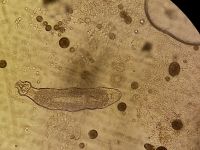
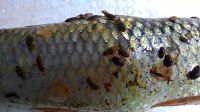
The aquatic environment contains many opportunistic pathogens and fish are frequently infected by a range of parasites, bacteria, viruses, and fungi. In most incidences of disease, the involvement of two or more pathogens are often seen, which in turn complicates diagnosis and treatment. Here we present a few case studies on mixed infections in aquaculture systems, which may become more common in future due to changing climatic patterns and associated adverse impacts on water quality. Mixed infections seem to be a big challenge to diagnostic laboratories and health specialists in terms of providing a correct diagnosis and treatment.
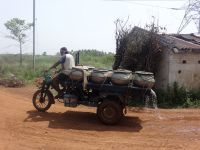
For the last five decades or so, West Bengal has been the leading state in India for the production of production and supply of major carp fry, underpinning the success of freshwater fish culture. This article describes the structure of the hatchery industry in Ramsagar, West Bengal, production practices and systems, packing, transport and links to major seed markets both within the state and elsewhere in India. Market price, broodstock management and natural breeding methods are also discussed.
23 June 2022 | S.K. Swain, H.K. De, G.S. Saha, B.N. Paul, S.N. Sethi and S.S. Giri | 1729 Downloads | .pdf | 1.01 MB
The Farmer Field School approach is promoted by FAO as an alternative technology dissemination mechanism to the top-down extension methods in south-east Asian countries. In order to utilise the potential of the farmer field school approach for aquaculture, ICAR-CIFA has piloted Aquaculture Field Schools (AFS) in several states in India. AFS are schools without walls to improve the decision-making capacity of the farmers and facilitate cross-learning opportunities. It is a participatory extension methodology whereby fish farmers are allowed to choose the methods of aquaculture production through discovery-based approaches.
17 May 2022 | Fish Health Section of the Asia Fisheries Society | 3412 views | .jpg | 210.17 KB
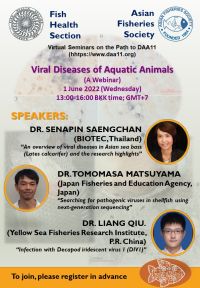
The Fish Health Section of the Asian Fisheries Society is inviting you to a Zoom Webinar on Viral Diseases of Aquatic Animals, 1 June at 13:00 Bangkok time (GMT +7).
With the implementation of the new aquatic animal disease reporting in the Asia Pacific region from January 2021, and in lieu of the published QAAD Reports (last issue published was 4th quarter of 2020), NACA is publishing reported aquatic animal diseases submitted by countries in the Asia-Pacific region. This report covers the fourth quarter of 2021 and the original and updated reports can be accessed from the QAAD page.
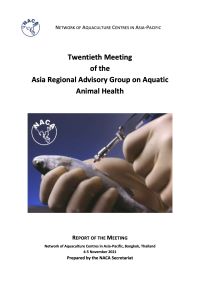
This report summaries the proceedings of the 20th meeting of the Regional Advisory Group on Aquatic Animal Health, held 4-5 November 2021. The meeting discussed: Progress on NACA’s Asia Regional Aquatic Animal Health Program; updates from the OIE Aquatic Animal Health Standards Commission; aquaculture biosecurity; Progressive Management Pathway for Improving Aquaculture Biosecurity activities relevant to Asia; a systematic approach for quantifying biosecurity measures in aquaculture; aquatic animal health strategy; updates on the OIE Regional Collaboration Framework on Aquatic Animal Health; and updates on the QAAD Reporting and Disease List.
Exploration of canal resources as a potential source for fish production in the Indian Sundarbans; Expansion of new host range of isopod Tachaea spongillicola infestation to fish species could pose a risk to aquaculture food industry in southeast Asian countries; Aspects of air-breathing fish farming practiced at Mathurapur-II Block, West Bengal, India; Magical role of live foods in boosting spawn survival of climbing perch: A success in the farmer’s field; NACA Newsletter.
7 March 2022 | D.N. Chattopadhyay, S. Adhikari, B.N. Paul, R.N. Mandal, G.S. Saha, B.R. Pillai and S.K. Swain | 1682 Downloads | .pdf | 3.81 MB
Climbing perch inhabit water bodies ranging from fresh to brackish waters across a wide range of environments, and are widely distributed throughout south and southeast Asia through to southern China. In India it is prized both as a foodfish and as a traditional medicinal food. This article describes the induced breeding of climbing perch and the interaction of scientists and farmers to improve survival of larvae and fry in through the use of live feeds (rotifer) in small-scale hatcheries in India.
7 March 2022 | Subrato Ghosh and Pulakesh Purkait | 2037 Downloads | .pdf | 4.95 MB
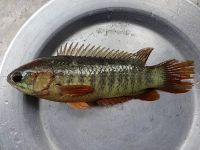
Climbing perch Anabas testudineus is a high-priced fish, nutritious and economically profitable for small- to medium-scale fish farmers, who can obtain fry from local paddy fields and low-lying inundated areas in late summer, monsoon and post-monsoon periods. Climbing perch is a facultative air-breathing fish that is able to move between water bodies by undertaking short migrations overland. This article describes techniques for climbing perch and major carp aquaculture, including use of biofloc systems, preparation of live feeds including mealworms, and some concerns regarding the hybridisation of native Indian strain of A. testudineus with an imported Vietnamese strain.
Our article in the journal Aquaculture highlighted the first record of the isopod Tachaea spongillicola infesting wild fish species of aquaculture importance, particularly of carps. T. spongillicola was first recorded in freshwater sponges, 114 years ago and later recorded infesting freshwater prawns. Our recent study has further recorded infestation of this isopod in wild fish species. The expansion of host range from freshwater sponges to freshwater prawns and now to freshwater fish could pose a risk to aquatic industries in the years to come. We hypothesise that climate change could be a major factor contributing towards the expansion of the host range of parasites.
3 March 2022 | Archana Sinha, Aparna Roy, Pranab Gogoi, Tasso Tayung, Mitesh. H. Ramteke, Arunava Mitra, Subhendu Mondal and Basanta Kumar Das | 1192 Downloads | .pdf | 2.15 MB
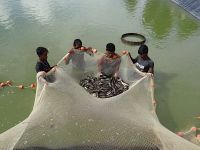
Fisheries is next to agriculture in offering employment opportunities for poor rural communities in Sundarbans. With around 17 million hectares of canals in India, there is considerable potential to generate jobs and improve the food security of rural populations if canals can be used for aquaculture production. This study explored the feasibility of aquaculture as a secondary use of canal infrastructure through use of net barrier partitions, installed and managed by local communities.
With the implementation of the new aquatic animal disease reporting in the Asia Pacific region from January 2021, and in lieu of the published QAAD Reports (last issue published was 4th quarter of 2020), NACA is publishing reported aquatic animal diseases submitted by countries in the Asia-Pacific region. This report covers the third quarter of 2021. The original and updated reports are available from the QAAD page.
A free virtual seminar series will be held from 13-17 December, hosted by the Freshwater Fisheries Research Center, Chinese Academy of Fisheries Sciences, in partnership with NACA and the Chinese Ministry of Agriculture and Rural Affairs. The seminar will be held via Zoom. It will give participants a background in aquatic resource conservation practices, recommend options for sustainable aquaculture farming systems with potential for intensification with intervention strategies, and build a communication and experience exchange platform for information dissemination and future collaboration. Participation is free. Registration closes 10 December.
Habitat breeding and seed rearing of a near threatened featherback, Chitala chitala; Wild seed collection and modified-extensive farming of Mystus gulio in inland water bodies of South 24 Parganas, West Bengal; Freshwater pearl culture practices and challenges in India; Next generation probiotics: Future therapeutics for sustainable aquaculture; NACA Newsletter.
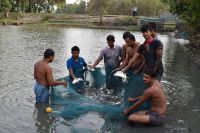
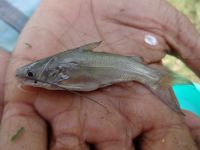
The cultivable small- to medium-sized bagrid catfish Mystus gulio is an estuarine species sold as a high-priced food fish in retail markets in cities and towns of southern West Bengal. M. gulio is a good addition to mixed species culture-based fisheries in canals in the Indian Sundarbans region. It adapts and grows well in freshwater ponds and is recommended for freshwater fish culture in areas of the Sundarbans vulnerable to saline water intrusion. This article describes the seed collection, nursery and grow-out practices of M. gulio as practiced in modified-extensive mixed culture systems in West Bengal, India.
The humped featherback, Chitala chitala is considered to be one of the most commercially important food, sport, aquarium and highly priced cultivable fish in Assam. However, over exploitation, habitat degradation and pollution has caused wild populations to decline in recent decades, to the point where the species is categorised as Near Threatened on the IUCN Red List. Here we present the biological aspects of breeding and larval rearing protocols of the humped featherback, which has been prioritised as a new candidate species for freshwater aquaculture in India. The information will also aid in stock enhancement and conservation of this species.
With the implementation of the new aquatic animal disease reporting in the Asia Pacific region from January 2021, and in lieu of the published QAAD Reports (last issue published was 4th quarter of 2020), NACA will be reporting aquatic animal diseases that are occurring or present in the countries of the region, on quarterly basis. This report covers the first and second quarters of 2021 and the original and updated reports are also available.
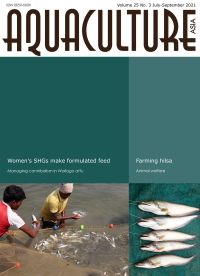
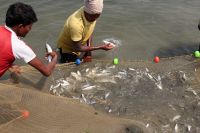
Opinion: Benefits of animal welfare in Indian aquaculture; Imparting skill on formulated fish feed preparation to women’s self-help groups in villages – an experience; Farming of the anadromous shad, Tenualosa ilisha: Signs of taking off in India; Some facts on cannibalism in Wallago attu and its management during captive seed production; NACA Newsletter.
Wallago attu is a large catfish reaching 45 kg found in the Indian subcontinent, Thailand, Vietnam, Cambodia and Indonesia. Early attempts at captive production encountered high losses due to cannibalism during early life stages. This article discusses the causative factors governing cannibalism in this catfish, including rapid transfer from live to commercial feed, size differences during stocking, seasonal changes, feeding at long intervals, high density rearing, feed distribution, feeding method and size of feed, and management strategies for minimising losses during the seed rearing period.
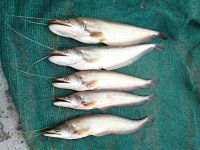
The andadromous shad Tenualosa ilisha (also known as hilsa) is an economically important food fish in south and southeast Asia. Populations of the species are declining globally, largely due to overexploitation and habitat modification. Its fishery has drastically declined in the Bay of Bengal bordering India. Considering the excessive demand and very high market price there have been efforts for domestication and farming of the species in India. Early efforts were not measurably successful. However, momentum on developing captive breeding and farming technologies for this species has been re-invigorated with research funding from the Indian Council of Agricultural Research.