Freshwater finfish

Information relating to aquaculture of freshwater finfish.

Creative Commons Attribution.

Related

Species / commodity tags

Major farmed commodity or species groups.

In this collection

Aquaculture Asia Magazine, July-September 2017

In this issue:

Regional network on culture-based fisheries and stock enhancement; trout fisheries in the uplands of Arunachal Pradesh - resources and opportunities; empowering young Indian women through entrepreneurship development - opportunities and constraints; a view on murrel (snakehead) fisheries in India; hybrid catfish Clarias batrachus x Heteropneustes fossilis produced by farmers in West Bengal, India; Backyard fish based pig farming using low-cost feed in Arunachal Pradesh - a success story; NACA Newsletter.

Backyard fish-based pig farming using low-cost feed in Arunachal Pradesh: A success story

In the north-east hill region of India, integrated fish farming is one of the best alternatives for improving livelihoods as most of the houses in rural areas have access to ponds and livestock. Among livestock, pigs are a popular choice, particularly for the tribal population of the region, who account for a major portion of the population. Pigs can fit into diverse systems of management, and can be reared on a wide variety of waste materials.

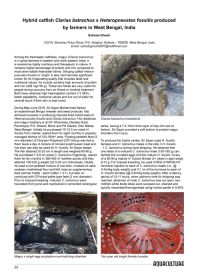
Hybrid catfish Clarias batrachus x Heteropneustes fossilis produced by farmers in West Bengal, India

Among the freshwater catfishes, magur (Clarias batrachus) is in great demand in eastern and north-eastern India; it is revered as highly nutritious and therapeutic in nature. During May-June 2016, Sri Sayer Mohammad Sarkar, an experienced magur breeder and seed producer, has achieved success in producing induced-bred hybrid seed of Heteropneustes fossilis and Clarias batrachus. His breeding protocol and experiences in nursery and growout of hybrid catfish are shared in this article.

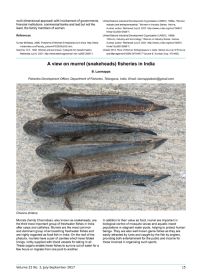
A view on murrel (snakehead) fisheries in India

Murrels (snakeheads) are the third most important group of freshwater fishes in India after carps and catfishes. Murrels are the most common and dominant group of air breathing freshwater fishes and are highly regarded as food fish. Murrels have a pair of cavities in the pharynx that have folded linings, richly supplied with blood vessels for taking in air. These organs enable these fishes to survive out of water for a few hours or migrate from one pool to another.

Emergency Regional Consultation for Prevention and Management of Tilapia Lake Virus in the Asia-Pacific

Since 2009, tilapia aquaculture has been threatened by mass die-offs in Israel and Ecuador, which have been caused by a novel Orthomyxo-like (RNA) virus named Tilapia lake virus. This has been reported as a newly emerging virus that causes syncytial hepatitis of tilapia. An emergency regional consultation was held in Guangzhou, China from 27-28 September 2017 to discuss and plan actions on the overall prevention and management of this disease.

Trout fisheries in the uplands of Arunachal Pradesh: Resources and opportunities

The potential for augmentation of fish production and fish-based eco-tourism in Arunachal Pradesh are immense. The landscape of the state is characterised by lofty mountains with snow-clad peaks, dense forests, turbulent streams and a rich diversity of flora and fauna. We review the potential of some of the lakes in the region to support trout fisheries for both recreational fishing and eco-tourism, with a view to providing job opportunities for highland communities.

NACA Newsletter, Vol. XXXII, No. 3, July-September 2017

In this issue:

28th NACA Governing Council, Dhaka, Bangladesh; register for the First Regional Training Course on Culture-based Fisheries; 11th Indian Fisheries and Aquaculture Forum, Kochi, 21-24 November; audio recordings for regional feed consultation now available; tilapia lake virus; Proceedings of the International Symposium on Aquatic Animal Health and Epidemiology for Sustainable Asian Aquaculture; ICAR-CIBA launch "Vanami Shrimpapp", a mobile app on Pacific white shrimp (Penaeus vannamei) farming; Pakistan officials train on aquaculture certification.

Quarterly Aquatic Animal Disease Report, January-March 2017

The 73rd edition of the Quarterly Aquatic Animal Disease Report contains information from 14 governments. The foreword provides a disease advisory on tilapia lake virus (TiLV), an emerging threat to farmed tilapia in the Asia-Pacific region.

Tilapia lake virus (TiLV): Literature review

Tilapia lake virus (TiLV) is an emerging infectious agent that has recently been identified on three continents. While the link between TiLV and disease outbreaks in Israel and Thailand are well documented, further investigations are being undertaken to determine the significance of TiLV in the other countries. This report summarises the available scientific information on TiLV, including clinical signs, diagnostics and epidemiology. Infection with TiLV in tilapia populations may result in socio economic losses and impacts on food security.

Certificate Degree Programme on Sustainable Asian Aquaculture at AIT

The Asian Institute of Technology (AIT) is launching a new Certificate programme on Sustainable Asian Aquaculture via the AARM Academic programme, for one semester beginning August 2017. This certificate programme is a combination of well-designed course work and hands-on experience in specialised areas (fish/shrimp hatchery or farming). The programme is useful for both students (with credit transfer) and for working professionals and entrepreneurs (without credits).

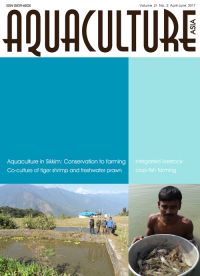
Aquaculture Asia Magazine, April-June 2017

In this issue:

Inspiring story of aquaculture in Sikkim - a journey from conservation to farming; farming of scampi and tiger shrimp together - a case study from West Bengal; Labeo pangusia - a candidate for diversification of hill aquaculture; sustainability of an integrated livestock-fish-crop farming system as a small scale enterprise; sustainable coastal aquaculture in India; potential scope and prospects of domestic fish market in Chhattisgarh.

Editorial: Tilapia lake virus (TiLV)

Tilapia lake virus (TiLV) is a relatively recent pathogen causing serious mortalities in farmed tilapia. The virus appears to be spreading via the usual pathway of importation of live fish with inadequate regard for biosecurity protocols. Countries that are at risk should establish surveillance for TiLV. Unusual tilapia mortalities should be investigated. Importation of live tilapia should probably be reconsidered until adequate biosecurity arrangements are in place. Links to some recent advisories and publications are provided.

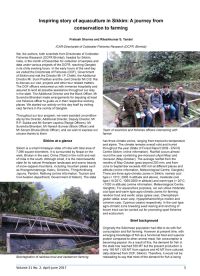
Inspiring story of aquaculture in Sikkim: A journey from conservation to farming

Sikkim is a small Himalayan state of India with three climatic zones ranging from tropical to temperate to alpine. The moderate-cool and warm agro-climatic zones are suitable for farming rainbow trout and exotic carp species, while brown trout hatchery and ranching can be conducted in the alpine areas. We report on the status of exotic carp and trout farming in Sikkim including farming practices, constraints faced by local farmers and possible solutions.

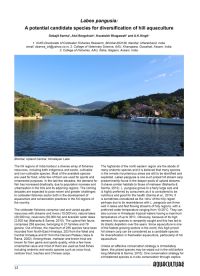
Labeo pangusia: A potential candidate species for diversification of hill aquaculture

Labeo pangusia is a highly prized hill stream carp found mainly in the deeper pools of upland streams. Heavy fishing pressure has led to depletion of wild populations in recent years and the species is likely to become threatened if a conservation strategy is not developed. We report on an investigation into the reproductive biology of this species and on the result of successful induced breeding trials.

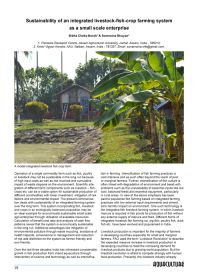
Sustainability of an integrated livestock-fish-crop farming system as a small-scale enterprise

We examined the sustainability and economic viability of a model integrated livestock-fish-crop farming system developed by the Fisheries Research Centre, Assam Agricultural University, over an extended period of 13 years. The system was developed as an ecologically sustainable alternative technology for small and margin farmers. It incorporates two livestock components, pig and poultry, with horticulture and carp polyculture. Analysis of cash flow and benefit-cost ration revealed the system to be economically sustainable over the long term.

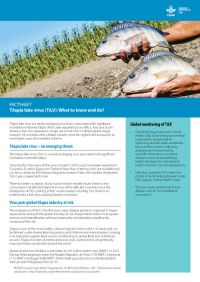
Fact sheet: Tilapia lake virus (TiLV): What to know and do?

Tilapia lake virus is a newly emerging virus that is associated with significant mortalities in farmed tilapia. This fact sheet describes the threat to industry, clinical signs, diagnosis, risk factors, prevention and control options and actions that must be taken to minimise the impact of this disease on the global tilapia aquaculture industry. All countries with a tilapia industry must be vigilant and act quickly to investigate cases of mortalities in farms.

Urgent update on possible worldwide spread of tilapia lake virus (TiLV)

Recently, we released a warning of TiLV in Thailand and an improved RT-PCR detection methodology. The Fish Health Platform in Centex, BIOTEC/Mahidol University has also obtained positive test results for TiLV in other Asian countries where it has not yet been reported. Many countries have been translocating tilapia fry/fingerlings prior to and even after the description of TiLV. We have prepared a map listing countries with confirmed reports of TiLV infections and 43 other countries that we believe have imported infected fish.

Tilapia lake virus (TiLV) - a novel Orthomyxo-like virus

This disease card published by the World Organisation for Animal Health (OIE) provides information about tilapia lake virus (TiLV), a recently observed pathogen causing significant mortalities in cultured tilapia. The disease card provides details of the pathogen, modes of transmission, host range, geographical distribution, clinical signs, diagnostic methods, socio-economic significance, transmission risk and a list of available references. We urge laboratories to test for TiLV when abnormal tilapia mortalities occur.


Disease advisory: Tilapia lake virus - an emerging threat to farmed tilapia in the Asia-Pacific region

Tilapia lake virus (TiLV) is an emerging disease of cultured tilapia in the Asia-Pacific region. Originally observed and reported in Israel, Ecuador, Colombia and Egypt, TiLV is now confirmed in cultured tilapia in Thailand causing mass mortalities. At risk is here is the US$7.5 billion global industry per annum, especially among the top tilapia-producing countries in the region including China, the Philippines, Thailand, Indonesia, Lao PDR and Bangladesh. This advisory describes signs of the disease and PCR detection methods.

Aquaculture Asia Magazine, January-March 2017

In this issue:

Anti-microbial resistance in aquaculture; participatory market chain approaches to boost fish nurseries; traditional community fishing practices of rural Assam; practical significance of restricted feeding regimes in aquaculture; Bangana dero: A potential indigenous fish species for diversification of carp culture; shell colour variation in farmed Litopenaeus vannamei: Comparison of white- and brown-shelled shrimp; culture-based fisheries: A low-tech, greenhouse friendly approach to improving food and income for Cambodian families.