Jharkhand, India, has a significant population of tribal people, around 28% of the state's 33 million. Agriculture is the main livelihood and subsistence-level farming is predominant, offering limited opportunities for employment to landless people for most of the year. This article documents the experience of the Jharkhand Department of Fisheries in developing cage-based aquaculture as an alternative livelihood for tribal fishers that had been displaced by the construction of reservoirs, working in association with fisher collectives.
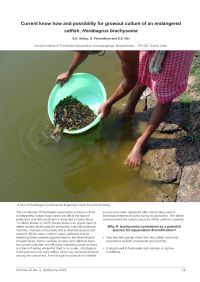
Some varieties of freshwater fish have low growth potential but remain economically attractive due to market preferences. The endangered catfish Horabagrus brachysoma is one such fish, which has limited production but high market demand, and a number of favourable biological characteristics. This article provides guidelines for the culture of this catfish in captivity including for the breeding, nursery, stocking and growout, including advice on pre- and post-stocking practices, harvesting and health management.
22 March 2018 | Network of Aquaculture Centres in Asia-Pacific | 3292 Downloads | .pdf | 3.45 MB
This report summarises the proceedings of the 16th meeting of the Advisory Group, held 26-27 August 2017 in Bali, Indonesia. The group's role includes reviewing disease trends and emerging threats in the region, identifying developments in global aquatic disease issues and standards, evaluating the Quarterly Aquatic Animal Disease Reporting Programme and providing guidance on regional strategies to improve aquatic animal health management. The meeting included discussion on Tilapia Lake Virus (TiLV) and developments in antimicrobial resistance.
The American Fisheries Society and the Environmental and Water Resources Institute of the American Society of Civil Engineers are holding this year's annual Fish Passage conference in Australia in December in collaboration with hosts Charles Sturt University and the New South Wales Government. The International Conference on River Connectivity, to be held in Albury from December 10 to 14 includes the First International Symposium on Hydropower and Fish Management.
Despite their abundance at one time in India and other Asian nations, wild mahseer populations have been declining because of degradation of aquatic ecosystems, urbanisation and indiscriminate fishing. Wild mahseer are populations are presently struggling for their mere existence.
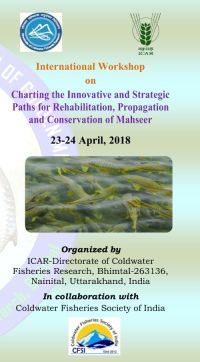
An international workshop on mahseer conservation, propagation and rehabilitation will be held in Bhimtal, India from 23-24 April 2018. The workshop is organised by the ICAR-Directorate of Coldwater Fisheries Research in collaboration with the Coldwater Fisheries Society of India.
BRAQCON 2019 wil cover latest research and development in the broader themes of the conference in the form of special sessions, contributed papers, expert group discussions and brainstorming on issues facing aquaculturists and ecosystem managers in India and around the world. The conference themes include: Brackishwater ecosystems, estuarine biodiversity and conservation; aquaculture production systems; larviculture; fish and shellfish nutrition; environment and climate change; aquatic animal health; socio-economic and livelihood issues; and aquaculture genetics and biotechnology.
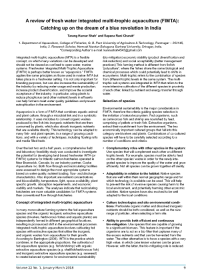
13 March 2018 | Tarang Kumar Shah and Sapana Rani Charak | 5219 Downloads | .pdf | 546.14 KB
Integrated multi-trophic aquaculture is a flexible concept, on which many variations can be developed and should not be viewed as confined to open-water, marine systems. Freshwater integrated multi-trophic aquaculture, perhaps better known as aquaponics, applies the same principles as those used in marine integrated multi-trophic systems. In particular, using plants to reduce phosphorus (and other nutrient) levels in effluents can help farmers meet water quality guidelines and prevent eutrophication in the environment.
This collection contains video recordings of the lectures from the Regional Training Course on Culture-based Fisheries in Inland Waters, held at Nha Trang University, Vietnam. The objective of the course was to provide participants with the skills to assist local communities to plan and manage culture-based fisheries; a relatively simple and low cost technology that can deliver nutritional and economic benefits to rural communities with few livelihood options. The course was sponsored by the United Nations University Fisheries Training Programme.
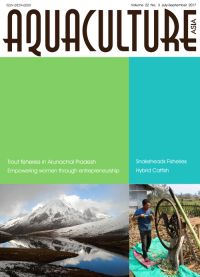
Regional network on culture-based fisheries and stock enhancement; trout fisheries in the uplands of Arunachal Pradesh - resources and opportunities; empowering young Indian women through entrepreneurship development - opportunities and constraints; a view on murrel (snakehead) fisheries in India; hybrid catfish Clarias batrachus x Heteropneustes fossilis produced by farmers in West Bengal, India; Backyard fish based pig farming using low-cost feed in Arunachal Pradesh - a success story; NACA Newsletter.
In the north-east hill region of India, integrated fish farming is one of the best alternatives for improving livelihoods as most of the houses in rural areas have access to ponds and livestock. Among livestock, pigs are a popular choice, particularly for the tribal population of the region, who account for a major portion of the population. Pigs can fit into diverse systems of management, and can be reared on a wide variety of waste materials.
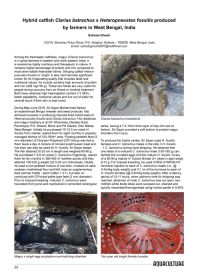
Among the freshwater catfishes, magur (Clarias batrachus) is in great demand in eastern and north-eastern India; it is revered as highly nutritious and therapeutic in nature. During May-June 2016, Sri Sayer Mohammad Sarkar, an experienced magur breeder and seed producer, has achieved success in producing induced-bred hybrid seed of Heteropneustes fossilis and Clarias batrachus. His breeding protocol and experiences in nursery and growout of hybrid catfish are shared in this article.
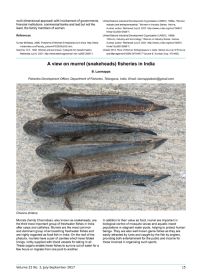
9 October 2017 | B. Laxmappa | 4173 Downloads | .pdf | 4.41 MB
Murrels (snakeheads) are the third most important group of freshwater fishes in India after carps and catfishes. Murrels are the most common and dominant group of air breathing freshwater fishes and are highly regarded as food fish. Murrels have a pair of cavities in the pharynx that have folded linings, richly supplied with blood vessels for taking in air. These organs enable these fishes to survive out of water for a few hours or migrate from one pool to another.
Since 2009, tilapia aquaculture has been threatened by mass die-offs in Israel and Ecuador, which have been caused by a novel Orthomyxo-like (RNA) virus named Tilapia lake virus. This has been reported as a newly emerging virus that causes syncytial hepatitis of tilapia. An emergency regional consultation was held in Guangzhou, China from 27-28 September 2017 to discuss and plan actions on the overall prevention and management of this disease.
3 October 2017 | Deepjyoti Baruah, K. Kunal, D. Sarma, A.K. Singh, Kabang Kamut and P.K. Thungon | 3181 Downloads | .pdf | 2.7 MB
The potential for augmentation of fish production and fish-based eco-tourism in Arunachal Pradesh are immense. The landscape of the state is characterised by lofty mountains with snow-clad peaks, dense forests, turbulent streams and a rich diversity of flora and fauna. We review the potential of some of the lakes in the region to support trout fisheries for both recreational fishing and eco-tourism, with a view to providing job opportunities for highland communities.
28th NACA Governing Council, Dhaka, Bangladesh; register for the First Regional Training Course on Culture-based Fisheries; 11th Indian Fisheries and Aquaculture Forum, Kochi, 21-24 November; audio recordings for regional feed consultation now available; tilapia lake virus; Proceedings of the International Symposium on Aquatic Animal Health and Epidemiology for Sustainable Asian Aquaculture; ICAR-CIBA launch "Vanami Shrimpapp", a mobile app on Pacific white shrimp (Penaeus vannamei) farming; Pakistan officials train on aquaculture certification.
The 73rd edition of the Quarterly Aquatic Animal Disease Report contains information from 14 governments. The foreword provides a disease advisory on tilapia lake virus (TiLV), an emerging threat to farmed tilapia in the Asia-Pacific region.
13 July 2017 | Mona Dverdal Jansen and Chadag Vishnumurthy Mohan | 8942 Downloads | .pdf | 830.05 KB
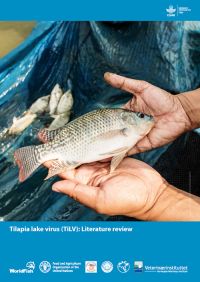
Tilapia lake virus (TiLV) is an emerging infectious agent that has recently been identified on three continents. While the link between TiLV and disease outbreaks in Israel and Thailand are well documented, further investigations are being undertaken to determine the significance of TiLV in the other countries. This report summarises the available scientific information on TiLV, including clinical signs, diagnostics and epidemiology. Infection with TiLV in tilapia populations may result in socio economic losses and impacts on food security.
Aquaculture Asia Magazine is an autonomous publication that gives farmers and scientists in developing countries a voice. Stories concern the small-scale aquaculture prevalent in the region and the circumstances of farmers trying to make ends meet in an increasingly globalised world. We accept articles on any aspect of aquaculture and the related processing, marketing, economic, environmental and social issues. An RSS feed is available if you wish to stay informed of new issues.
NACA frequently organises technical workshops and consultations on aspects of aquaculture. The proceedings of such meetings are made available for free download. Audio and video recordings of technical presentations are also available for some meetings (please see the podcast section).