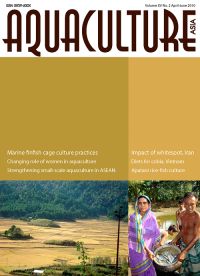
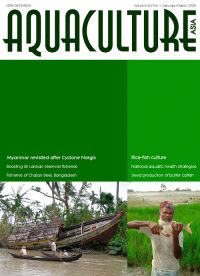
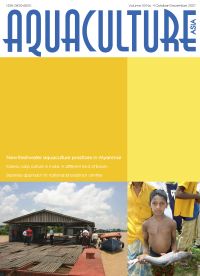
The Dedanaw Project, Myanmar. The changing face of women for small-scale aquaculture in Bangladesh. Strengthening capacity of small holders in ASEAN. Carp seed production in Orissa, India. Sustainable mountain paddy-fish farming of the Apatani tribes. The economic impacts of whitespot virus on shrimp production in Iran. Current practices of marine finfish cage culture in China, Indonesia, Thailand and Vietnam. Effects of trash fish on growth and body composition of cobia.
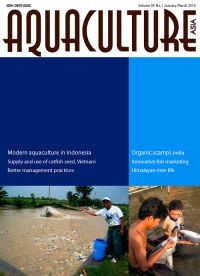
Development of modern aquaculture in Java, Indonesia. Better management practices - gateway to sustainability. Update on organic scampi aquaculture in Andhra Pradesh. Domestic fish marketing in south India. Seed rearing of catfish Clarias batrachus. Supply and use of catfish Pangasianodon hypopthalmus seed in the Mekong Delta. Risk analysis and sustainability of catfish seed in the Mekong Delta. Life of a river in the Himalaya: Ecological study of the Trisuli River, Nepal and more.
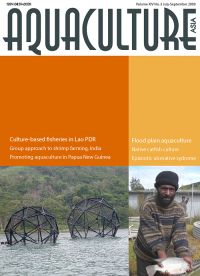
Community management and revenue sharing practices of culture-based fisheries in Lao PDR. Floodplain aquaculture in Bangladesh. Promoting small-scale inland aquaculture in Papua New Guinea. Group approaches to shrimp farming: The key to sustainability. Native catfish culture - a technology package for farmers. Influence of salinity in the growth of the black clam Villorita cyprinoides. EUS in Asia and Africa. Offshore opportunities for artisinal aquaculture. Grouper aquaculture in Brazil. NACA Newsletter.
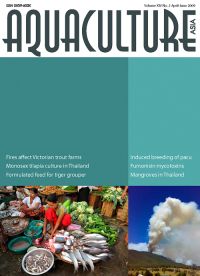
GLOBALGAP standard in Thai shrimp farms: Mission (im)possible? The Victorian trout industry and the bushfires. Small-scale aquaculture in the Ayeyarwady Delta, Myanmar. The history, status and future prospects of monosex tilapia culture in Thailand. Mangroves of Nakhon Si Thammaarat Province in Souther Thailand. Induced breeding of pacu Piaractus brachypomus in captivity. Fumosins - mycotoxins of increasing importance in fish. Microsatellite DNA markers, a fisheries perspective. Formulated feed for tiger grouper grow out.
Myanmar revisited. Harvesting, traditional preservation and marketing of fishes of Chalan Beel, Bangladesh. Role of community in production and supply of larger, quality fingerlings. Can rice-fish farming provide food security in Bangladesh? Nutritional and food security for rural poor through multi-commodity production from a lake of eastern Uttar Pradesh. Emerging boost in Sri Lankan reservoir fish production. Farming the freshwater prawn Macrobrachium malcolmnsonii. Breeding and seed production of catfish Ompok pabda.
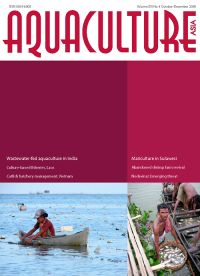
An increasingly secure future for wastewater-fed aquaculture in Kolkata, India? First culture-based fisheries growth cycle in Lao PDR is overhwelmingly encouraging. Revival of abandoned shrimp farms in Andhra Pradesh. Growth of industries linked with aquaculture in Kolleru Lake area, India. Applications of nutritional biotechnology in aquaculture. Technical and management aspects of catfish hatcheries in Vietnam. Asian seabass farming. Mariculture development opportunities in southeast Sulawesi, and much more.
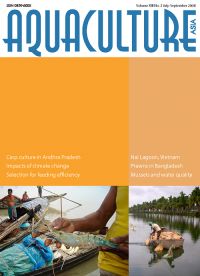
Possible improvements to carp culture in Andhra Pradesh. Aquaculture and environmental issues in the region of Nai Lagoon, Vietnam. Selection potential for feed efficiency in farmed salmonids. Freshwater prawn broodstock concern in Bangladhesh hatcheries. Production of Cirrhinus molitorella and Labeo chrysophekadion for culture-based fisheries in Lao PDR: Nursery and grow-out. Mussel farming: Alternate water monitoring practice. Use of poultry by-product meals in pelleted feed for humpback grouper Cromileptes altivelis.
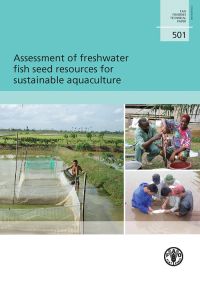
17 April 2008 | Melba G. Bondad-Reantaso (ed.) | 6469 Downloads | .pdf | 9.61 MB
This publication contains the proceedings and major recommendations of the expert workshop which tackled three major themes: Seed quality, genetics, technology and certification; seed networking, distribution, entrepreneurship and certification; and how rural fish farmers can benefit from the seed sector. It also contains the outcomes of a desk study consisting of three regional syntheses, twenty-one country case studies and five thematic reviews (seed quality, genetics and breeding, seed networks, role of seed supply, farmer innovations and womens' involvement).
From integrated carp polyculture to intensive monoculture in the Pearl River Delta, China. Better management practices for Vietnamese catfish. Ipomoea aquatica - an aquaculture friendly macrophyte. Status of fisheries and aquaculture development in Pakistan. The changing face of post-grad education in aquaculture: Contributing to soaring production and sustainable practices. Hatchery management in Bangladesh. Production of Cirrhinus molitorella and Labeo chrysophekadion for culture-based fisheries in Lao PDR and much more.
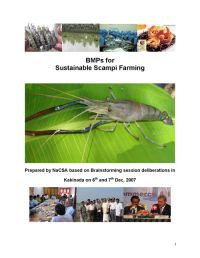
This manual provides practical advice on good management practices for sustainable freshwater prawn (scampi) farming in India. The manual covers general principles of sustainable farming, relevant legal issues including for hatcheries, land and water use, impact on natural habitats, hatchery, nursery and growout management, and environmental and social responsibility. The manual was developed via a multi-stakeholder consultation held at the Head Office of the National Centre for Sustainable Aquaculture (NaCSA), Kakinada, 6-7 December 2007.
The Project 'Artificial propagation of empurau, Tor tambroides and semah, Tor douronensis, two species of commercial and conservation value to Sarawak, Malaysia' successfully achieved captive breeding and larval to fingerling rearing. An enhancement strategy for the long-term management of semah and empurau broodstock, and conservation of wild stocks, based on genetic findings is discussed. Guidelines on best husbandry management practices to ensure a supply of physically and genetically healthy quality seed are provided.
Developing guidelines for sustainable freshwater aquaculture planning in Vietnam. Aquaculture production, certification and trade for small-scale farmers. Backyard hatcheries for crustaceans in Thailand. Alternative carp species for diversification in India. Genetic and reproduction technologies for aquaculture and fisheries management of Murray cod. Status of sahar domestication in Nepal. Comparative advantage analysis of shrimp production in Asia. Strategies to improve the livelihoods of the rural poor, Vietnam, and more.
22 October 2007 | Antoine Teitelbaum | 3511 Downloads | .pdf | 914.46 KB
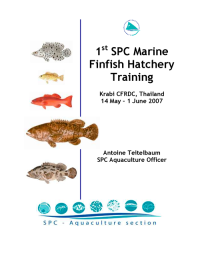
This report describes a training course on marine finfish hatchery protocols, which was convened at the Karabi Coastal Fisheries Research and Development Center, Thailand at the request of the Secretariat of the Pacific Community. The main goal of the training was to carry out hands-on practical work in finfish hatchery techniques, with an emphasis on grouper. This work involved spawning induction, incubation and larval rearing until day 12.
A different form of dumping: The need for a precautionary approach for yet another new species for shrimp farming in Asia. Sustainable livelihoods of pangus farming in Bangladesh. Business approach to national broodstock centres in Vietnam. Freshwater aquaculture in Myanmar. Traditional carp culture in Central Europe. Egg and larval quality in sand bass Psammoperca weigiensis. Effect of protein and lipid level of growth performance of tiger grouper Epinephelus fuscoguttatus.
19 September 2007 | Sih Yang Sim | 2681 Downloads | .pdf | 2.19 MB
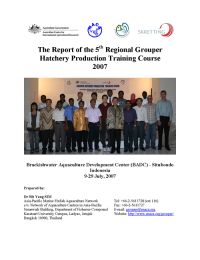
The 5th Regional Grouper Hatchery Training Course was another success with all participants is pleased with the overall training activities and field trips. A total of 17 participants from eight countries attended the training course which was hosted by the Brackishwater Aquaculture Development Centre, Situbondo, Indonesia. Participants were able to involve in the broodstock activities for giant grouper, in additional to the tiger and humpback groupers, and attended field trips to backyard hatcheries and export facilities.
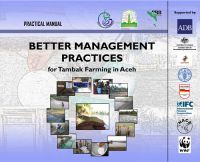
This practical manual provides better management practices for the farming of shrimp in tambak systems in Aceh, Indonesia. The manual addresses the formation of farmer groups, crop planning, and specifies better management practices. These include: Location of tambaks, design and construction of tambaks, pond preparation practices, shrimp seed selection and stocking practices, feed management practices, water management practices, health management practices, harvest and post-harvest handling practices, keeping records and improved marketing practices.
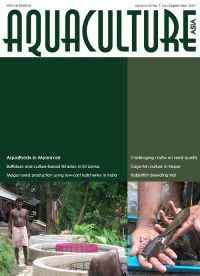
Buffaloes in favour of culture-based fisheries in Sri Lanka. Aquafeeds in Myanmar: A change from farm-made to factory-made feeds. Challenging myths about seed quality and potential benfits to the rural poor. Catfish Clarius batrachus production using low cost hatcheries. Cage fish culture and livelihoods in the mid-hill lakes of Pokhara, Nepal. Marine fish hatchery training. Rabbitfish Siganus guttatus breeding and larval rearing. Vietnamese extension manual on culture-based fisheries.
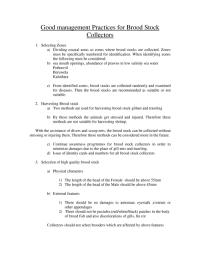
The National Aquaculture Development Authority of Sri Lanka (NAQDA) took several steps to regularise collectors of Penaeus monodon under the restructuring programme of the shrimp aquaculture industry in Sri Lanka. Regularisation of broodstock collectors is very imperative mitigate transmission of white spot disease. NAQDA developed these practices in consultation with the Department of Fisheries and Aquatic Resources, shrimp hatchery owners, broodstock suppliers, NARA, Wayamba environmental authority, Sri Lanka aquaculture development alliance and the consortium for shrimp aquaculture development.
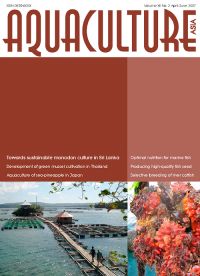
Sustainable black tiger shrimp farming in Sri Lanka. An economic analysis of Persian sturgeon stock enhancement. Aquaculture and environmental sustainability in Thailand: Food or financial security? Cage fish culture - successful income generation in manmade reservoir Kulekhani, Nepal. Diversification of rice farming alleviates poverty in a Bangladesh village. Sea-pineapple aquaculture in Japan. Green mussel cultivation in Thailand. Selective breeding for growh and fillet yield in Vietnamese catfish. Producing quality fish seed in rural Asia.
9 March 2007 | Thuy Nguyen, David Hurwood, Peter Mather, Uthairat Na-Nakorn, Wongpathom Kamonrat and Devin Bartley | 7705 views | .zip | 3.09 MB
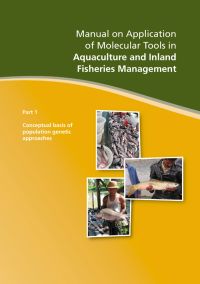
This manual provides a comprehensive practical tool for the generation and analysis of genetic data for subsequent application in aquatic resources management in relation to genetic stock identification in inland fisheries and aquaculture. The material only covers general background on genetics in relation to aquaculture and fisheries resource management, the techniques and relevant methods of data analysis that are commonly used to address questions relating to genetic resource characterisation and population genetic analyses.