Practices and people can be considered as two key ingredients to responsible aquaculture. Practices that are in conformity with national and international standards and requirements, ensure sustainability of the sector, ensure environment protection and integrity, enable social equity and respect ethical values and standards, consider human food safety concerns seriously and people who; are well informed, willing to change and ready to embrace practices for public good.
4 December 2013 | F.A. Aya | 13216 views | .mp4 | 25.48 MB
The Aquaculture Department of the Southeast Asian Fisheries Development Center has been promoting a number of programs towards effective dissemination and adoption of science-based aquaculture technologies for rural aquaculture development. This is in line with the national government development program on sustainable aquaculture, which is implemented in agreement with the country’s Fisheries Code of 1998 and Local Government Code of 1991.
4 December 2013 | S. Ruangsivakul | 5432 views | .mp4 | 24.82 MB
In 2001, the Southeast Asian Fisheries Development Center and Department of Fisheries in Thailand conducted acollaborative pilot project on coastal fishery resources management with the cooperation of local fishing communities and other stakeholders, community groups and local administrative authorities in Chumphon Province. The project established a practical framework for locally-based coastal resource management by encouraging fishermen’s participation supported by the creation of alternative job opportunities in coastal fishing communities.
4 December 2013 | C. Da | 4918 views | .mp4 | 66.89 MB
Aquaculture could be a solution to increase the nutrition available as well as to provide additional income source to local farmers, as it is known that the potential demand for small-scale aquaculture using paddy fields, canals and ponds is very high. However, many rural communities have little experience with fish culture. In addition, there are local shortages of the required raw materials for farmers to practice fish culture.
PROVAC aims to increase fish farmers in the target seven provinces of the Southern Benin by using the extension approach so-called “farmer-to-farmer” training. In this approach, the Project supports establishment of core farmers who can produce seeds and homemade feeds. The core farmers then offer technical training for ordinary farmers in cooperation with extension officers at the facilities of core farmers. PROVAC has achieved various technical improvements including in seed production.
4 December 2013 | O. Hirsohi, R.J.H. Zoelys, M. Longondraza and T.J. Mana | 6289 views | .mp4 | 45.9 MB
An FAO project ignited a first practice of freshwater carp aquaculture in highlands of Madagascar in the late 1980’s. Since then, carp culture has been practiced in the area but the number of farms at present are only few. In terms of tilapia culture, the Rural Development Support Project in Madagascar financed by the World Bank promoted tilapia culture for small-scale farmers in the district of Marovoay from 2002 to 2004.
4 December 2013 | A.K. Soe, W. Kine, K. Soe, A.S. Min, S.M. Aye and S. Takahashi, S | 5925 views | .mp4 | 40.55 MB
Fish is one of the most important foods for the Myanmar people since more than 70% of animal protein is taken from fishery products. It has been reported that people in the rural areas, particularly those who live far from the main river systems suffer from a deficiency of animal protein due to insufficient supply of fish. The majority of those are needy farmers and they depend only on crop cultivation for their livelihoods.
4 December 2013 | V. Tammajedy | 4878 views | .mp4 | 49.6 MB
The Lao government has set a target to increase fish supply to 24 kg/year/person by 2020. In most cases of aquaculture extension, exotic species have been used as target species. In view of biodiversity, establishment of habitat and hybridizations with indigenous species in the natural water body, this practice may cause deterioration of the natural biodiversity. Therefore, to protect the diversifications, aquaculture extension using indigenous species should be promoted.
Freshwater aquaculture production in Indonesia has significant contribution to the total aquaculture production. In 2012 freshwater aquaculture production was 2.15 million tons or 68% of the total aquaculture production of 3.16 million tons (excluding seaweed). The major commodities cultured are common carp, tilpia, pangasius, giant gouramy, African catfish, java carp, and freshwater prawn. Small-scale freshwater aquaculture extension is very important to assist the fish farmers in the region.
In the context of aquaculture technological extension, this paper and accompanying presentation reveal how the government and key UN partners, initiated the farming and breeding of Asian and Indian major carps in the country between 1965 up to late 1970s. Emphasis is given on bighead carp Aristichthys nobilis, which as per 2011 and 2012 official agricultural statistics, ranked 3rd in freshwater aquaculture (17,464 MT) and 6th on inland capture fisheries output (12,119 MT).
Modern aquaculture practices in Nepal started around the 1950s). Since then, aquaculture has contributed about 1% of GDP. The national average production from pond aquaculture is about 3.6 million tons/ha. However, the range of fish production varies from about few hundred kilograms to 7.0 million tons/hectare depending upon different farming and management system. Aquatic resources located at different altitudes can offer potential for different fisheries and aquaculture activities in Nepal.
4 December 2013 | B. Vakaramoko | 4898 views | .mp4 | 16.26 MB
Promoting small-scale freshwater fish farming in Côte d’Ivoire was done in two stages. First was awareness and establishment stage (1974-1990) implemented by dense and diverse state support. The second was the professional stage (1992-2002) executed by specific regional projects. Activities targeted small-scale fish farming including promotion of quality amenities, reproducible by the promoters; marketing; and the promotion of research and development focused on the needs of stakeholders.
4 December 2013 | H. Zidana | 4153 views | .mp4 | 5.53 MB
Fisheries resources play a very important role in Malawi’s national economy, in terms of food and nutritional security of the population. It contributes about 60-70% of annual animal protein supply of the nation. In fact, fish is the readily available source of animal proteins consumed in small amounts among Malawian daily meals, thereby nutritionally supplementing essential amino acids in their diet. Fisheries provides source of employment to over 300,000 people through fishing and associated activities.
4 December 2013 | E. Manda | 4886 views | .mp4 | 8.39 MB
The largest percentage of aquaculture production in Zambia comes from small-scale fish farmers. This is mainly because there are many small scale fish farmers compared to other categories. In comparison to small-scale fish farmers, there are very few commercial or large-scale fish farmers. This situation suggests that one of the ways for effectively increasing aquaculture production is to improve fishpond productivity and commercialization of aquaculture production systems.
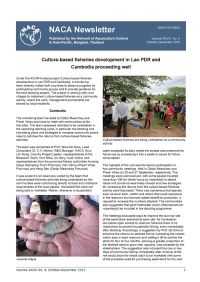
Under the ACIAR-funded project Culture-based fisheries development in Lao PDR and Cambodia, a monitoring team recently visited both countries to observe progress by participating community groups and to provide guidance for the next stocking season. The project is working with rural villages to implement culture-based fisheries as a community activity, where the work, management and benefits are shared by local residents.
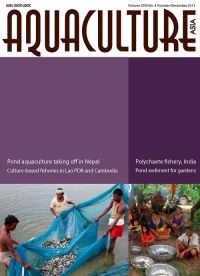
Special session on regional cooperation for improved biosecurity. Pond aquaculture taking off in Nepal. Introduction of culture-based fishery practices in small water bodies in Cambodia: Issues and strategies. A case study on polychaete fishery by the Irular tribal fishing community on the Tamil Nadu coast. Use of pangasius pond sediment for rooftop bag gardening: Potential for rural-urban integrated agriculture-horticulture. Culture-based fisheries exchanges between Lao PDR and Cambodia.
Culture-based fisheries development in Lao PDR and Cambodia proceeding well. National aquatic animal disease surveillance programme launched in India. Report on early mortality syndrome / acute hepatopancreatic necrosis syndrome of shrimp. International Symposium on Small-scale Freshwater Aquaculture Extension, 2-5 December, Bangkok. 'Perfect' food for 'perfect' prawns. Aquaculture without Frontiers Special Session. We asked CSIRO: Gold Coast Tiger Prawns. Understanding the sex of salmon. Overcoming smallholder challenges with biotechnology. Coordinated efforts in aquaculture needed to meet global demand. FAO e-book collection for tablets and e-readers.
NACA was pleased to coordinate an aquaculture study tour to Bangladesh, Vietnam and Thailand from 19-26 April for a delegation of twelve fisheries development officials from Assam, India. The delegation included Mr Sri Hemanta Narzary, Commissioner and Secretary for Fisheries; Mr Sri Kailash Chang Damria, State Project Director for the ARIAS Society, Mr Sri Siddhartha Purkayastha, Deputy Directory of Fisheries, and district fisheries development and extension officers.