Livelihoods, gender and social issues

Aquaculture livelihoods and social issues in rural communities.

Creative Commons Attribution.

Related

Subject tags

A collection of subject tags relating to technical matters.

In this collection

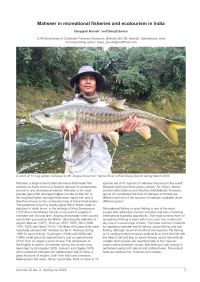
Mahseer in recreational fisheries and ecotourism in India

Mahseer are the most popular game fish amongst anglers in India, with a reputation as one of the toughest fighters amongst freshwater sports fish. In this article, we have made an attempt to compile information on recreational mahseer fisheries in India. The importance of the mighty mahseer as a game fish is told through the perspectives of active anglers and the visions of stakeholders and researchers in conservation and ecotourism are presented.

Accelerated poverty alleviation of tribal households: Cage fish farming by displaced fishers in reservoirs of Jharkhand

Jharkhand, India, has a significant population of tribal people, around 28% of the state's 33 million. Agriculture is the main livelihood and subsistence-level farming is predominant, offering limited opportunities for employment to landless people for most of the year. This article documents the experience of the Jharkhand Department of Fisheries in developing cage-based aquaculture as an alternative livelihood for tribal fishers that had been displaced by the construction of reservoirs, working in association with fisher collectives.
Global fish passage forum to include first symposium on hydropower and fish, December, Australia

The American Fisheries Society and the Environmental and Water Resources Institute of the American Society of Civil Engineers are holding this year's annual Fish Passage conference in Australia in December in collaboration with hosts Charles Sturt University and the New South Wales Government. The International Conference on River Connectivity, to be held in Albury from December 10 to 14 includes the First International Symposium on Hydropower and Fish Management.

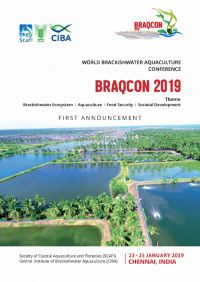
World Brackishwater Aquaculture Conference, 23-25 January 2019, Chennai, India

BRAQCON 2019 wil cover latest research and development in the broader themes of the conference in the form of special sessions, contributed papers, expert group discussions and brainstorming on issues facing aquaculturists and ecosystem managers in India and around the world. The conference themes include: Brackishwater ecosystems, estuarine biodiversity and conservation; aquaculture production systems; larviculture; fish and shellfish nutrition; environment and climate change; aquatic animal health; socio-economic and livelihood issues; and aquaculture genetics and biotechnology.

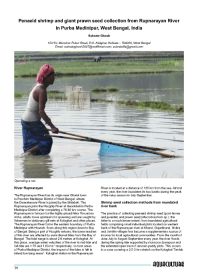
Penaeid shrimp and giant prawn seed collection from the Rupnarayan River in Purba Medinipur, West Bengal, India

The practice of collecting penaeid shrimp seed and prawn seed from inundated agricultural fields adjacent to the Rupnarayan River has become a supplementary source of income for local communities. During the wet season each year, the river floods the extended open tract of unsown paddy fields. This article describes the traditional fishing practices, gear and livelihoods associated with capture and grow out of shrimp and prawn seed in this region of West Bengal, India.

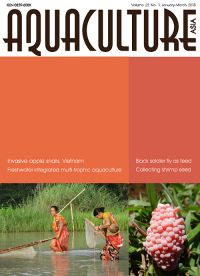
Aquaculture Asia Magazine, January-March 2018

In this issue:

Invasive apple snails (Pomacea spp.) in Vietnam: Short review; A review of fresh water integrated multi-trophic aquaculture: Catching up on the dream of a blue revolution in India; Pre-pupae (larvae) of black soldier fly - a potential alternate protein source for aquaculture feeds; Penaeid shrimp and giant prawn seed collection from Rupnarayan River in Purba Medinipur, West Bengal, India; NACA Newsletter; First training course on culture-based fisheries held in Nha Trang, Vietnam.

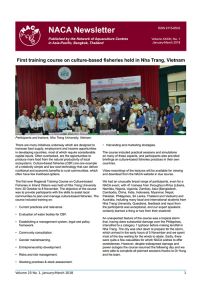
NACA Newsletter, Vol. XXXIII, No. 1, January-March 2018

In this issue:

First training course on culture-based fisheries held in Nha Trang, Vietnam; GAF7: Gender in Aquaculture and Fisheries; 3rd International Symposium on Aquaculture and Fisheries Education, India; International Fishing Industry Safety and Health Conference, Canada; WHO: Stop using antibiotics in healthy animals to prevent the spread of antibiotic resistance; Register for the 8th International Symposium on Aquatic Animal Health; Quarterly Aquatic Animal Disease Report, July-September 2017; Biology and Management of Invasive Apple Snails; Antimicrobial use in the aquaculture sector.

Video lectures: Regional Training Course on Culture-based Fisheries in Inland Waters

This collection contains video recordings of the lectures from the Regional Training Course on Culture-based Fisheries in Inland Waters, held at Nha Trang University, Vietnam. The objective of the course was to provide participants with the skills to assist local communities to plan and manage culture-based fisheries; a relatively simple and low cost technology that can deliver nutritional and economic benefits to rural communities with few livelihood options. The course was sponsored by the United Nations University Fisheries Training Programme.

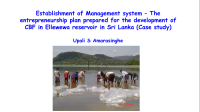
Entrepreneurship plan prepared for the development of culture-based fisheries in Ellewewa reservoir, Sri Lanka

How an entrepreneurship plan facilitated the development of culture-based Fisheries in a Sri Lankan reservoir.

Community consultation in culture-based fisheries

People-oriented approaches for engaging communities in culture-based fisheries development.

Culture-based fisheries: What, why, where and how?

A briefing on the context and relevance of culture-based fisheries in rural development.

Youth and Fish Drawing Competition Art Book

An art book containing the winners of the Youth and Fish Drawing Competition, which was held during the 6th Global Symposium on Gender in Aquaculture and Fisheries (GAF), 4-7 August 2016, Bangkok, Thailand. Ten senior and seven junior high schools participated, with two students (male and female) from each school. The competition ended after three hours of drawing and painting. This was the first activity involving youth in raising awareness of gender to be conducted at a GAF event.

International Fishing Industry Safety and Health Conference, 10-13 June, Canada

The National Institute for Occupational Safety and Health in collaboration with the SafetyNet Centre for Occupational Health and Safety Research (Memorial University) and the Food and Agriculture Organization of the United Nations (FAO), will be hosting the 5th International Fishing Industry Safety and Health Conference (IFISH 5) in St. John’s, Newfoundland and Labrador, Canada from June 10-13, 2018. Abstracts can be submitted electronically until 31 January, 2018.

First training course on culture-based fisheries held in Nha Trang, Vietnam

The first ever Regional Training Course on Culture-based Fisheries in Inland Waters was held at Nha Trang University from 30 October to 8 November. The objective of the course was to provide participants with the skills to assist local communities to plan and manage culture-based fisheries. These practices are an example of a relatively simple and low cost technology that can deliver nutritional and economic benefits to rural communities, which often have few livelihood options.

Empowering young Indian women through entrepreneurship development: Opportunities and constraints

Women’s entrepreneurship can be a boon for sustainable utilisation of resources, food security and employment generation. Women entrepreneurship can be defined as the process, in which she thinks to set up a business, gathering all the resources necessary to manage a business venture, provide employment to others and to make a profit along the way while minimising risk while initiating, organising and running a business enterprise.

Job opportunity - Research Program Manager (Fisheries), ACIAR

The Australian Centre for International Agricultural Research (ACIAR) has a job opening for Fisheries Research Program Manager. The position is based in Australia and reports to the Chief Scientist. The position is responsible for managing a portfolio of fisheries research and development projects commissioned by ACIAR. The projects are typically partnerships between research institutions in Australia and agencies within ACIAR's partner countries in the Indo-Pacific and aim to improve the productivity and sustainability of fisheries.

Aquaculture Asia Magazine, April-June 2017

In this issue:

Inspiring story of aquaculture in Sikkim - a journey from conservation to farming; farming of scampi and tiger shrimp together - a case study from West Bengal; Labeo pangusia - a candidate for diversification of hill aquaculture; sustainability of an integrated livestock-fish-crop farming system as a small scale enterprise; sustainable coastal aquaculture in India; potential scope and prospects of domestic fish market in Chhattisgarh.

Potential scope and prospects of domestic fish market in Kawardha District, Chhattisgarh, India

Trade in fisheries products is an important source of livelihoods for economically underprivileged people in Chhattisgarh. A socio-economic profile of traders and other actors from a domestic fish market is presented, including age, gender, education and income levels. The market infrastructure, distribution channels and species traded are described. Constraints to marketing arrangements are identified and include a lack of cold chain, storage and transport facilities.

FAO e-learning course “End Child Labour in Agriculture”

FAO has developed an online training course on ending child labour in agriculture. The course is designed to raise awareness and build knowledge among agricultural stakeholders about the importance of addressing child labour in agriculture, including livestock, forestry, fisheries and aquaculture. It aims to build specific skills, depending on work-related responsibilities and tasks and/or interests, by providing concrete ideas and guidance that can be applied in real life agricultural policy and programming situations.

Culture-based fisheries: A low-tech, greenhouse friendly approach to improving food and income for Cambodian families

Improvements to fish yield in small water bodies as well as to the incomes and nutritional status of rural communities have been demonstrated. in Laos, Sri Lanka and Vietnam but culture-based fisheries practices are not yet widespread, despite having significant potential in tropical climates. A project to introduce culture-based fisheries to Cambodia is described. Participating communities reported improved catch per unit effort, an increase in the number of people engaged in fishing and lower food costs.