In this issue: Hon Mun MPA Pilot Project on Community-based Natural Resources Management. An experience with participatory research in Tam Giang Lagoon, Thua Thien-Hue. Experiences and benefits of livelihoods analysis. Lessons learnt in implementing PRA in livelihoods analysis. Lessons learnt from livelihoods analysis and PRA in the Trao Reef Marine Reserve. Using the findings from a participatory poverty assessment in Tra Vinh Province. About the STREAM Journal. About STREAM. This edition is also available in Ilonggo, Khmer, Nepali and Vietnamese.
This study of the livelihood of farmers and fishermen is based on the information provided by the villagers representing 142 households in the village. There had been some changes that impacted on the livelihood of villagers, especially in natural resources. The population is constantly growing which leads to an increase in natural resource utilisation and ultimately their degradation. The villagers usually suffer from diseases such as malaria, fever and dengue fever.
This is the report of a livelihoods study team working together with villagers from Saob Leu Village in Kratie Province, Cambodia from 10-15 July 2002. The team worked with 1530 villagers who volunteered to participate and represented the 177 households in the village. The villagers rely mainly on farming, with dry season rice being the most important crop. Most villagers are involved in small-scale fishing, with some having other skills.
This is the report of a livelihoods study team working together with villagers from Trorbek Pork in Kandal Province, Cambodia. In Trorbek Pork Village there are 140 families and a total population of 700 persons. The primary occupation of villagers was farming dry season rice on 47 ha, and in addition cultivating vegetables such as corn, mung bean, wax gourd, chilli and sesame on 15 ha. Secondary occupations included fishing, garment making, singing, laboring and repairing machines.
This study was based on the population census (1998) and key informant interviews (10 to 50 villagers voluntarily represented the 253 families of Dong Kom Village). There were 253 families with a total population of 1,192 persons. The primary occupation of villagers was farming, growing dry season rice on 1,900 ha, besides that they grow other vegetables such as corn, pumpkin and other vegetables on 200 ha. Secondary occupations were fisher, teachers, traditional medical practitioner, barber and other services.
This is the report of a livelihoods study team working together with villagers from Dang Tong Village in Kampong Chhnang Province, Cambodia. In general, villagers are skilled in farming and mat weaving, but some villagers also have individual skills such as carpentry, boat making, hairdressing and fixing machines. Although this village is in the Tonle Sap (Great Lake) area, which has the most plentiful supply of fresh fish in the country, the villagers are subsistence fishers.
The main objective of the study is to understand the villagers’ standard of living, hardship, external impact, present and future demand. The team interviewed with 15 to 60 villagers including men, women, young and old villagers, represented 135 families in the village. The main occupations of the villagers are farmers cultivating rice on 299 hectares of seasonal rice and 61.8 hectares dry season rice and fishers. Beside that, they have other occupations such as repairers, making thatch.
In this issue: From resource user to resource manager: A significant change story. Significant change with Cambodian provincial livelihoods study teams. The Community Fisheries Development Office: One year on. CFDO open for business! Stakeholders and institutional involvement in aquaculture management and development. Fish seed production for aquaculture in Southeast Cambodia: Decentralisation - the way to go? About the STREAM Journal. About STREAM. This edition is also available in Ilonggo, Khmer, Nepali and Vietnamese.
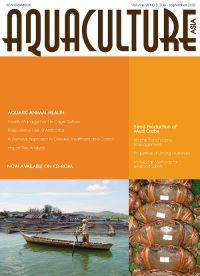
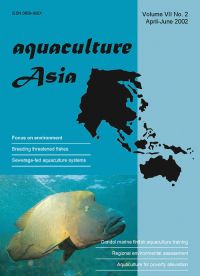
Aquaculture for poverty alleviation and food security. Shrimp pond waste management. Properties of liming materials. Seed production of mud crab Scylla spp. The dilemmas of strain selection. Seed production of the crucifix crab Charybdis feriatus. A general approach to disease treatment and control. Breeding and seed production of mangrove snapper Lutjanus argentimaculatus. Responsible use of antibiotics in shrimp farming. Health management for cultured marine fishes. Molecular methods for rapid detection of pathogens in seafood.
The aim of this workshop was to formulate an approach which would enable participants to start detailed work on a process monitoring system, building on current activities and using already existing skills in Cambodia, Nepal, Philippines, Thailand and Vietnam. Objectives were to familiarise participants with recent developments in process monitoring and significant change, and to develop an action plan for each country and a set of guiding principles for a monitoring system to underpin work in all countries.
This is the report of the First Regional STREAM Regional Conference, held 19-21 June 2002 in Bangkok, Thailand. The conference was the first opportunity for participants in the STREAM Initiative, launched on 1 December 2001, to come together to discuss the programme. The conference discussed the main activities of STREAM, ways of working, communications strategies, feedback from participating countries and issues to follow up.
1 June 2002 | Graham Haylor, William Savage and S.D. Tripathi | 1600 Downloads | .pdf | 346.1 KB
The “Rural Aquaculture Service Recipients and Implementers Workshop” was held from 9-10 May 2002 in Ranchi, Jharkand. It was among the first activities of the DFID NRSP Research Project R8100 entitled “Investigating Improved Policy on Aquaculture Service Provision to Poor People”. The workshop provided the first opportunity for feedback on the project design from people who live and work in tribal communities in the three states of Jharkhand, Orissa and West Bengal.
1 June 2002 | John Levinson | 1855 Downloads | .pdf | 191.58 KB
This study examines the development of the Community Fisheries Sub-Decree. From its promulgation in late 2000 through its draft form in June 2002, this sub-decree has gone through over 25 drafts. Initially, the writing process involved the public intimately: community meetings were conducted, NGOs contributed their knowledge and expertise, and then, with these consultations in mind, the newly-formed Community Fisheries Development Office (CFDO) in the Department of Fisheries (DoF) drafted the sub-decree.
1 May 2002 | Graham Haylor, William Savage and S.D. Tripathi | 1693 Downloads | .pdf | 343.49 KB
This document is the Inception Report of the DFID NRSP Research Project R8100 (March 2002 – May 2003), managed by the NACA. The purpose of the project is to identify, test and promote mechanisms for the delivery of improved rural services critical to the development of rural livelihoods, with emphasis on services in support of aquaculture objectives, strengths and constraints of marginalised groups and their complex diverse livelihoods. An inception visit was made from 17-24 March 2002.
1 April 2002 | Graham Haylor, William Savage and S.D. Tripathi | 1857 Downloads | .pdf | 159.89 KB
This article discusses a process for transacting pro-poor policy change is discussed drawing on examples in aquaculture from India. Based on research and development experience in Bihar, West Bengal and Orissa, and some further work in the western and central regions covering tribal populations, the Fisheries Development Commissioner encouraged the NACA-STREAM Initiative to recommend reforms under the FFDA scheme or even suggest a new “tribal” rainfed farming component that could be launched in the next year.
In this issue: Efforts of a farmer in fish seed production for self-employment. Remembering: The missing capacity. Measuring the process. Women's fish farmers group in Nawalparasi, Nepal. Periphyton-based aquaculture: A sustainable technology for resource-poor farmers. Unlocking information on the internet: STREAM media monitoring and issue tracking. This edition is also available in Ilonggo, Nepali and Vietnamese.
Prawn farm energy audits. Freshwater fish farming and poverty alleviation in Bangladesh. Artificial propagation for conservation of endangered species. Sewerage-fed aquaculture systems of Kolkata. Rice-fish farming in India. The use of lime, gypsum, alum and potassium permanganate in water quality management. Fish gene technology research in China. Low-salinity shrimp farms. Seed production of Clarius batrachus. Supplying good-quality seed for sustainable aquaculture and more.
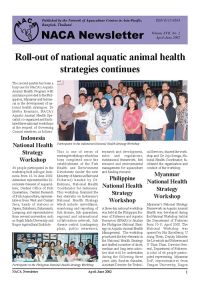
Roll-out of national aquatic animal health strategies continues. STREAM concludes inception phase of 'Improved Policy on Aquaculture Service Provision to Poor People' Project in India. Expert consultation on rapid diagnosis of shrimp viral diseases held in Chennai, India. ACIAR/NACA Workshop on Feeds and Feeding Constraints in Inland Aquaculture: Research and Extension Priorities. NACA supports health management in Indian shrimp farming. Marine Finfish Aquaculture aquaculture programme gears up for workshop. Launch of Trans-Himalayan Coldwater Fisheries Network Website. NACA Organises Emergency Assistance to Indonesia in the Control of a Serious Koi and Common Carp Disease.
In this issue: Learning from each other about conflict. e-learning to support knowledge sharing in aquatic resources. Livelihood strategies, gender and participation in aquaculture: Findings from participatory research in northwestern Sri Lanka. Farming of giant tiger shrimp in northern central Vietnam. Interacting with stakeholders and policy-makers. This edition is also available in Ilonggo, Khmer, Nepali and Vietnamese.
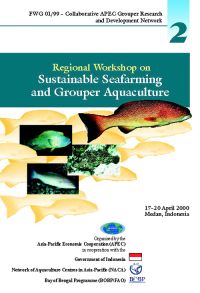
These are the proceedings of a workshop focussed on grouper culture, but also explored management strategies required to support the sustainable development of seafarming in the Asian region. The emphasis was on technology transfer and management strategies for the benefit of farmers and coastal communities. The workshop included special sessions on diversification of seafarming systems and culture species, the role of seafarming in the livelihoods of coastal communities.