Marine finfish

Information relating to aquaculture of marine finfish.

Creative Commons Attribution.

Related

Species / commodity tags

Major farmed commodity or species groups.

In this collection

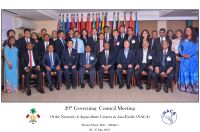
29th Governing Council Meeting held in Malé, Maldives

NACA’s 29th Governing Council Meeting was held in the Maldives capital, Malé, from 26-27 June, with attendance by fifteen member governments. This was the first official NACA meeting in the Maldives, since it became a member in 2014, and also the first time that most of the delegates had visited the country, affording participants a fascinating glimpse of a very different lifestyle in the archipelago, and a very different development context.

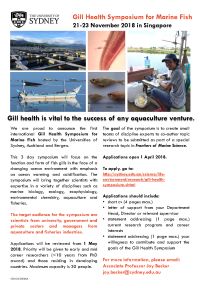
2018 Gill Health Symposium for Marine Fish, 21-23 November, Singapore

This symposium will focus on the function and form of fish gills in the face of a changing ocean environment with emphasis on ocean warming and acidification. The goal is to create small teams of discipline experts to co-author topic reviews to be submitted as part of a special research topic in Frontiers of Marine Science. Priority will be given to early and mid career researchers and developing country scientists. For more information please download the flyer below or visit the symposium website.

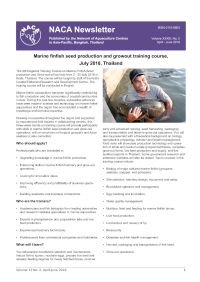
NACA Newsletter, Vol XXXIII, No. 2, April-June 2018

In this issue:

Marine finfish seed production and growout training course, Thailand; global fish passage forum to include first symposium on hydropower and fish; International Workshop on Rehabilitation, Propagation and Conservation of Mahseer, India; World Brackishwater Aquaculture Conference, January 2019, India; Offshore Mariculture Asia 2018, 15-17 May, Singapore; Video lectures: Regional Training Course on Culture-based Fisheries in Inland Waters; Youth and Fish Drawing Competition Art Book; Report of the Sixteenth Meeting of the Asia Regional Advisory Group on Aquatic Animal Health.

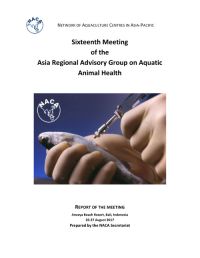
Report of the Sixteenth Meeting of the Asia Regional Advisory Group on Aquatic Animal Health

This report summarises the proceedings of the 16th meeting of the Advisory Group, held 26-27 August 2017 in Bali, Indonesia. The group's role includes reviewing disease trends and emerging threats in the region, identifying developments in global aquatic disease issues and standards, evaluating the Quarterly Aquatic Animal Disease Reporting Programme and providing guidance on regional strategies to improve aquatic animal health management. The meeting included discussion on Tilapia Lake Virus (TiLV) and developments in antimicrobial resistance.

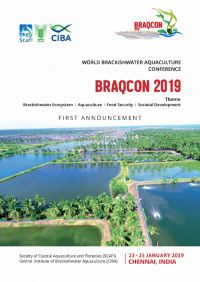
World Brackishwater Aquaculture Conference, 23-25 January 2019, Chennai, India

BRAQCON 2019 wil cover latest research and development in the broader themes of the conference in the form of special sessions, contributed papers, expert group discussions and brainstorming on issues facing aquaculturists and ecosystem managers in India and around the world. The conference themes include: Brackishwater ecosystems, estuarine biodiversity and conservation; aquaculture production systems; larviculture; fish and shellfish nutrition; environment and climate change; aquatic animal health; socio-economic and livelihood issues; and aquaculture genetics and biotechnology.

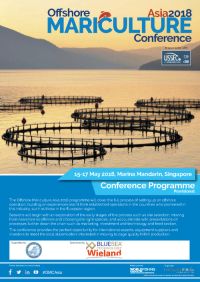
Offshore Mariculture Asia 2018, 15-17 May, Singapore

Offshore Mariculture Asia 2018 will cover the full process of setting up an offshore operation, building on experiences learnt from established operations in the countries who pioneered in this industry. Sessions will begin with an exploration of the early stages of the process such as site selection, moving from nearshore to offshore and choosing the right species, and will culminate with presentations on processes further down the chain such as marketing, investment and technology and feed section.

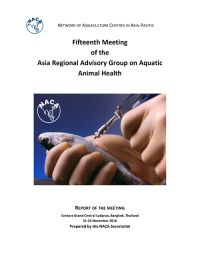
Report of the fifteenth meeting of the Asia Regional Advisory Group on Aquatic Animal Health, 21-23 November 2016

The Asia Regional Advisory Group on Aquatic Animal Health meets annually to discuss regional health issues including emerging disease threats. This report includes a review of regional disease status circa 2016, global and regional disease reporting arrangements, global issues and standards, progress in implementation of the the Regional Technical Guidelines on Health management for the Responsible Movement of Live Aquatic Animals, identification and designation of regional aquatic animal health resources and regional and international cooperation.

15th meeting of the Asia Regional Advisory Group on Aquatic Animal Health

The 15th meeting was held from 21-23 November 2016, in Bangkok, Thailand. A special session was held on addressing the use of anti-microbial substances in aquaculture and the development of anti-microbial resistance. This is an issue of global concern for both human and animal health, and it had been addressed by a resolution at FAO’s Thirty-ninth Conference in June 2015. The meeting reviewed in detail the status of aquatic animal disease in the region.

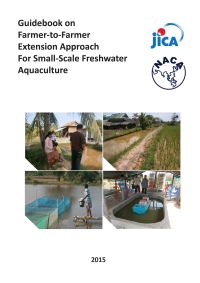
Development of a Guidebook on Farmer-to-Farmer Extension Approaches for Small-scale Aquaculture in the Asia-Pacific Region

The objectives of this project were to i) develop a guidebook in English on "Farmer-to-farmer extension approaches for small-scale aquaculture" and ii) to translate the developed guidebook into selected local dialects in Asia-Pacific and other regions (e.g. Africa). The project made use of the significant results from the JICA projects in Cambodia, Benin and other countries on farmer-to-farmer extension approaches on technology extension for small-scale farmers. The book is available in eleven languages (English, Arabic, Bahasa Indonesia, BurmeseFrenchKhmerLoatian, Malay, NepaliThai and Vietnamese.
Culture-based Fisheries Development in Lao PDR and Cambodia

Culture-based fisheries (CBF) are a useful development strategy for improving the income and food security of rural communities. CBF requires minimal capital outlay, mobilising farming communities to make use of existing small dams and reservoirs for the secondary purpose of foodfish production. The objective of this project is to introduce community-based CBF to Cambodia, and to consolidate the gains of communities that have adopted CBF in Lao PDR.

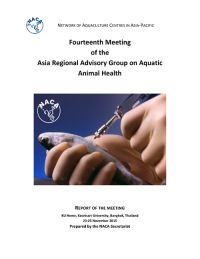
Report of the fourteenth meeting of the Asia Regional Advisory Group on Aquatic Animal Health, 23-25 November 2015

The Asia Regional Advisory Group on Aquatic Animal Health meets annually to discuss regional health issues including emerging disease threats. This report includes a review of regional disease status circa 2015, global and regional disease reporting arrangements, global issues and standards, progress in implementation of the the Regional Technical Guidelines on Health management for the Responsible Movement of Live Aquatic Animals, identification and designation of regional aquatic animal health resources and regional and international cooperation.

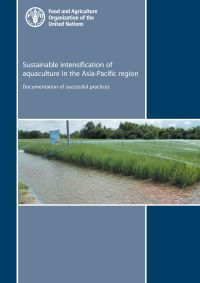
Sustainable intensification of aquaculture in the Asia-Pacific region: Documentation of successful practices

This publication is the major output of a regional programme jointly implemented by FAO and NACA in 2015 to document and disseminate successful practices that contribute to the sustainable intensification of aquaculture in the Asia-Pacific region. Twelve practices are described that contribute to at least one of the following: Improved production and resource use efficiency (land, water, feed, energy); improved environmental benefits; strengthened economic viability and farmers' resilience; and improved social acceptance and equity.

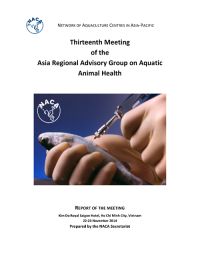
Report of the thirteenth meeting of the Asia Regional Advisory Group on Aquatic Animal Health, 22-23 November 2014

The Asia Regional Advisory Group on Aquatic Animal Health meets annually to discuss regional health issues including emerging disease threats. This report includes a review of regional disease status circa 2014, global and regional disease reporting arrangements, global issues and standards, progress in implementation of the the Regional Technical Guidelines on Health management for the Responsible Movement of Live Aquatic Animals, identification and designation of regional aquatic animal health resources and regional and international cooperation.

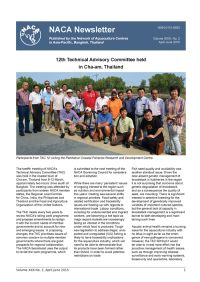
NACA Newsletter, Volume XXX, No. 2, April-June 2015

In this issue:

12th Technical Advisory Committee held in Cha-am, Thailand. Audio recordings: WAS special session on regional cooperation for improved biosecurity. AFSPAN Final Technical Report now available! Pillay Aquaculture Foundation Awards for Scientists in Least Developed Countries. Gender seminar conducted and ASEAN Gender Network launched. A two-tube, nested PCR detection method for AHPND bacteria. 9th Regional Grouper Hatchery Production Training Course. Developing an environmental monitoring system to strengthen fisheries and aquaculture in the Lower Mekong Basin. Asia-Pacific Regional Workshop on the Status of Aquatic Genetic Resources for Food and Agriculture.

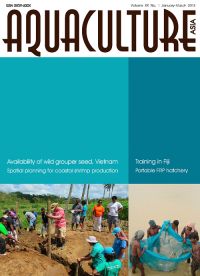
Aquaculture Asia Magazine, January-March 2015

Further training provided to aquaculturists in Fiji. Spatial planning for sustainable coastal shrimp production. Availability of grouper (Serranidae) fingerlings and seed in the coral reef of Son Tra Peninsula, central Viet Nam. Small-scale carp seed production through portable FRP hatchery at Khanguri, Odisha. Regional consultation on culture-based fisheries developments in Asia. Gender Assessment Synthesis Workshop. Broodstock management in aquaculture. Urgent appeal to control spread of the shrimp microsporidian parasite Enterocytozoon hepatopenaei (EHP).

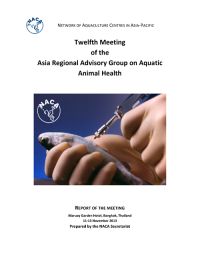
Report of the twelfth meeting of the Asia Regional Advisory Group on Aquatic Animal Health, 11-13 November 2013

The Asia Regional Advisory Group on Aquatic Animal Health meets annually to discuss regional health issues including emerging disease threats. This report includes a review of regional disease status circa 2013, global and regional disease reporting arrangements, global issues and standards, progress in implementation of the the Regional Technical Guidelines on Health management for the Responsible Movement of Live Aquatic Animals, identification and designation of regional aquatic animal health resources and regional and international cooperation.

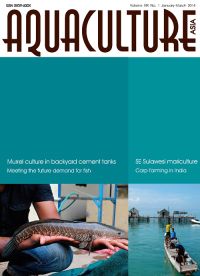
Aquaculture Asia Magazine, January-March 2014

In this issue:

Towards meeting future demand for fish: Aquaculture in inland or marine land or water-based systems? Status of carp farming in India. Recent trends in mariculture in southeast Sulawesi, Indonesia. Murrel (snakehead) culture in backyard cement tanks: A breakthrough and a success story. Mobile telephony - ICT eneabled fisheries extension service for sustainable shrimp farming. International Symposium on Small-scale Freshwater Aquaculture Extension. Report on early mortality syndrome / acute hepatopancreatic necrosis syndrome of shrimp.

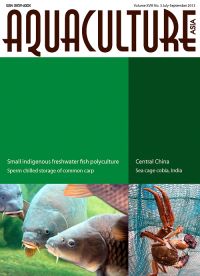
Aquaculture Asia Magazine, July-September 2013

In this issue:

A second trip to Hubei Province, central China. Sea cage growout of cobia Rachycentron canadum in the Gulf of Mannar. Culture of small indigenous fish species in polyculture with Indian major carps and high value crops along pond dykes. Study on sperm chilled storage of common carp Cyprinus carpio in Vietnam. Culture-based fisheries exchanges between Lao PDR and Cambodia. Culprit behind massive shrimp die-offs in Asia unmasked.

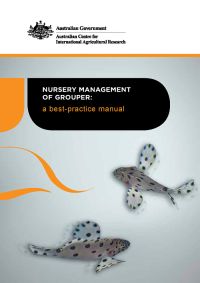
Nursery management of grouper: A best-practice manual

This manual provides practical guidelines for those engaged in the nursery culture of groupers in Indonesia as well as elsewhere in the tropics. It provides information on husbandry of groupers in the nursery phase, to reduce losses due to disease and cannibalism, and thus to increase the profitability of grouper nursing. The guidelines are derived from outcomes of ACIAR-funded research as well as other published information on grouper nursery management.

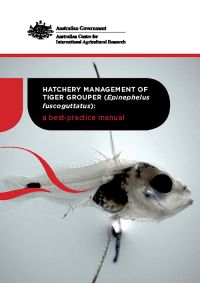
Hatchery management of tiger grouper (Epinephelus fuscoguttatus): A best-practice manual

This manual provides guidelines for the production of tiger grouper fingerlings. It outlines best-practice methods for broodstock maintenance, spawning, egg incubation and rearing of larvae through to 2–3 cm, fully metamorphosed juveniles. The guidelines have been developed from the outcomes of ACIAR-funded research, as well as from the experience of Indonesian, Philippine and Australian scientists and commercial hatchery operators, and published information. It provides an aid for improving the availability of grouper seed stock.