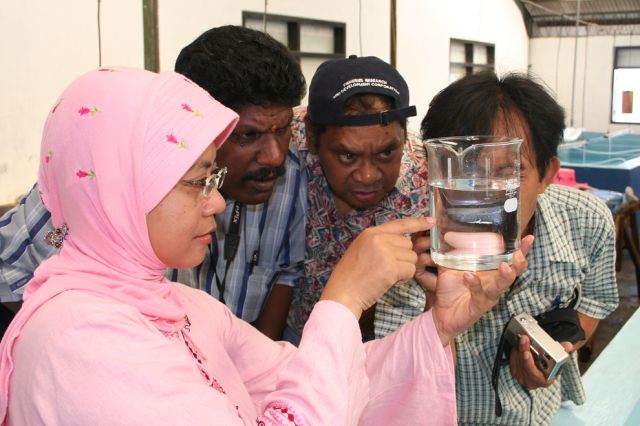
The Education and Training Programme assists capacity building among NACA members through the exchange and sharing of knowledge and skills between members. Activities may take the form of training courses, study visits and personnel exchange. The programme also supports the training components of the other thematic programmes and serves as an outreach arm of NACA. Regular training activities include three to four courses each year on various topics of regional priority in aquaculture development, such as:
Broodstock management in aquaculture.
Aquaculture business management.
Marine finfish seed production.
Aquaculture governance and planning.
Management for sustainable aquaculture development.
Key activities
Key activities of the programme include:
Identifying training needs for aquaculture development in NACA members.
Identifying and organising relevant expertise and capacities to meet the training needs.
Developing training modules and materials.
Facilitating routine education and training activities of NACA.
Facilitating and coordinating exchange programmes among members and with other regions.
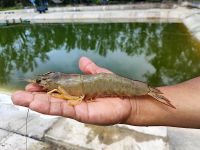
The Thai Fish Project began in 2019, and involves around 200 research members and multiple institutions in Thailand and Japan. The project aims to promote domestication and wise use of two Thai native aquatic species, namely the Asian sea bass Lates calcarifer and banana shrimp Penaeus merguiensis through increasing productivity, reducing the impact of infectious diseases, and preserving genetic resources. The project also encompasses several specific research topics to ensure that it comprehensively addresses the concerns on safeguarding the food security and enhancing the environmental sustainability as much as possible. This article describes the main research activities, outputs and future expectations of the Thai Fish Project.
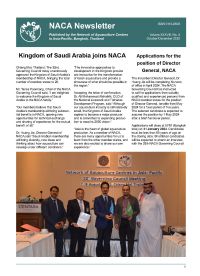
Kingdom of Saudi Arabia joins NACA; Applications for the position of Director General, NACA; NACA awarded the Aziz-Ul Haq Rural Development Medal; Training Course on Risk Analysis in the Aquaculture Value Chain held in Bangkok; Free FAO publication: Genetic management of Indian major carps; 7th International Symposium on Cage Aquaculture in Asia; PhD scholarships: Shanghai Ocean University PhD Programme 2024; WAS Journal Special Issue: Global Conference on Aquaculture Millennium +20 Thematic Reviews; Seminar on Artemia Research and Production: Videos; Reported aquatic animal diseases in the Asia-Pacific Region during the first quarter of 2023.
Eight thematic reviews prepared as preparation for the Global Conference on Aquaculture Millennium +20 (GCA +20) have been published in a Special Issue of the Journal of the World Aquaculture Society "Aquaculture for Food and Sustainable Development". A group of experts prepared advanced working drafts of each thematic review and the key findings from each theme were presented and discussed by expert panels during the GCA +20. Participants were then invited to provide their feedback and perspectives on the reviews and their key messages for consideration in finalisation of the papers. The reviews are available for free download.
Don’t miss this opportunity! Only ten places are left. The Yantai Institute of Coastal Zone Research will sponsor international applicants to attend an in-person Training Course on Science and Technology for Coastal Ecological Aquaculture and Biotechnology in Qingdao, China, from 23 April to 7 May. Enrollments close soon, do not delay. Please see the enclosed application form and information sheet for more details.
3 February 2023 | Stanzin Gawa and A.K. Singh | 2177 Downloads | .pdf | 5.21 MB
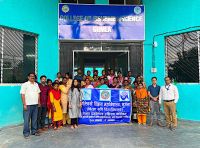
Today, tribal people comprise 8.6 percent of the Indian population and are one of the most disadvantaged sections of society. Many tribal groups in different parts of the country depend on natural resources for their livelihoods, to which their access has been progressively eroded. With financial support from ICAR-CIFT the College of Fisheries, Gumla, undertook seven training programmes for tribal women from economically marginalised tribal communities in the preparation and marketing of value-added fisheries products. The training encouraged women to develop small businesses building on their micro-entrepreneurship.
High-level meeting on aquaculture transformation in the Asia-Pacific region; Developing a regional strategy for aquatic organism health: Progressive management pathways; Job opportunity - health management and husbandry researcher; 2022 China-ASEAN International Forum on Sustainable Development of Fisheries and Aquaculture Under the Blue Transformation Strategy; A new progressive management pathway for improving seaweed biosecurity; Indian delegates visit Thailand for training and industry exposure; PhD scholarships: Shanghai Ocean University PhD Programme 2023; Reported aquatic animal diseases in the Asia-Pacific region during the second quarter of 2022.
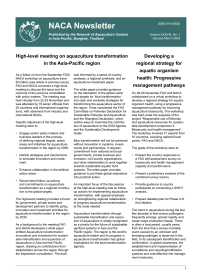
On 28-29 November FAO and NACA collaborated on a virtual workshop to develop a regional strategy for aquatic organism health, using a progressive management pathway for improving aquaculture biosecurity. The workshop was held under the auspices of the project “Responsible use of fisheries and aquaculture resources for sustainable development component 3: Biosecurity and health management”. The workshop involved 31 experts from 16 countries, including national focal points, FAO and NACA. The objectives of the workshop were to: Present and analyse country responses to a self-assessment survey on biosecurity and health management capacity and performance; to provide guuidance to country participants on conducting a SWOT analysis; and to prepare a detailed plan for Phase II of the initiative.
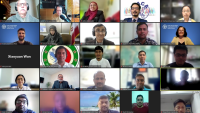
As a follow on from the September FAO/NACA workshop on aquaculture transformation, FAO and NACA convened a high-level meeting to discuss the issue and the outcome of the previous consultation with policy makers. The meeting was held virtually from 22-23 November and was attended by 79 senior officials from 25 countries and international organisations, with observers from industry and international NGOs. Specific objectives of the high-level meeting were to: Engage senior policy makers and business leaders in the process of defining regional targets, action areas and initiatives for aquaculture transformation in the region by 2030, identify strategies and mechanisms to stimulate innovation and investment, and to recommend follow up actions and commitments.
NACA welcomed five delegates from India on an aquaculture training and exposure visit from 31 October to 4 November. The visit began with a discussion at the NACA Secretariat on Thai mariculture, the recently established International Artemia Aquaculture Consortium, and better management practices concerning hatchery production and use of live feeds. The delegates left Bangkok the next day to visit seabass cage and pond culture and a shrimp nursery in the Chachengsao area and Bangprakong River. The following day they travelled to the Rayong Coastal Aquaculture Center and visited local farm sites before overnighting in Chantaburi. On the final day they visited the Kung Krabae Bay Royal Development Study Center and mangrove walk; and a freshwater fish farm to observe intensive carp and pangasius culture.
Shanghai Ocean University (SOU) is offering full scholarship PhD programmes in a wide range of marine sciences 2023. Disciplines include: Aquaculture, biology, fishing science, fisheries resources, marine science, food science and engineering, fishery economics and management, and marine engineering and information. The scholarships cover tuition, accommodation, medical insurance and include a monthly stipend.
Applications are due 1 February 2023. For details of the programmes, eligibility criteria, required documentation and application procedures, please download the prospectus. Postdoc positions are available for excellent graduates and full-time faculty positions are available for excellent international postdocs.
The Shanghai Ocean University Center for Ecological Aquaculture “Lancang-Mekong Rice-Fish” Training Program aims to help establish locally-adapted rice-fish models in Lancang-Mekong countries through collaboration to mitigate poverty, provide food security, meet the nutritional demands of local people, and educate local experts.
The center will offer the training programme as an online course from 5-7 November. The course is free and will cover practical farming systems for the Lancang-Mekong region.
The International Max Planck Research School for Molecular Life Sciences (IMPRS-LS) is a PhD program that brings together two renowned Munich-based Max Planck Institutes as well as two leading German universities, the LMU and TUM, to deliver first-class doctoral training to some of the world‘s most promising young scientists.
Applications are now open for fully funded PhD programmes with IMPRS-LS. The closing date is 15 November 2022, with accepted candidates commencing research project between March and October 2023.
For more information please download the attached announcement, or refer to IMPRS-LS website for eligibility criteria and online applications.
Ocean University of China and partners will convene the forum from 20 to 22 November 2022. The forum will cover the following: Topic 1: International talent cultivation and training;Topic 2: Science and technology innovation; Topic 3: Industrial synergy. The forum will host discussions about the implementation of the “Blue Transformation” strategy, further expansion of the space for fisheries and aquaculture, and ways of improving the production capacity of aquatic products, with the purpose of facilitating the achievement of the UN Sustainable Development Goals. Participation is free but registration is required. Registration closes on 22 October.
Training Course on Mariculture Technologies in Asia-Pacific; FAO/NACA Virtual Workshop on Aquaculture Transformation in Asia and the Pacific Region; Belt & Road Forum for International Freshwater Fishery Industry Innovation; 8th Global Conference on Gender in Aquaculture and Fisheries, 21-23 November; Reported Aquatic Animal Diseases in the Asia-Pacific Region during the First Quarter of 2022; International Training Course on Biology and Pathology of the Penaeid Shrimp 2022; Angkasa Putra inaugurated as first President of the South-East Asian Fisheries and Aquaculture Student Association; Artemia webinars: Video recordings of technical presentations available.
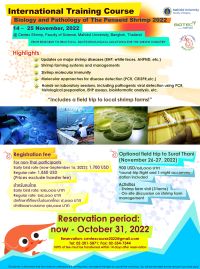
Highlights of the course include: Updates on major shrimp diseases including EHP, white faeces, and AHPND; shrimp farming systems and management; Shrimp molecular immunity; molecular approaches for disease detection including PCR and CRISPR; hands-on laboratory sessions, including pathogenic viral detection using PCR, histological preparations, EHP assays and bioinformatic analysis, and an optional field trip to local shrimp farms in Surat Thani.
The course will be held at Centex Shrimp, Faculty of Science, Mahidol University in Bangkok, Thailand. This is a paid training course. Reservations will close on 31 October. For more information, please download the flyer.
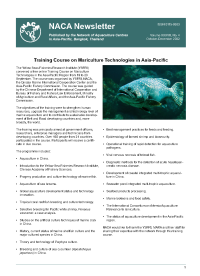
The Yellow Seas Fisheries Research Institute (YSFRI) will convene a free online Training Course on Mariculture Technologies in the Asia-Pacific Region from 19 to 23 September (please note the change of date). The course is organised by YSFRI, NACA, the Qindao Marine International Cooperation Center and the Asia-Pacific Fishery Commission. The training course will cover: Theory and technology for producing high-quality seed; New mariculture modes and technology; Nutrient regulation and feeding technology; Disease prevention and control technologies; Product processing and utilisation technologies. Applications close 5 September.
An online forum will be held on 16 August to enable technical exchange between policymakers, fishery extension officers, researchers and entrepreneurs in development of the freshwater fisheries industry through technology innovation.
The forum will focus on innovations and developments in freshwater fishery biotech, breeding, culture models, digitisation, and industrialisation, featuring presentations and discussions from experts of international organisations, the Chinese Academy of Sciences, Chinese Academy of Engineering, universities and entrepreneurs in virtual exchanges and discussions. Participation is free but registration is required.
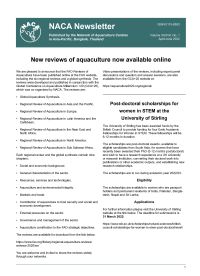
New reviews of aquaculture now available online; Post-doctoral scholarships for women in STEM at the University of Stirling; Research breakthrough seen to curb shortage of "poor man's fish"; Free online aquaculture courses; Fishing for life 2022: South and South-East Asian Conference on Small Scale Fisheries and Aquaculture; Reported Aquatic Animal Diseases in the Asia-Pacific Region during the Third Quarter of 2021; Shrimp 2022: INFOFISH World Shrimp Trade Conference and Exhibition; Tuskfish CMS v2.0.3 available.
The University of Stirling has been awarded funds by the British Council to provide funding for four Early Academic Fellowships for Women in STEM. These fellowships will be 6-12 months in duration. The scholarships are available to women who are passport holders and permanent residents of India, Pakistan, Bangladesh, Nepal and Sri Lanka. For further information please visit the University of Stirling website. The deadline for submissions is 31 March 2022.