Water quality

Content related to water quality.

Creative Commons Attribution.

Related

Subject tags

A collection of subject tags relating to technical matters.

In this collection

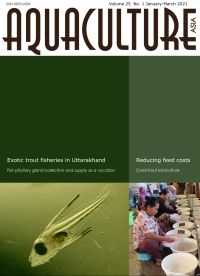
Aquaculture Asia Magazine, January-March 2021

In this issue:

Exotic trout fisheries resources and potentialities in Uttarakhand; Scenario of captive production of Clarias magur in India; Strategies to reduce feed cost by improving gut health and nutrient utilisation of fish in aquaculture; Fish pituitary gland collection and supply as a vocation in West Bengal, India; Coral trout Plectropomus leopardus aquaculture research and fingerling production in Indonesia; Smartphone app improving smallholder shrimp farming practices in Bangladesh; NACA Newsletter.

Coral trout Plectropomus leopardus aquaculture research and fingerling production in Indonesia

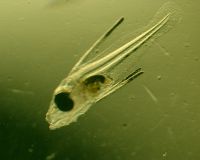
Coral trout Plectropomus leopardus is an emerging exported grouper commodity in Indonesia. The demand for coral trout fingerlings has been increasing and the value of this species is the highest among groupers. However, the rearing of coral trout larvae is notoriously more ‘difficult’ than other groupers. This article describes research on coral trout larval rearing protocols conducted by the Institute for Mariculture Research and Fisheries Extension, which has achieved a survival rate of 12%.

Aquaculture Asia Magazine, January-March 2020

In this issue:

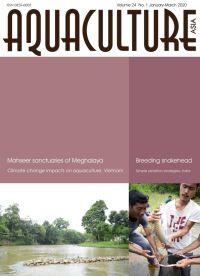
Mahseer sanctuaries of Meghalaya: A conservation and recreational perspective; Impacts of climate change on aquaculture in Vietnam: A review of local knowledge; Simple means of water aeration adopted by progressive fish breeders in West Bengal, India; Breeding striped snakehead (Channa striata) using the concrete tank method in the Cangkringan Area, Special Region of Yogyakarta; NACA Newsletter.

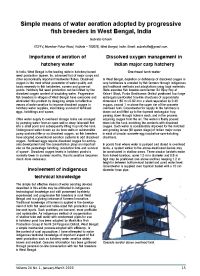
Simple means of water aeration adopted by progressive fish breeders in West Bengal, India

In India, West Bengal is the leading state in hatchery-based seed production (spawn, fry, advanced fry) of major carps and other economically important freshwater fishes. Dissolved oxygen is the most critical parameter of water quality and basic necessity in fish hatcheries, nursery and grow-out ponds. Hatchery fish seed production can be limited by the dissolved oxygen content of circulating water. Progressive fish breeders in villages of West Bengal have overcome and eliminated this problem by designing simple but effective means of water aeration to improve dissolved oxygen in hatchery water supplies, maximising survival of fertilised eggs, hatchlings and spawn. This article describes some of the techniques that have been adopted using low-cost and recycled materials.

We need an aquaculture internet of things

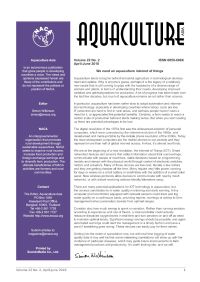
We are at the beginning of a new revolution, the Internet of Things (IOT): Smart networked devices and sensors that collect information about their surroundings, communicate with people and machines, make decisions based on programming models and interact with the physical world through control of switches, motors and actuators. Many of these devices are low-cost, literally a few dollars and they are getting cheaper all the time. The IOT offers new opportunities for the aquaculture industry to improve on-farm efficiency.

Global fish passage forum to include first symposium on hydropower and fish, December, Australia

The American Fisheries Society and the Environmental and Water Resources Institute of the American Society of Civil Engineers are holding this year's annual Fish Passage conference in Australia in December in collaboration with hosts Charles Sturt University and the New South Wales Government. The International Conference on River Connectivity, to be held in Albury from December 10 to 14 includes the First International Symposium on Hydropower and Fish Management.

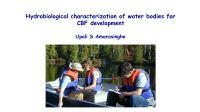
Hydrobiological characterisation of water bodies for CBF development

A presentation on assessment of the suitability of water bodies for culture-based fisheries development.

Giant Prawn 2017

The fourth major international event on giant freshwater prawns was organised by the Asian Institute of Technology from 20-24 March 2007. The conference, organised by Salin Krishna and Michael New, built on a series of highly successful events that trace back to the very beginnings of the industry. The first conference, Giant Prawn 1980 brought together all those involved in freshwater prawn research and farming for the first time and set many priorities for future research and development.

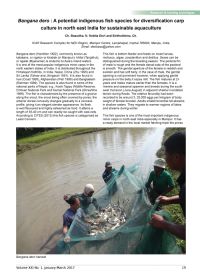
Bangana dero: A potential indigenous fish species for diversification of carp culture in north east India for sustainable aquaculture

Bangana dero is one of the most popular indigenous minor carps in the north eastern states of India, fetching triple the market prices of Indian major carps. B. dero is a bottom feeder and feeds on insect larvae, molluscs, algae, zooplankton and detritus. Over the last two decades the occurrence of wild juveniles of this fish in Indian rivers has fallen drastically. A protocol for induced breeding, larviculture, nursery rearing and growout including polyculture of B. dero is described.

Staff directory

Directory of NACA's staff members and their contact details.

Governing Council

The Governing Council is NACA's peak policy body, consisting of representatives from member governments.

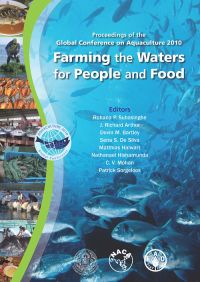
Proceedings of the Global Conference on Aquaculture 2010

The Global Conference on Aquaculture 2010 reviewed the present status and trends in aquaculture development, addressed emerging issues relevant to aquaculture development, assessed opportunities and challenges for future aquaculture development and built consensus on advancing aquaculture as a global, sustainable and competitive food production sector. This volume provides information on how aquaculture could be mobilized to alleviate global poverty and improve food and nutrition security in the coming decades.

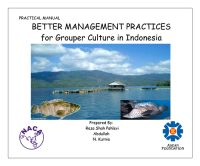
Better management practices for grouper culture in Indonesia: A practical manual

This practical manual covers key aspects for successful grouper farming including formation of farmer groups, cage crop planning, crop calendar and better management practices for cage aquaculture of grouper. These include site selection, design, cage preparation, seed selection and stocking practices, feed, water and health management, harvest and post-harvest, record keeping, marketing and capital strengthening. It is designed for use by small-scale farmers.

National Training Workshop for Cluster Certification Trainers

International requirements on food safety, traceability, animal health and welfare and social responsibility are increasingly stringent. The burden of compliance and the cost of certification are particularly heavy for small scale farmers who are often excluded by the limited resources at their disposal. Working in groups can help small scale farmers attain economies of scale necessary to address compliance issues and participate in certification schemes, improving their competitive position.

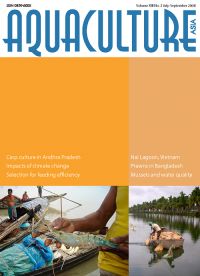
Aquaculture Asia Magazine, July-September 2008

In this issue:

Possible improvements to carp culture in Andhra Pradesh. Aquaculture and environmental issues in the region of Nai Lagoon, Vietnam. Selection potential for feed efficiency in farmed salmonids. Freshwater prawn broodstock concern in Bangladhesh hatcheries. Production of Cirrhinus molitorella and Labeo chrysophekadion for culture-based fisheries in Lao PDR: Nursery and grow-out. Mussel farming: Alternate water monitoring practice. Use of poultry by-product meals in pelleted feed for humpback grouper Cromileptes altivelis.

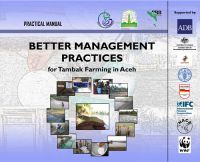
Practical Manual on Better Management Practices for Tambak Farming in Aceh

This practical manual provides better management practices for the farming of shrimp in tambak systems in Aceh, Indonesia. The manual addresses the formation of farmer groups, crop planning, and specifies better management practices. These include: Location of tambaks, design and construction of tambaks, pond preparation practices, shrimp seed selection and stocking practices, feed management practices, water management practices, health management practices, harvest and post-harvest handling practices, keeping records and improved marketing practices.

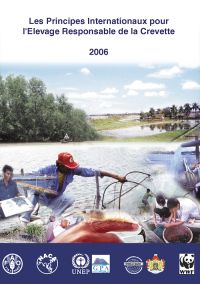
Principes Internationaux pour l'Elevage Responsable de la Crevette

L'élevage de la crevette est l’un des secteurs d'aquaculture le plus en essor dans beaucoup de régions du monde, il est également l’un des plus controversés. L'expansion rapide de ce secteur a généré, certes, des sources de revenus pour plusieurs pays, mais elle a été accompagnée par une préoccupation croissante sur les impacts environnemental et social. Les Principes Internationaux pour l'Elevage Responsable de la Crevette fournissent la base sur laquelle les parties prenantes peuvent collaborer pour un développement plus durable de l'élevage de crevette.

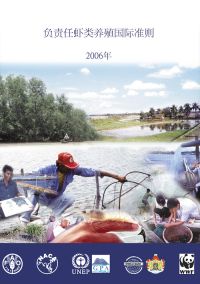
负责任虾类养殖国际准则

在世界许多地方,虾类养殖是水产养殖业增长最快,而且也是最具争 议的部门之一。这一部门的快速发展为许多国家创造了收入,但也伴随着 对环境和社会影响的忧虑。《负责任虾类养殖国际准则》在以更可持续的 方式发展虾类养殖方面为利益相关者之间开展合作提供了基础。《国际准 则》由虾类养殖与环境协作计划制定。该协作包括联合国粮食及农业组织 (粮农组织)、亚太水产养殖中心网、联合国环境规划署保护海洋环境免 受陆上活动污染全球行动纲领协调办公室、世界银行和世界自然基金会。

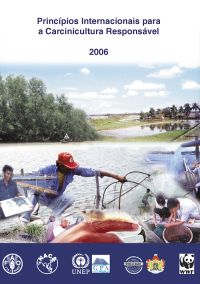
Princípios Internacionais para a Carcinicultura Responsável

O Cultivo de Camarão é um dos setores de mais rápido crescimento na aqüicultura em várias partes do mundo e também o mais controverso. A rápida expansão deste setor possibilitou a geração de renda para muitos países, entretanto, ela tem sido acompanhada por crescentes preocupações sobre seus impactos ambientais e sociais. Os Princípios Internacionais para a Carcinicultura Responsável provêm a base sobre a qual todas as partes interessadas poderão colaborar para um desenvolvimento mais sustentável do cultivo de camarão.

Principios Internacionales para el Cultivo Responsable de Camarón

El cultivo de camarón es uno de los sectores de la acuicultura de más rápido crecimiento y también uno de los más polémicos en muchas partes del mundo. La rápida expansión de este sector generó ingresos para muchos países, pero ha estado acompañada por preocupaciones crecientes relacionadas con sus impactos ambientales y sociales. Los Principios Internacionales para el Cultivo Responsable de Camarón proporcionan las bases sobre las cuales los diversos participantes pueden colaborar en pro de un desarrollo más sostenible de la camaronicultura.