NACA member governments are: Australia, Bangladesh, Cambodia, China, Hong Kong SAR, India, Indonesia, I.R. Iran, Kingdom of Saudi Arabia, Korea (DPR), Lao PDR, Malaysia, Maldives, Myanmar, Nepal, Pakistan, Philippines, Sri Lanka, Thailand and Vietnam.
A Regional Proficiency Testing Program for Aquatic Animal Disease Diagnostic Laboratories in Asia-Pacific was developed to strengthen diagnostic capability across Asia. This capability was identified as a requirement to facilitate the sanitary safety of trade in aquatic animal products. The program provided 41 laboratories across the Asia-Pacific with the opportunity to assess their diagnostic performance for 10 regionally significant aquatic animal pathogens, and to adapt or modify practices where necessary to improve.
Due to the world’s rapidly growing population, which is expected to peak somewhere around 9.5 billion, food production will need to be massively increased over the next few decades. This increase must be achieved without further degrading the environment. The unit environmental footprint of food production must be significantly reduced from where it is today. This concept, termed sustainable intensification, applies as much to aquaculture as it does to other agricultural sectors.
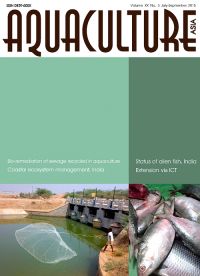
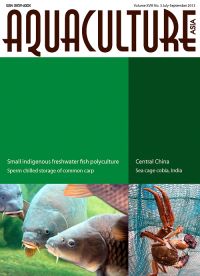
Changes to the magazine and website. Status of alien fish species farming and it's implications for Andhra Pradesh, India. Bridging the research-extension-farmer-input and market linkage gap in coastal aquaculture through application of ICT. Bio-remediation of domestic sewerage recycled in aquaculture: A Central Institute of Freshwater Aquaculture model. Role of family farming in marine and coastal ecosystem management in India. Conservation of fish genetic resources: An introduction to the state fishes of India.
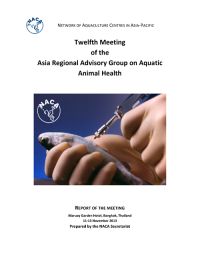
The Asia Regional Advisory Group on Aquatic Animal Health meets annually to discuss regional health issues including emerging disease threats. This report includes a review of regional disease status circa 2014, global and regional disease reporting arrangements, global issues and standards, progress in implementation of the the Regional Technical Guidelines on Health management for the Responsible Movement of Live Aquatic Animals, identification and designation of regional aquatic animal health resources and regional and international cooperation.
In this paper, the culture-based fisheries in lakes are presented, with special reference to mandarin fish and mitten crab stocking in lakes in China. The stocking rate of mandarin fish is determined by food consumption rates, which are mainly related to water temperature and fish size, and prey fish productivity. A bioenergetics model of mandarin fish was established to predict the growth and consumption of prey fish in stocked lakes.
This book is the proceedings of the “Regional Consultation on Culture-Based Fisheries Development in Asia”, held in Siem Reap, Cambodia, 21-23rd of October 2014, under the auspices of the Australian Centre for International Agricultural Research (ACIAR), the Mekong River Commission (MRC) and the Network of Aquaculture Centres in Asia-Pacific (NACA). The consultation was jointly organised by NACA and the Fisheries Administration of the Royal Government of Cambodia.
This report, the 68th in the series, contains information about the aquatic animal health status of thirteen states in the Asia-Pacific region. The foreword discusses harmonisation in ASEAN aquaculture certification.
12th Technical Advisory Committee held in Cha-am, Thailand. Audio recordings: WAS special session on regional cooperation for improved biosecurity. AFSPAN Final Technical Report now available! Pillay Aquaculture Foundation Awards for Scientists in Least Developed Countries. Gender seminar conducted and ASEAN Gender Network launched. A two-tube, nested PCR detection method for AHPND bacteria. 9th Regional Grouper Hatchery Production Training Course. Developing an environmental monitoring system to strengthen fisheries and aquaculture in the Lower Mekong Basin. Asia-Pacific Regional Workshop on the Status of Aquatic Genetic Resources for Food and Agriculture.
The objectives of the Aquaculture for Food Security, Poverty Alleviation and Nutrition (AFSPAN) project were to strengthen the knowledge base and develop new and more rigorous methodologies of quantifying the contribution of aquaculture to combat hunger and poverty, thus providing the evidence upon which sound strategies, policies and research programs can be developed to support the sustainable expansion of aquaculture to maximise its impact on food and nutrition security and poverty alleviation.
This report, the 67th in the series, contains information about the aquatic animal health status of fourteen states in the Asia-Pacific region. The foreword discusses the OIE Regional Workshop on Safe International Trade in Aquatic Animals and Aquatic Animal Products.
Regional consultation on culture-based fisheries developments in Asia. Gender Assessment Synthesis Workshop. NACA participation in the 5th Global Symposium on Gender in Aquaculture and Fisheries, Lucknow, India. Broodstock Management in Aquaculture: Long term effort required for regional capacity building. Urgent appeal to control spread of the shrimp microsporidian parasite Enterocytozoon hepatopenaei (EHP).
Labour issues in the fishing and aquaculture industries. Commercial tilapia farming at take-off point in Fiji. Tank based captive breeding and seed production of the pearlspot (Etroplus suratensis). Cage culture of pearlspot in Kerala, India. Culture-based fisheries exchange visit from Lao PDR to Cambodia. National Fish Day, Cambodia. WAS Adelaide: Special Session on Regional Cooperation for Improved Biosecurity. Inbreeding and disease in tropical shrimp aquaculture: A reappraisal and caution.
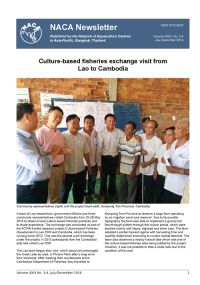
Culture-based fisheries exchange visit from Lao to Cambodia. National Fish Day, Cambodia. WAS Adelaide: Special Session on Regional Cooperation for Improved Biosecurity. Inbreeding and disease in tropical shrimp aquaculture: a reappraisal and caution. Shrimp EMS/AHPND Special Session at DAA9. 2nd International Symposium on Aquaculture and Fisheries Education. Report on Sustainable Fisheries and Aquaculture for Food Security and Nutrition.
This report, the 64th in the series, contains information about the aquatic animal health status of fourteen states in the Asia-Pacific region. The foreword discusses the 9th Symposium on Diseases in Asian Aquaculture.
The Asia Regional Advisory Group on Aquatic Animal Health meets annually to discuss regional health issues including emerging disease threats. This report includes a review of regional disease status circa 2013, global and regional disease reporting arrangements, global issues and standards, progress in implementation of the the Regional Technical Guidelines on Health management for the Responsible Movement of Live Aquatic Animals, identification and designation of regional aquatic animal health resources and regional and international cooperation.
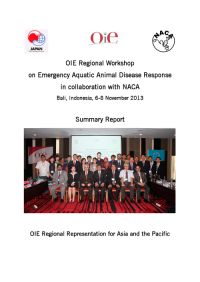
The workshop was held in Bali, Indonesia from 6 to 8 November 2013. The programme included reports on current aquatic animal disease situations in selected countries and presentations on the national aquatic animal health programmes of China, Japan and Korea. In addition, case studies on the molluscan diseases, shrimp diseases and finfish diseases were presented to facilitate the subsequent discussion on emergency response of those diseases in the national and regional level.
International Symposium on Small-scale Freshwater Aquaculture Extension, 2-5 December, Bangkok. 12th Meeting of the Asia Regional Advisory Group on Aquatic Animal Health. National Workshop on EMS/AHPND of Cultured Shrimp held in India. Report on early mortality syndrome / acute hepatopancreatic necrosis syndrome of shrimp. Sustaining Ethical Aquaculture Trade Newsletter. India and the AFSPAN Project. Report on AFSPAN Chilean survey. Feeding and feed management of Indian major carps in Andhra Pradesh.
This report is the proceedings of a workshop held under the FAO technical cooperation project Emergency assistance to control the spread of an unknown disease affecting shrimps held in Hanoi, Viet Nam from 25 to 27 June 2013. The workshop reviewed recent investigations into the cause of acute hepatopancreatic necrosis syndrome, believed to related to a strain of Vibrio parahaemolyticus and drew a number of recommendations on specific and generic actions and measures for reducing the risk of AHPND.
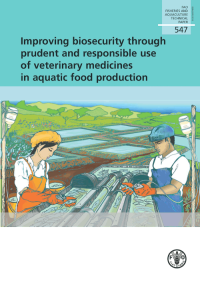
These are the proceedings of the FAO/AAHRI Expert Workshop on Improving Biosecurity through Prudent and Responsible Use of Veterinary Medicines in Aquatic Food Production, held in Bangkok, Thailand, from 15 to 18 December 2009. The workshop discussed the current status of antimicrobial usage in aquaculture and the impacts of their irresponsible use on human health, the aquatic environment and trade. The outcomes are relevant to the development of guiding principles on the responsible use of antimicrobials in aquaculture.
A second trip to Hubei Province, central China. Sea cage growout of cobia Rachycentron canadum in the Gulf of Mannar. Culture of small indigenous fish species in polyculture with Indian major carps and high value crops along pond dykes. Study on sperm chilled storage of common carp Cyprinus carpio in Vietnam. Culture-based fisheries exchanges between Lao PDR and Cambodia. Culprit behind massive shrimp die-offs in Asia unmasked.