NACA member governments are: Australia, Bangladesh, Cambodia, China, Hong Kong SAR, India, Indonesia, I.R. Iran, Kingdom of Saudi Arabia, Korea (DPR), Lao PDR, Malaysia, Maldives, Myanmar, Nepal, Pakistan, Philippines, Sri Lanka, Thailand and Vietnam.
This report, the 62nd in the series, contains information about the aquatic animal health status of sixteen states in the Asia-Pacific region. The foreword discusses the outcomes of the 12th meeting of the Asia Regional Advisory Group on Aquatic Animal Health.
This report, the 61st in the series, contains information about the aquatic animal health status of fifteen states in the Asia-Pacific region. The foreword discusses the OIE tool for evaluation of performance of aquatic veterinary services.
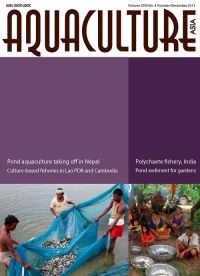
Special session on regional cooperation for improved biosecurity. Pond aquaculture taking off in Nepal. Introduction of culture-based fishery practices in small water bodies in Cambodia: Issues and strategies. A case study on polychaete fishery by the Irular tribal fishing community on the Tamil Nadu coast. Use of pangasius pond sediment for rooftop bag gardening: Potential for rural-urban integrated agriculture-horticulture. Culture-based fisheries exchanges between Lao PDR and Cambodia.
Culture-based fisheries development in Lao PDR and Cambodia proceeding well. National aquatic animal disease surveillance programme launched in India. Report on early mortality syndrome / acute hepatopancreatic necrosis syndrome of shrimp. International Symposium on Small-scale Freshwater Aquaculture Extension, 2-5 December, Bangkok. 'Perfect' food for 'perfect' prawns. Aquaculture without Frontiers Special Session. We asked CSIRO: Gold Coast Tiger Prawns. Understanding the sex of salmon. Overcoming smallholder challenges with biotechnology. Coordinated efforts in aquaculture needed to meet global demand. FAO e-book collection for tablets and e-readers.
The Department of Animal Husbandry Dairying and Fisheries, Ministry of Agriculture, Government of India has approved a national project on aquatic animal disease surveillance for five years and funding of INR 320 million (about US$ 6 million) has been allocated through the National Fisheries Development Board (NFDB). A national consultation on aquatic animal disease surveillance held last April 2012, attended by NACA, made a strong recommendation for the need for a national program on surveillance.
NACA was pleased to coordinate an aquaculture study tour to Bangladesh, Vietnam and Thailand from 19-26 April for a delegation of twelve fisheries development officials from Assam, India. The delegation included Mr Sri Hemanta Narzary, Commissioner and Secretary for Fisheries; Mr Sri Kailash Chang Damria, State Project Director for the ARIAS Society, Mr Sri Siddhartha Purkayastha, Deputy Directory of Fisheries, and district fisheries development and extension officers.
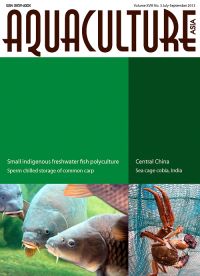
A second trip to Hubei Province, central China. Sea cage growout of cobia Rachycentron canadum in the Gulf of Mannar. Culture of small indigenous fish species in polyculture with Indian major carps and high value crops along pond dykes. Study on sperm chilled storage of common carp Cyprinus carpio in Vietnam. Culture-based fisheries exchanges between Lao PDR and Cambodia. Culprit behind massive shrimp die-offs in Asia unmasked.
Culture-based fisheries exchanges between Lao PDR and Cambodia. Culprit behind massive shrimp die-offs in Asia unmasked. Presentations from the final technical consultation on EMS/AHPNS of shrimp available for download. Aquaculture certification workshop held in Viet Nam. Aquaculture in a genetic plunge towards extinction? NACA implements World Bank training program on Good Aquaculture Practices. Study tour on aquaculture and wetland management for delegation from Assam, India. Koh Yao Noi Tree Bank and mangrove replanting continues. Consistent fish names key to consumer confidence. We are hiring! Request for contributions: Global Advances in Ecology and Management of Golden Apple Snails (2nd edition).
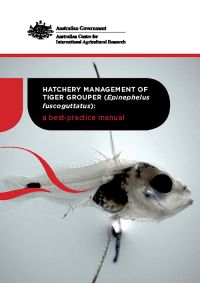
This manual provides guidelines for the production of tiger grouper fingerlings. It outlines best-practice methods for broodstock maintenance, spawning, egg incubation and rearing of larvae through to 2–3 cm, fully metamorphosed juveniles. The guidelines have been developed from the outcomes of ACIAR-funded research, as well as from the experience of Indonesian, Philippine and Australian scientists and commercial hatchery operators, and published information. It provides an aid for improving the availability of grouper seed stock.
This report, the 60th in the series, contains information about the aquatic animal health status of fifteen states in the Asia-Pacific region. The foreword discusses response to aquatic animal disease emergencies.
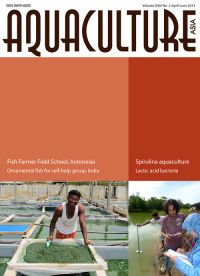
Workshop on mainstreaming gender in NACA. Fish Farmer Field School: Towards healthier milkfish / shrimp polyculture and fish farmer empowerment in South Sulawesi. A success story of Maa Tarini Self Help Group Ornamental Fish Unity, India. Use of lactic acid bacteria in fish farming. AFSPAN field surveys underway. Anti-viral treatment for healthier black tiger prawns. Jungle perch on the comeback trail. Nursery management of grouper manual. Hatchery management of tiger group manual.
Call for applications (2nd round): FK Norway South-South Aquaculture Professional Exchange Programme. AFSPAN field surveys underway! 4th Global Symposium on Gender in Aquaculture and Fisheries. An anti-viral treatment for healthier black tiger prawns. Jungle perch on the comeback trail. Nursery management of grouper: A best-practice manual (Indonesian translation). Hatchery management of tiger grouper (Epinephelus fuscoguttatus): A best-practice manual (Indonesian translation). Priority adaptations to climate change for Pacific fisheries and aquaculture: Reducing risks and capitalising on opportunities. Improving biosecurity through prudent and responsible use of veterinary medicines in aquatic food production.
This report, the 59th in the series, contains information about the aquatic animal health status of sixteen states in the Asia-Pacific region. The foreword contains an update on acute hepatopancreatic necrosis syndrome (AHPNS) of cultured shrimp.
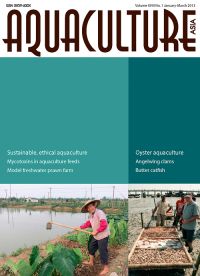
Health issues are not going away. Sustainable and Ethical Aquaculture Trade project in China. Oyster aquaculture for coastal defense and food production in Bangladesh. Importance of mycotoxins in aquaculture feeds. A model modular farm for size grading and monosex culture of freshwater prawn. Angelwing clam (Pholas orientalis) future assured after Thai DOF's breeding success. Ompok bimaculatus, an emerging species for diversification of aquaculture in Tripura, North-eastern India.
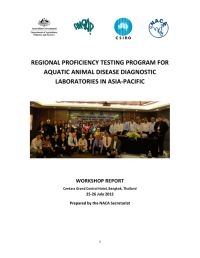
This is the report of the first workshop of the Regional proficiency testing program for aquatic animal disease diagnostic laboratories in Asia-Pacific, held from 25-26 July 2012 in Bangkok, Thailand. The objectives of the programme were to strengthen Asia’s regional capability to diagnose important aquatic animal diseases that impact on trade, train participating laboratory personnel in diagnostic standards and proficiency testing procedures, and to provide technical assistance to improve laboratory performance.
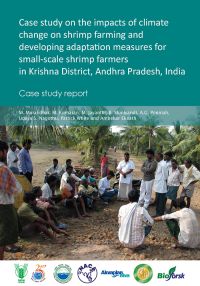
Shrimp aquaculture is threatened by climatic changes that affect infrastructure and livelihoods of farmers. Ecological changes, inundation of low-lying lands and saline intrusions into freshwater regions are likely to cause substantial dislocation of communities and disruption of farming systems. The focus of the present study report is on mapping the small scale farmer’s perceptions and attitudes towards climate change impacts and their adaptive capacities to address the impacts in Krishna District, Andhra Pradesh, India.
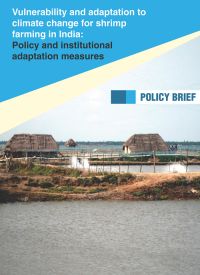
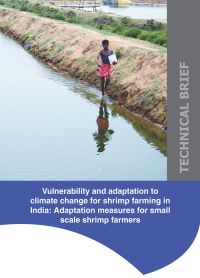
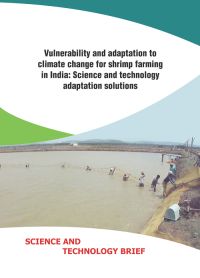
This brief summarises the results from the interdisciplinary and multi stakeholder participatory study conducted within the Aquaclimate Project in Krishna District, Andhra Pradesh, India looking at the impacts of climate change on shrimp farming. The brief further provides guidelines for development of policy measures to address the climate change impacts on small scale shrimp farming.
This technical brief summarises the results from the interdisciplinary and multi stakeholder participatory study conducted within the Aquaclimate project in Krishna District, Andhra Pradesh, India, looking at the impacts of climate change and adaptation measures in the shrimp farming sector. The brief further provides guidelines for adaptation measure that can be undertaken by the farmers together with the institutional, policy and science and technology support for improving their adaptive capacity to cope with future climate change.
This brief summarises the results from the interdisciplinary and multi stakeholder participatory study conducted within the Aquaclimate project in Krishna District, Andhra Pradesh, India, looking at the impacts of climate change and adaptation measures in the shrimp farming sector. The brief based on scientific analysis and stakeholders inputs, further provides science and technology solutions to be undertaken for improving farmers' adaptive capacity to climate change.
This report, the 58th in the series, contains information about the aquatic animal health status of fifteen states in the Asia-Pacific region. The foreword contains a disease advisory notice on acute hepatopancreatic necrosis syndrome (AHPNS) of cultured shrimp.