NACA member governments are: Australia, Bangladesh, Cambodia, China, Hong Kong SAR, India, Indonesia, I.R. Iran, Kingdom of Saudi Arabia, Korea (DPR), Lao PDR, Malaysia, Maldives, Myanmar, Nepal, Pakistan, Philippines, Sri Lanka, Thailand and Vietnam.
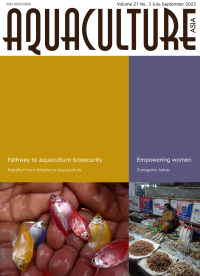
Promoting and encouraging community participation in marine ornamental aquaculture presents an alternative approach to enhancing the economic status of marginalised individuals, particularly women, in the Lakshadweep islands. Additionally, it aids in curbing the wild capture of marine ornamental organisms, thereby relieving pressure on natural resources. The article examines the strategy of community-based marine ornamental aquaculture and its significance in bolstering the economy of islanders, particularly women, in the Lakshadweep Sea. It seeks to investigate effective approaches to promote the sustainability of the coral reef ecosystem in the region. High-value marine ornamental organisms, such as fishes and shrimps, are cultivated in community aquaculture units using simplified technology. These organisms are supplied to aquarists and hobbyists, thus supplementing the income of local women islanders.
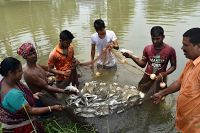
The Central Institute of Freshwater Aquaculture uses funds from the Scheduled Caste Sub Plan project to provide support such as fish seed, feed, lime, and manure to Scheduled Caste farmers. The goal is to enable them to utilise untapped water resources for fish production. This support in aquaculture inputs has resulted in increased fish production, heightened income, the creation of employment opportunities, the development of skilled labourers, and made a significant contribution to the national income. Marginal fish farmers have consistently generated revenue through these efforts. They have also directly provided poor communities with essential nutrients through fish consumption, combating hunger. This article describes the methodology and outcomes of the project Scientists-Farmers Interface and Aquaculture Input Support to SC Farmers of Sonarpur C.D. Block.
With the implementation of the new aquatic animal disease reporting in the Asia Pacific region from January 2021, and in lieu of the published QAAD Reports (last issue published was 4th quarter of 2020), NACA is publishing reported aquatic animal diseases submitted by countries in the Asia-Pacific region. This report covers the fourth quarter of 2023 and the original and updated reports can be accessed from the QAAD page.
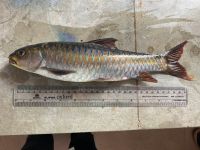
This article investigates the ecological, economic, and cultural importance of Neolissochilus hexagonolepis, commonly known as chocolate mahseer and its potential for hill aquaculture in Northeast India. The taxonomy, distribution, and distinct features are described. Chocolate mahseer populations are in decline due to habitat degradation, overfishing and environmental changes, and it is designated as "near threatened" by the IUCN. Breeding patterns, growth parameters, and culture techniques are explored in depth as a candidate species for aquaculture development. Conservation initiatives and the need to balance economic utilisation with species conservation in chocolate mahseer farming are discussed.
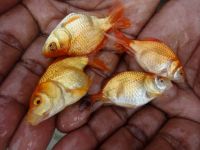
The article highlights the successful commercial-scale breeding, propagation, rearing, and sale of aquarium fish species in the Howrah and South 24 Parganas districts of West Bengal, India. It focuses on the innovative practices of two experienced aquarium fish farmers, Sri Bikash Sau and Sri Swapan Parua, who have introduced a novel approach to aquarium fish culture in open earthen and common village ponds. The success stories of Sri Bikash Sau and Sri Swapan Parua serve as inspirations for small and medium-scale farmers and aqua-entrepreneurs. Their innovative approach to open pond production for aquarium fishes demonstrates the increasing potential and expansion of the aquarium fish business in the region.
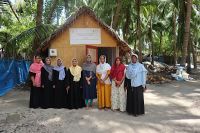
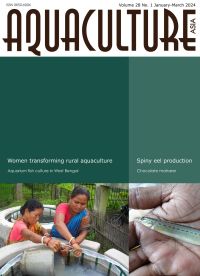
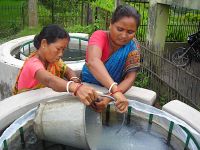
Aquaculture has traditionally been a male-dominated activity. Changes in rural dynamics, with men migrating to cities for better opportunities, have led women to take up aquaculture in Bengal. Collaboration with Krishi Vigyan Kendras and local R&D institutions have provided them with training in ecological aquaculture, focusing on resource utilisation. Women engage in agro-ecological farming, utilising local inputs and traditional knowledge. The cooperative approach has enabled women to systematise production processes at a low cost, overcoming challenges and reviving local production. By forming self-help groups women have access to unconventional water resources and utilise mobile communication tools to strengthen the fish production system. The article discusses the broader role of women in diverse domains of aquaculture, including fish culture, hatchery management, nutrition, and fish processing technology, showcasing their resilience, capability, and contributions to the success of aquaculture.
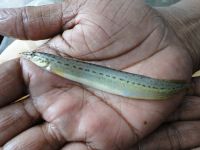
The striped spiny eel, Macrognathus pancalus, is economically significant but faces population decline due to anthropogenic factors. This study presents a comprehensive approach to breeding and seed production techniques for M. pancalus, conducted at the Regional Research Centre, ICAR-Central Institute of Freshwater Aquaculture, Rahara, India. The study describes broodstock management simulation of natural habitat to stimulate natural breeding. Techniques for hatching and larval rearing, management of early spawn, and precautions to prevent cannibalism are presented. Survival of 88% after one month was achieved. The breeding and seed production techniques provided are suitable for farmers to adapt, and will contribute to the conservation and utilisation of M. pancalus in sustainable aquaculture practices. The findings also highlight the economic potential of this species to provide a nutritious option for consumers at affordable prices.
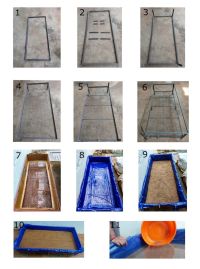
This study explores the cultivation of the Indian spiny loach, Lepidocephalichthys thermalis, in indigenously designed poly-lined iron frame tanks as a sustainable solution. The article details the fabrication methods for these tanks, highlighting the use of rust-resistant iron and low-density polyethylene sheets.The study proposes a supplementary feed mixture and provides insights into water quality management to ensure optimal conditions. The study demonstrates the potential for achieving a net production level of 1 kg from 400 liters, offering economic viability for farmers. The modified tank-based rearing system is shown to be beneficial in hilly regions with limited land and water resources.
With the implementation of the new aquatic animal disease reporting in the Asia Pacific region from January 2021, and in lieu of the published QAAD Reports (last issue published was 4th quarter of 2020), NACA is publishing reported aquatic animal diseases submitted by countries in the Asia-Pacific region. This report covers the third quarter of 2023 and the original and updated reports can be accessed from the QAAD page.
In 2023, FAO and NACA initiated a consultation process on aquaculture effluent management in Asia and the Pacific in collaboration with NACA member governments. Experts across the region gathered information to assess the state of governance, advancements in technology and innovation in aquaculture effluent management. The consultative process culminated in an expert workshop, convened from 14 to 15 November, funded by FAO, to share views and national experiences on aquaculture effluent management.
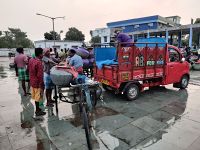
Naihati fish seed market of West Bengal was established in 1976 and is the largest seed market in India. With the advent of induced breeding technology and hatcheries, fish seed is now available almost year-round, catering to the need of Indian farmers. Situated in North 24 Parganas, Naihati wholesale fish seed market is a well-known establishment that provides multifaceted services to stakeholders including fish seed growers, retailers, sellers, and mediators. This article describes the state of the market as aspects of its evolution over time.
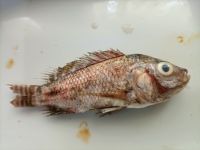
In late 2022 tilapia parvovirus (TiPV) was found to be associated with mass mortalities of tilapia in Odisha, India, both individually and in co-infections with tilapia lake virus. Infections have also been reported from Thailand and China. Clinical signs include lethargy, scale loss, redness on the body with haemorrhages on the operculum, base of fins and ventral part, opaqueness of the eyes, swimming near the pond edge and loss of appetite before death. This article describes the epidemiology of TiPV disease including its diagnosis, transmission, prevention and control, and its potential impact on the tilapia aquaculture industry.
The Late Sri Kripan Sarkar was an enterprising ornamental fish breeder-cum-farmer par excellence, exporter and supplier of the same from northern part of West Bengal. As proprietor of Rainbow Ornamental Fish Farm, at Bakshipara Village in Jalpaiguri District, he was an expert and authority in scientific breeding, larval rearing, propagation, research and experimentation on economically important freshwater ornamental fishes. There was a time when Sri Sarkar was the only commercial ornamental fish breeder in north Bengal. This article documents his experiences and career as an influential pioneer in the ornamental fish culture trade.
With the implementation of the new aquatic animal disease reporting in the Asia Pacific region from January 2021, and in lieu of the published QAAD Reports (last issue published was 4th quarter of 2020), NACA is publishing reported aquatic animal diseases submitted by countries in the Asia-Pacific region. This report covers the second quarter of 2023 and the original and updated reports can be accessed from the QAAD page.
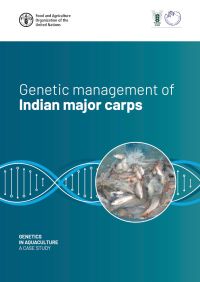
Collectively carps represent the largest global aquaculture sector, contributing over 20 percent of global aquaculture production. The Indian major carps including catla (Catla catla), rohu (Labeo rohita) and mrigal (Cirhinnus mrigala) are cultured widely across the Indian sub-continent with the main culture system being a multi-species polyculture in ponds, often including other carp species. This production sector is supported by major seed supply systems producing over 50 billion seed per annum. This case study analyses genetic management of Indian major carps since they were first domesticated with the development of hypophysation techniques in the 1950s. A review of literature and a survey of common hatchery practices identifies significant problems prevalent in the sector brought about by a lack of application of best practices in genetic management resulting in loss of genetic diversity, inbreeding and uncontrolled hybrid introgression.
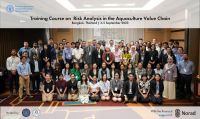
Risk analysis is an essential component of a national aquatic organism health strategy. Now widely applied in many fields, risk analysis provides a science-based framework for evaluating hazards, determining the likelihood and extent of potential harms, mitigating risks and guiding policy decisions. Combining risk and value chain analysis provides a risk-based and people-centred approach to managing disease risks and planning control measures for aquaculture systems. FAO organised a training course on Risk Analysis in the Value Chain from 3-5 September in Bangkok, Thailand, in partnership with NACA, INFOFISH, Thailand Department of Fisheries and the ASEAN Network of Aquatic Animal Health Centres. Financial support was provided by the Norwegian Agency for Development Cooperation and Thailand Department of Fisheries.