3 February 2004Haylor, G., Briggs, M.R.P., Pet-Soede, L., Tung, H., Yen, N.T.H., Adrien, B., O'Callaghan, B., Gow, C., De Vantier, L., Santos, R., Pador, E., de la Torre, M., Bulcock, P., and Savage, W. | 26865 views | .pdf | 2.25 MB
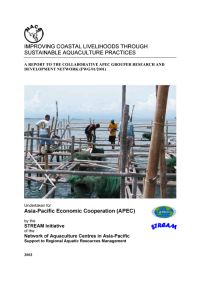
Wild-harvest fisheries for live reef fish are largely over-exploited or unsustainable. Sustainable aquaculture – such as that of groupers – is one option for meeting increasing demand for reef fish as well as potentially maintaining livelihoods of coastal communities. This report draws upon secondary literature, media sources and four diverse case studies from at-risk reef fisheries, to frame a strategy for encouraging sustainable aquaculture as an alternative to destructive fishing practices. It was commissioned by the APEC Secretariat.
The Second SPARK-STREAM Workshop on Livelihoods and Languages took place in Tagaytay City, Philippines, from 12-14 June 2003. The outputs of the workshop included drafts of a language-specific “Guide to Learning and Communicating about Livelihoods”, drafts of articles for STREAM Journal and SPARK Newsletter, identification of priorities and practical follow-up for capacity-building in carrying out participatory livelihoods analysis and the development of follow-up plans.
The purpose of this workshop was to build shared understandings of participatory livelihoods concepts and approaches, with emphases on the approaches as ways of thinking and working, and on learning from concrete examples from the experiences of STREAM in Cambodia and Vietnam, and SPARK in the Philippines. One outcome from the first workshop, was that between the two workshops participants would carry out follow-up tasks appropriate to their context.
Sulawesi has the largest coral reef area in Indonesia, at the epicenter of worldwide marine biodiversity, but is one of the areas most threatened in Southeast Asia by destructive fishing practices. This case study reviews the potential for aquaculture to provide alternative livelihoods for fishers within the context of an integrated, community-based coastal management plan with involvement of local communities empowered to control and steward their resources so that they can conserve and utilise them sustainably.
The Nature Conservancy has been working in Komodo National Park since 1995 to establish a marine reserve that 1) ensures long-term protection of the natural community structure, habitat and species and protects a portion of the exploited reef fish stock to enhance fisheries in the traditional use zones inside the Park and in the waters surrounding the Park. This case study illustrates mariculture activities that could contribute to conservation purposes and more sustainable use of natural resources.