The 83rd edition of the Quarterly Aquatic Animal Disease report contains information from twelve governments. The foreword discusses the upcoming 11th Symposium on Diseases in Asian Aquaculture (DAA 11), which will be held from 29 September to 2 October 2020, at the Borneo Convention Center, Kuching, Sarawak, Malaysia.
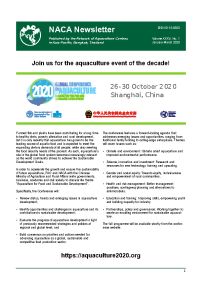
Join us for the aquaculture event of the decade! 18th Meeting of the Asia Regional Advisory Group on Aquatic Animal Health; New Director General of the Department of Fisheries, Thailand; Thailand holds National Sea Bass Fair; Tuskfish CMS 2.0 is available; Regional consultations on strengthening aquaculture governance and demographic changes in fishing communities; INFOFISH World Shrimp Conference and Exposition.
The 35th Session of Asia-Pacific Fishery Commission has identified the lack of effective governance as a major threat to sustainable aquaculture growth for greater contribution to achievement of the Sustainable Development Goals. The objectives of the consultation were to: Share the results of country studies on aquaculture governance in respective countries; identify gaps, issues and challenges in aquaculture governance; and recommend strategies and actions to improve and strengthen aquaculture governance.
27 January 2020Huang Jie, Yuan Derun, Xiangjun Yao | 4709 views | .mp3 | 11.1 MB
Audio recording of presentation delivered at the Consultation on Strengthening Governance of Aquaculture for Sustainable Development in Asia-Pacific, 5-6 November 2019, Bangkok, Thailand.
27 January 2020Chin Da | 4153 views | .mp3 | 6.99 MB
Audio recording of presentation delivered at the Consultation on Strengthening Governance of Aquaculture for Sustainable Development in Asia-Pacific, 5-6 November 2019, Bangkok, Thailand.