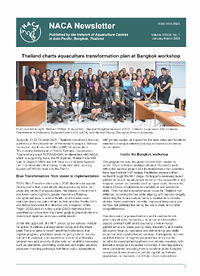
In this issue:
- Thailand charts aquaculture transformation plan at Bangkok workshop.
- Report of the 3rd High-Level Meeting on Aquaculture Transformation in Asia and the Pacific Region.
- AquaHub Vision Workshop: Setting a direction.
- AquaHub private-sector engagement discussion at Third AQUADAPT Peer Learning Event.
- Veterinary training programme: Fundamentals of farm health management in aquaculture.
- Reported aquatic animal diseases in the Asia-Pacific region during the first and second quarters of 2025.
- PhD scholarships in marine sciences: Shanghai Ocean University PhD Programme 2026.
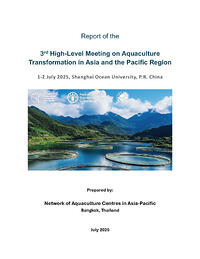
The third High-Level Meeting on Aquaculture Transformation assessed progress towards 2030 transformation goals and identified priority actions for the Asia-Pacific region. The meeting report, covering discussions held 1-2 July 2025 in Shanghai, documents findings from representatives of NACA member governments, FAO and regional organisations.
Participants identified multiple barriers to sustainable intensification: farmer scepticism about unfamiliar technologies, limited access to expertise, and misaligned incentives that prioritise profit over environmental responsibility. Investment remains concentrated at higher levels rather than reaching small-scale producers. The discussions emphasised collaborative approaches, knowledge-based farming systems, and the need to document aquaculture's positive social impacts.
NACA and FAO will continue supporting National Innovation and Investment Plans in India, the Philippines, Thailand and Vietnam. Future work includes establishing an Aquaculture Innovation and Investment Hub and developing monitoring systems to track transformation progress across the region.

Bangkok, 7 October - NACA convened a one-day, in-person working group to shape the vision, mission and strategy for the AquaHub, a startup incubator and support network for innovators in the aquaculture space. The workshop focused on establishing the AquaHub’s vision, mission, values and partnership principles to define how it will operate, and the immediate steps required to mobilise partners and resources across the Asia–Pacific.
Participants began by clarifying the problems AquaHub should address and why a dedicated hub is the right vehicle. Small group exercises produced draft vision and mission statements looking to 2035, which were then refined through rapid peer feedback. This work was grounded in a brief review of AquaHub’s current status and the wider innovation landscape to ensure complementarity with existing efforts.
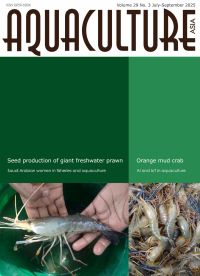
In this issue:
- From office to field: The role of women in Saudi Arabia’s small-scale aquaculture and fisheries sector
- Farming of orange mud crab in the Indian Sundarbans: Opportunities and challenges
- Seed production of giant freshwater prawn in brackishwater ponds in Purba Medinipur, West Bengal
- AI and IoT (AIoT): The New Wave in Fish Farming
- NACA Newsletter
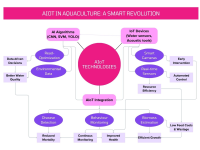
Aquaculture is changing as farms add artificial intelligence (AI) and the Internet of Things (IoT). Sensors and cameras watch water quality and animal behaviour, while software analyses the data to guide feeding, detect disease early, and plan harvests. This “AIoT” approach helps farmers act faster and with more accuracy.
This article reviews the main uses now in play such as automatic counting of postlarvae, biomass estimation, smart feeding, water-quality monitoring, behaviour tracking, and health diagnostics. The benefits include higher productivity, lower costs, and better fish welfare. Barriers to adoption are also summarised such as equipment cost, connectivity, and training needs.


