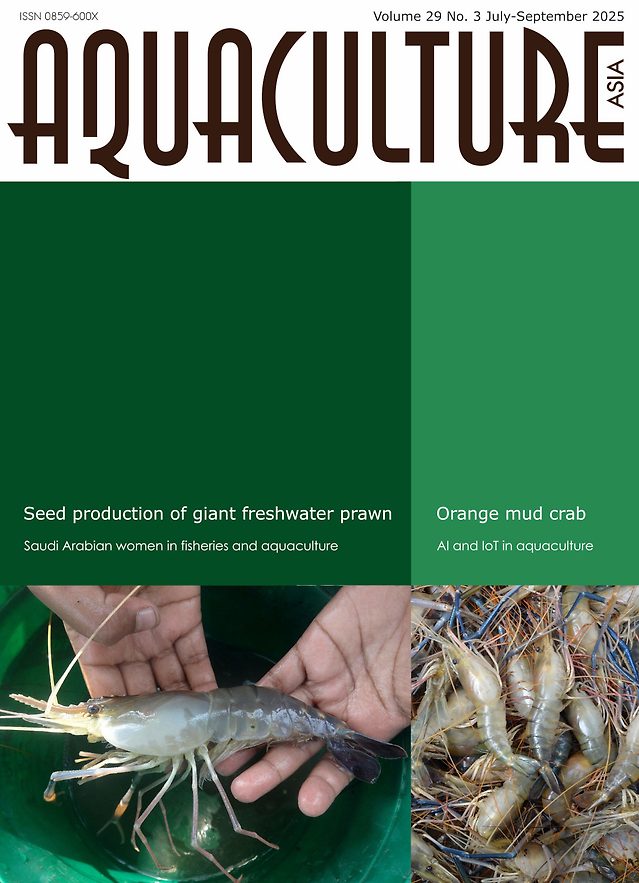
From office to field: The role of women in Saudi Arabia’s small-scale aquaculture and fisheries sector Hana Bahi, Osamah Ahmad, Pedro Guemes, Benjamin C. Young, Hussain Alnazry, Saif Algethami, and Ali Al Shaikhi
Farming of orange mud crab in the Indian Sundarbans: Opportunities and challenges Biju Francis, Debasis De, Sudheer N. S. and Kuldeep K. Lal
Seed production of giant freshwater prawn in brackishwater ponds in Purba Medinipur, West Bengal Subrato Ghosh and Himadri Chandra
AI and IoT (AIoT): The New Wave in Fish Farming Arun Konduri, Raveendar Banothu, Shyam Prasad. M, Potluri Sai Kishore, Kalithkar Bheemeswararao
Aquaculture Asia Magazine is an autonomous publication that gives farmers and scientists in developing countries a voice. Stories concern the small-scale aquaculture prevalent in the region and the circumstances of farmers trying to make ends meet in an increasingly globalised world. We accept articles on any aspect of aquaculture and the related processing, marketing, economic, environmental and social issues. An RSS feed is available if you wish to stay informed of new issues.
9 October 2025 | Hana Bahi, Osamah Ahmad, Pedro Guemes, Benjamin C. Young, Hussain Alnazry, Saif Algethami, and Ali Al Shaikhi | 1251 Downloads | .pdf | 1.62 MB
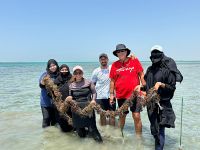
Saudi Arabia’s coastal communities are opening new pathways for women in aquaculture and fisheries. Under the REEF programme led by MEWA, recent pilots have shifted participation from office-based roles toward hands-on production and processing. Seaweed farming trials of Gracilaria multipartita in Jeddah and the Farasan Islands show why: accessible tasks, modest equipment needs, and suitability for community-run operations. In parallel, a women-led seafood processing initiative in the Farasan Islands has provided training, essential tools, and branding skills, improving hygiene and product quality and motivating participants to form cooperatives; a tuna-canning exercise highlighted the potential for higher value capture.
8 October 2025 | Biju Francis, Debasis De, Sudheer N. S. and Kuldeep K. Lal | 1573 Downloads | .pdf | 4.27 MB
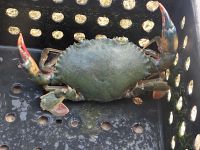
Orange mud crab (Scylla olivacea) has emerged as the main mud crab for aquaculture in the Sundarbans, supplying India’s live-crab export trade. This article explains why: faster maturation at smaller sizes, strong demand for gravid females, and practical fattening systems using HDPE boxes or seasonal pond units with tied claws. It summarises how farmers source crabs, feed with trash fish, grade by size and reproductive status, and move product through local traders to export hubs.
7 October 2025 | Subrato Ghosh and Himadri Chandra | 1075 Downloads | .pdf | 5.68 MB
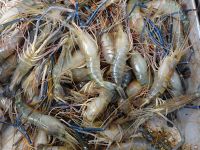
Farmers in West Bengal produce giant freshwater prawn seed in coastal ponds. The article sets out their practices in pond preparation and management, stimulating natural food with simple biological aids, and use of in-pond shelters to support survival. Broodstock come from two sources: local rivers or freshwater grow-out -offering different balances of reliability and handling effort. Seed then moves through harvest, grading, packing and delivery to buyers. With a livelihoods-and-sustainability focus, the model benefits smallholders, lessens river collection pressure and underpins a steadier giant freshwater prawn seed pipeline in eastern India.
6 October 2025 | Arun Konduri, Raveendar Banothu, Shyam Prasad. M, Potluri Sai Kishore, Kalithkar Bheemeswararao | 9896 Downloads | .pdf | 329.47 KB
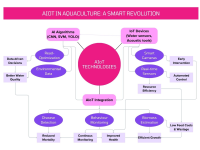
Aquaculture is changing as farms add artificial intelligence (AI) and the Internet of Things (IoT). Sensors and cameras watch water quality and animal behaviour, while software analyses the data to guide feeding, detect disease early, and plan harvests. This “AIoT” approach helps farmers act faster and with more accuracy.
This article reviews the main uses now in play such as automatic counting of postlarvae, biomass estimation, smart feeding, water-quality monitoring, behaviour tracking, and health diagnostics. The benefits include higher productivity, lower costs, and better fish welfare. Barriers to adoption are also summarised such as equipment cost, connectivity, and training needs.