Better management practices

Improved management practices to generate better crop outcomes, environmental performance and profitability through improved resource utilisation efficiency.

Creative Commons Attribution.
Related

Subject tags

A collection of subject tags relating to technical matters.

In this collection

Multiple use of water resources in culture-based fisheries

Harmonising culture-based fisheries with other users and uses of water resources.

Species selection in culture-based fisheries

A technical presentation on selection of appropriate species in culture-based fisheries.

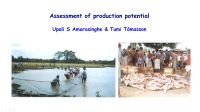
Assessment of production potential

A presentation on technical assessment of water bodies for culture-based fisheries production potential.

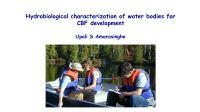
Hydrobiological characterisation of water bodies for CBF development

A presentation on assessment of the suitability of water bodies for culture-based fisheries development.

CBF experiences, current practices and constraints in China

A presentation on the current state of culture-based fisheries practices in China.

First training course on culture-based fisheries held in Nha Trang, Vietnam

The first ever Regional Training Course on Culture-based Fisheries in Inland Waters was held at Nha Trang University from 30 October to 8 November. The objective of the course was to provide participants with the skills to assist local communities to plan and manage culture-based fisheries. These practices are an example of a relatively simple and low cost technology that can deliver nutritional and economic benefits to rural communities, which often have few livelihood options.

Regional Consultation on Responsible Production and Use of Feed and Feed Ingredients for Sustainable Growth of Aquaculture in Asia-Pacific

A regional consultation on aquaculture feed production and use in Asia-Pacific was held from 7-9 March 2017. The consultation reviewed the current situation of aquaculture feed production and use, sourcing of ingredients, policy and research needs. This collection contains audio recordings of the technical presentations made by experts, international organisations, the private sector and governments in the region. The report of the consultation is in press and will be made available for download in due course.

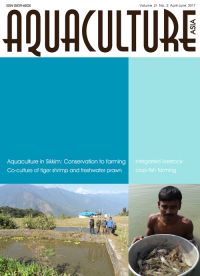
Aquaculture Asia Magazine, April-June 2017

In this issue:

Inspiring story of aquaculture in Sikkim - a journey from conservation to farming; farming of scampi and tiger shrimp together - a case study from West Bengal; Labeo pangusia - a candidate for diversification of hill aquaculture; sustainability of an integrated livestock-fish-crop farming system as a small scale enterprise; sustainable coastal aquaculture in India; potential scope and prospects of domestic fish market in Chhattisgarh.

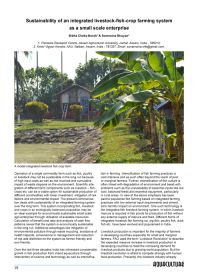
Sustainability of an integrated livestock-fish-crop farming system as a small-scale enterprise

We examined the sustainability and economic viability of a model integrated livestock-fish-crop farming system developed by the Fisheries Research Centre, Assam Agricultural University, over an extended period of 13 years. The system was developed as an ecologically sustainable alternative technology for small and margin farmers. It incorporates two livestock components, pig and poultry, with horticulture and carp polyculture. Analysis of cash flow and benefit-cost ration revealed the system to be economically sustainable over the long term.

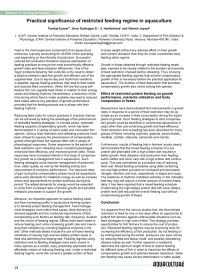
Practical significance of restricted feeding regime in aquaculture

Feed is the most expensive component of an aquaculture enterprise. Successful cultured fish production requires optimisation of feeding practices to ensure the most economically effective growth rates. Reducing feed costs for culture practices can be achieved by taking the advantage of restricted feeding strategies. Under a restricted feeding regime fish convert a greater portion of feed to body weight. Case studies of restricted feeding are presented for several species and the costs savings and other benefits are briefly discussed.

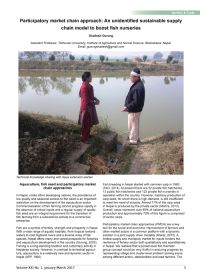
Participatory market chain approach: An unidentified sustainable supply chain model to boost fish nurseries

In Nepal, low quality and seasonal access to fish seed is an important restriction on the development of the aquaculture sector. Commercialisation of fish farming cannot progress rapidly in the absence of critical inputs and a regular supply of quality fish seed is an integral requirement for the transition of fish farming from a subsistence activity to a commercial enterprise. Participatory market chain approaches are a key tool for the social and economic improvement of farmers and market participants.

Regional consultation on responsible production and use of feeds in aquaculture

FAO, NACA and the Thai Department of Fisheries convened a Regional Consultation Responsible Production and Use of Feed and Feed Ingredients for Sustainable Growth of Aquaculture in Asia-Pacific in Bangkok, 7-9 March 2017. The objective of the consultation was to review the current status of aquaculture feed production and use, demand and supply, sourcing of ingredients, government policies and institutional support, ongoing progress and development gaps. The meeting brought together government and private sector representatives.

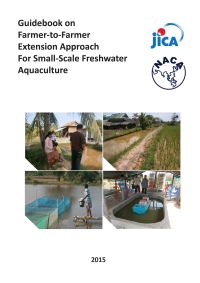
Development of a Guidebook on Farmer-to-Farmer Extension Approaches for Small-scale Aquaculture in the Asia-Pacific Region

The objectives of this project were to i) develop a guidebook in English on "Farmer-to-farmer extension approaches for small-scale aquaculture" and ii) to translate the developed guidebook into selected local dialects in Asia-Pacific and other regions (e.g. Africa). The project made use of the significant results from the JICA projects in Cambodia, Benin and other countries on farmer-to-farmer extension approaches on technology extension for small-scale farmers. The book is available in eleven languages (English, Arabic, Bahasa Indonesia, BurmeseFrenchKhmerLoatian, Malay, NepaliThai and Vietnamese.

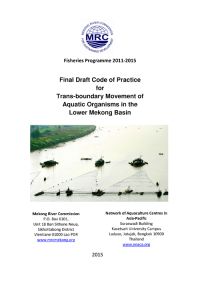
Development of regional code of practice for movement of aquatic organisms in the lower Mekong basin

The objective of this project was to develop an agreed code of practice for the transboundary movement of aquatic organisms that feeds into the fisheries management strategy for the lower Mekong basin. The code of practice provides guidance on risk management and mitigation measures be taken into account for live aquatic animal imports or other transfers that are part of the established commercial practice, or those related to scientific study at research facilities.

Guidelines for hatchery production of Pa Phia fingerlings in Lao PDR

The objective of this manual was to provide basic guidelines for the hatchery production of Pa Phia (Labeo chrysophekadion) fingerlings. It includes information on managing and spawning broodstock, genetic guidelines, egg incubation, hatching larviculture and fry rearing. Although the guidelines were specifically developed for production of Pa Phia at government hatcheries in the Lao PDR, they may be applied to other, related, species and could be adopted and commercialised by the private sector hatcheries

Final Draft Code of Practice for Trans-boundary Movement of Aquatic Organisms in the Lower Mekong Basin

This Code of Practice is prepared to promote or ensure compliance to World Trade Organisation-Sanitary and Phytosanitary measures for the movement of live aquatic organisms in the Lower Mekong Basin. The goals of the Code are to achieve environmental protection and management, biodiversity conservation as well as prevention of spread of disease epizootics. Most of the points listed in this Code are based on the inputs of MRC Member Countries.

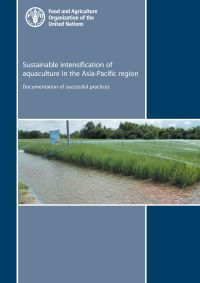
Sustainable intensification of aquaculture in the Asia-Pacific region: Documentation of successful practices

This publication is the major output of a regional programme jointly implemented by FAO and NACA in 2015 to document and disseminate successful practices that contribute to the sustainable intensification of aquaculture in the Asia-Pacific region. Twelve practices are described that contribute to at least one of the following: Improved production and resource use efficiency (land, water, feed, energy); improved environmental benefits; strengthened economic viability and farmers' resilience; and improved social acceptance and equity.

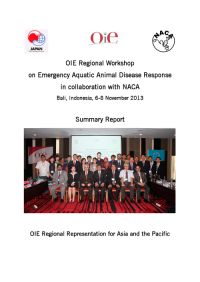
OIE Regional Workshop on Emergency Aquatic Animal Disease Response in Collaboration with NACA: Summary report

The workshop was held in Bali, Indonesia from 6 to 8 November 2013. The programme included reports on current aquatic animal disease situations in selected countries and presentations on the national aquatic animal health programmes of China, Japan and Korea. In addition, case studies on the molluscan diseases, shrimp diseases and finfish diseases were presented to facilitate the subsequent discussion on emergency response of those diseases in the national and regional level.

FAO support to small aquaculture farmers in Asia and the Pacific

Small aquaculture farm holders are experiencing some drastic changes, the shift from household consumption focused subsistent production to market oriented commercial production and external environment changes such as tightening governance on environment impacts control and resource allocation and increasingly stringent standard for food safety and quality. To adapt to the changes, the small-scale farmers need to intensify, diversify and commercialise production, which requires better management.

Implementation of better management practices through cluster management

Practices and people can be considered as two key ingredients to responsible aquaculture. Practices that are in conformity with national and international standards and requirements, ensure sustainability of the sector, ensure environment protection and integrity, enable social equity and respect ethical values and standards, consider human food safety concerns seriously and people who; are well informed, willing to change and ready to embrace practices for public good.