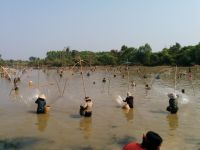
Culture-based fisheries

Culture-based fisheries (CBF) are stock enhancement practices to improve the productivity of water bodies that do not have enough natural recruitment to support a capture fishery. The stocked seed usually rely on the natural productivity of the water body as food supply.

CBF is usually conducted in small water bodies, which are often communally managed by local communities, and the where the seed is owned either individually or collectively. CBF practices are therefore a form of aquaculture.

Creative Commons Attribution.
Related

Subject tags

A collection of subject tags relating to technical matters.

In this collection

Culture-based Fisheries Development in Lao PDR and Cambodia

Culture-based fisheries (CBF) are a useful development strategy for improving the income and food security of rural communities. CBF requires minimal capital outlay, mobilising farming communities to make use of existing small dams and reservoirs for the secondary purpose of foodfish production. The objective of this project is to introduce community-based CBF to Cambodia, and to consolidate the gains of communities that have adopted CBF in Lao PDR.

Development of regional code of practice for movement of aquatic organisms in the lower Mekong basin

The objective of this project was to develop an agreed code of practice for the transboundary movement of aquatic organisms that feeds into the fisheries management strategy for the lower Mekong basin. The code of practice provides guidance on risk management and mitigation measures be taken into account for live aquatic animal imports or other transfers that are part of the established commercial practice, or those related to scientific study at research facilities.

Aquaculture Asia Magazine, July-September 2015

In this issue:

Changes to the magazine and website. Status of alien fish species farming and it's implications for Andhra Pradesh, India. Bridging the research-extension-farmer-input and market linkage gap in coastal aquaculture through application of ICT. Bio-remediation of domestic sewerage recycled in aquaculture: A Central Institute of Freshwater Aquaculture model. Role of family farming in marine and coastal ecosystem management in India. Conservation of fish genetic resources: An introduction to the state fishes of India.

Culture-based fisheries: Why, what, where, how and for whom?

CBF is essentially a stock and recapture strategy, where the stocked fish feed and grow on naturally produced food resources, and which are most effective when communally managed. The returns from CBF could be very significant in terms of nutritional as well as monetary benefits to the communities. In this presentation the relevant background information on food fish needs and the ways and means of introducing CBF practices in inland waters are dealt with.

General aspects of stock enhancement in fisheries developments

In recent years, stocking programs have been subjected to substantial criticism due to perceived impact of hatchery-bred fish on genetic structure and fitness of wild stocks, transfer of disease, introduction of exotic species and non-target species, and their effects on other aquatic species and the environment. To maximise the potential benefits to fisheries from stock enhancement a responsible and ecologically sustainable approach should be adopted for all stocking programs.

Genetic considerations in culture-based fisheries development in Asia

A shift away from exotic speces towards the use of indigenous ones was believed to counter negative impacts of culture-based fisheries. However, hatchery-produced fingerlings can also pose a potential threat to genetic diversity and integrity of their wild counterparts. This paper entails the pros and cons in the use exotic vs. indigenous species in CBF and steps to be followed when decisions are made on species choice for CBF.

Summary of culture-based fisheries developments in Lao PDR

A summary of culture-based fisheries developments in Lao PDR based on publications, either in the primary literature, or as manuals and reports posted on the website of the Network of Aquaculture Centres in Asia-Pacific, that have originated from projects funded by the Australian Centre for International Agriculture research (ACIAR) since 1997.

Challenges and constraints for developing CBF in Cambodia and a possible strategy for success

The application of culture-based fisheries in Cambodian waters commenced with a project in sixteen small reservoirs located in four provinces. Initial consultations with the village communities responsible for the water regime management were held and their agreement obtained for monitoring and cooperating through the trial period. One common feature in all the reservoirs selected is the provision of a “conservation zone”, generally in the deeper areas of the water body, where fishing is prohibited.

Results of a decade of R&D efforts on culture-based fisheries in Sri Lanka

Culture-based fisheries in village reservoirs of Sri Lanka is a communal activity involving agricultural farmers without prior experience in fisheries. Awareness programs have facilitated establishment of CBF in small village reservoirs. Dissemination of research findings through means such as production of a documentary film, publication of a monograph which was translated to several regional languages, and holding a series of regional workshops were instrumental for CBF development at the regional level.

Potential of culture-based fisheries in Indonesian inland waters

Fish stocking in Indonesian lakes and reservoirs has been conducted for a long time. Since 1999, culture-based fisheries (CBF) practices based on scientific evidence such as using suitable fish species, consideration of the primary productivity, stocking density, economic evaluation and community participation, have been conducted in some reservoirs and lakes and have showed encouraging results. CBF is highly recommended and prioritised in small reservoirs with an area less than 200 ha.

Impact of introduction of culture-based fisheries on fish production in perennial reservoirs of Sri Lanka

Sri Lanka is blessed with a large number of irrigation reservoirs. Culture-based fisheries (CBF) in seasonal reservoirs was initiated in the 1980’s and the government has recognised CBF as an effective way of increasing fish supplies in rural areas, at affordable prices, while providing employment and income to farmers and thereby contributing towards alleviation of poverty. The role of fisher community based organisations and fisheries management for effecting successful CBF are discussed.

Culture-based fishery of giant freshwater prawn: Experiences from Thailand

Releasing of giant freshwater prawn (Macrobrachium rosenbergii) for the purposes of stock enhancement and to create a fishery has been conducted in Thailand since the 1980s. Average age at harvest is around 6 to 8 months, with an average total length of 20 cm. Overall, the success of stocking M. rosenbergii is poor since the recapture rate is generally less than 5 %. However, the economic return is high.

Culture-based fisheries in lakes of the Yangtze River basin, China, with special reference to stocking of mandarin fish and Chinese mitten crab

In this paper, the culture-based fisheries in lakes are presented, with special reference to mandarin fish and mitten crab stocking in lakes in China. The stocking rate of mandarin fish is determined by food consumption rates, which are mainly related to water temperature and fish size, and prey fish productivity. A bioenergetics model of mandarin fish was established to predict the growth and consumption of prey fish in stocked lakes.

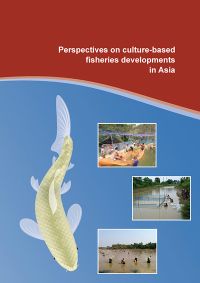
Perspectives on culture-based fisheries developments in Asia

This book is the proceedings of the “Regional Consultation on Culture-Based Fisheries Development in Asia”, held in Siem Reap, Cambodia, 21-23rd of October 2014, under the auspices of the Australian Centre for International Agricultural Research (ACIAR), the Mekong River Commission (MRC) and the Network of Aquaculture Centres in Asia-Pacific (NACA). The consultation was jointly organised by NACA and the Fisheries Administration of the Royal Government of Cambodia.

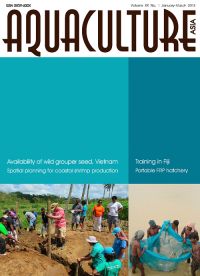
Aquaculture Asia Magazine, January-March 2015

Further training provided to aquaculturists in Fiji. Spatial planning for sustainable coastal shrimp production. Availability of grouper (Serranidae) fingerlings and seed in the coral reef of Son Tra Peninsula, central Viet Nam. Small-scale carp seed production through portable FRP hatchery at Khanguri, Odisha. Regional consultation on culture-based fisheries developments in Asia. Gender Assessment Synthesis Workshop. Broodstock management in aquaculture. Urgent appeal to control spread of the shrimp microsporidian parasite Enterocytozoon hepatopenaei (EHP).

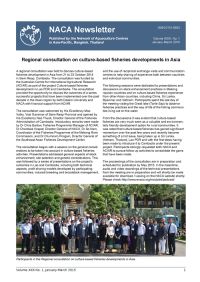
NACA Newsletter, Volume XXX, No. 1, January-March 2015

In this issue:

Regional consultation on culture-based fisheries developments in Asia. Gender Assessment Synthesis Workshop. NACA participation in the 5th Global Symposium on Gender in Aquaculture and Fisheries, Lucknow, India. Broodstock Management in Aquaculture: Long term effort required for regional capacity building. Urgent appeal to control spread of the shrimp microsporidian parasite Enterocytozoon hepatopenaei (EHP).

Regional consultation on culture-based fisheries developments in Asia

A regional consultation was held to discuss culture-based fisheries development in Asia from 21 to 23 October 2014 in Siem Reap, Cambodia. The consultation was funded by the Australian Centre for International Agricultural Research as part of the project Culture-based fisheries development in Lao PDR and Cambodia. The consultation provided the opportunity to discuss the outcomes of a series successful projects that have been implemented over the past decade in the Asian region.

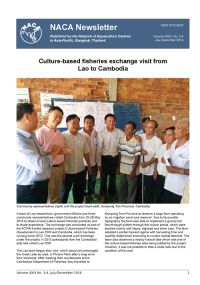
NACA Newsletter, Volume XXIX, No. 3-4, July-December 2014

In this issue:

Culture-based fisheries exchange visit from Lao to Cambodia. National Fish Day, Cambodia. WAS Adelaide: Special Session on Regional Cooperation for Improved Biosecurity. Inbreeding and disease in tropical shrimp aquaculture: a reappraisal and caution. Shrimp EMS/AHPND Special Session at DAA9. 2nd International Symposium on Aquaculture and Fisheries Education. Report on Sustainable Fisheries and Aquaculture for Food Security and Nutrition.

Culture-based fisheries development in Lao PDR and Cambodia proceeding well

Under the ACIAR-funded project Culture-based fisheries development in Lao PDR and Cambodia, a monitoring team recently visited both countries to observe progress by participating community groups and to provide guidance for the next stocking season. The project is working with rural villages to implement culture-based fisheries as a community activity, where the work, management and benefits are shared by local residents.

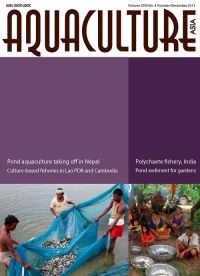
Aquaculture Asia Magazine, October-December 2013

In this issue:

Special session on regional cooperation for improved biosecurity. Pond aquaculture taking off in Nepal. Introduction of culture-based fishery practices in small water bodies in Cambodia: Issues and strategies. A case study on polychaete fishery by the Irular tribal fishing community on the Tamil Nadu coast. Use of pangasius pond sediment for rooftop bag gardening: Potential for rural-urban integrated agriculture-horticulture. Culture-based fisheries exchanges between Lao PDR and Cambodia.