Freshwater finfish

Information relating to aquaculture of freshwater finfish.

Creative Commons Attribution.

Related

Species / commodity tags

Major farmed commodity or species groups.

In this collection

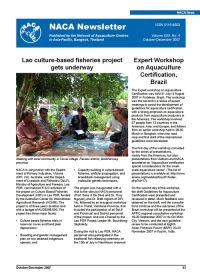
NACA Newsletter Volume XXII, No. 4, October-December 2007

In this issue:

Lao culture-based fisheries project gets underway. Expert Workshop on Aquaculture Certification, Brazil. Strategies for Development of Asian Reservoir and Lake Fisheries Management. EUS identified as cause of fish kills in Africa. NACA seeks shrimp farm specialists for assignments in Indonesia. FDA detains five species of farm-raised seafood from China. 7th Symposium on Diseases in Asian Aquaculture. Aquafeed Horizons Asia 2008. Scientists join fight against frog diseases. Artificial propagation of snow trout Schizothorax zarudnyi by Iranian experts. NACA keynotes three international meetings. Culture, capture conflicts project review, Indonesia. Sign up to the coldwater aquaculture Yahoo! Tech Group. Website publishing and administration training, Vietnam. Aquatic Animal diseases Significant to Asia-Pacific: Identification Field Guide.
Standard operating procedures for health certification and quarantine measures for the responsible movement of live food finfish within ASEAN

These standard operating procedures were developed to reduce the risk of spread of trans-boundary disease of aquatic animals through the movement of live food fish. The procedures are a set of documents for health certification and quarantine measures to be used by competent authorities in trade among ASEAN member countries. The procedures recognise the existing variation in capacity between ASEAN members and have been designed so that they can be implemented across varying policy and legal frameworks.

Aquaculture Asia Magazine, July-September 2007

In this issue:

Buffaloes in favour of culture-based fisheries in Sri Lanka. Aquafeeds in Myanmar: A change from farm-made to factory-made feeds. Challenging myths about seed quality and potential benfits to the rural poor. Catfish Clarius batrachus production using low cost hatcheries. Cage fish culture and livelihoods in the mid-hill lakes of Pokhara, Nepal. Marine fish hatchery training. Rabbitfish Siganus guttatus breeding and larval rearing. Vietnamese extension manual on culture-based fisheries.

Quy trình nuôi cá hồ chứa nhỏ

Mục tiêu của cuốn sách nhằm cung cấp những chỉ dẫn cơ bản của CBF, một hình thức nuôi cá hiệu quả, đang được quan tâm nhiều ở các vùng nông thôn miền núi châu.

NACA Newsletter Volume XXII, No. 2, April-June 2007

In this issue:

Expert Workshop on Guidelines for Aquaculture Certification. Responsible movement of live food finfish within ASEAN: Cebu Workshop finalises the standard operating procedures. Information and capacity requirements for maintaining aquatic animal biosecurity identified. China-ASEAN efforts to minimise risk of spread of aquatic pathogens. National Centre for Sustainable Aquaculture inaugurated. NACA Better Management Practices program expands in Indonesia. Manual on Application of Molecular Tools in Aquaculture and Inland Fisheries Management. Research Needs to Sustain Asia-Pacific Aquaculture to 2025 and Beyond. Endemic freshwater finfish of Asia: Distribution and conservation status.

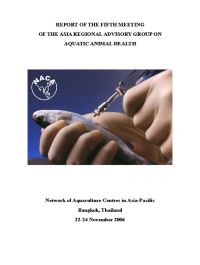
Report of the fifth meeting of the Asia Regional Advisory Group on Aquatic Animal Health, 22-24 November 2006

The Asia Regional Advisory Group on Aquatic Animal Health meets annually to discuss regional health issues including emerging disease threats. This report includes a review of regional disease status circa 2006, global and regional disease reporting arrangements, global issues and standards, progress in implementation of the the Regional Technical Guidelines on Health management for the Responsible Movement of Live Aquatic Animals, identification and designation of regional aquatic animal health resources and regional and international cooperation.

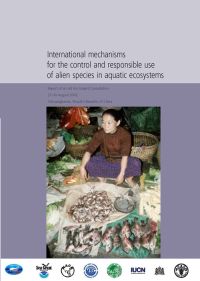
International mechanisms for the control and responsible use of alien species in aquatic ecosystems

The use of alien species is a proven means to increase production and value from aquatic ecosystems. However, alien species are now recognised as one of the most significant threats to aquatic biodiversity. There are a range of international mechanisms that have been established to assist countries in meeting international obligations and responsibilities. Implementation is often difficult due to lack of awareness and problems with enforcement. Regional coordination of policies is needed for effective national management.

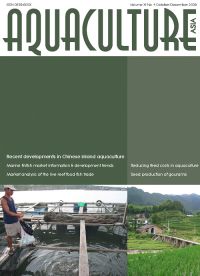
Aquaculture Asia Magazine, October-December 2006

In this issue:

Peter Edwards writes on rural aquaculture: Recent developments in Chinese inland aquaculture. Reducing feed costs in aquaculture: Is the use of mixed feeding schedules the answer for semi-intensive practices? Seed production technology of ornamental gouramis Colisa fasciata and C. lalia under captive conditions. Marine finfish market information and aquaculture development trends in selected locations in Indonesia and Malaysia. Market analysis of the live reef food fish trade.

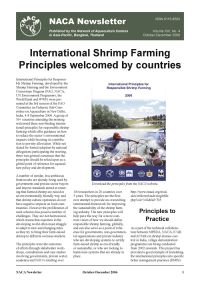
NACA Newsletter Volume XXI, No. 4, October-December 2006

In this issue:

International shrimp farming principles welcomed by countries. Discussions on the establishment of a "Mahseer R&D Centre". Microsatellite DNA markers for mahseer are now available. First study on genetic variation of the critically endangered Mekong giant catfish. IMNV found in Asia-Pacific. Thailand and US to jointly install tsunami wave sensors. Co-management in aquaculture explored at APFIC Forum. Virus may control Australia's feral carp problem. A milestone in India's sustainable shrimp farming efforts. Fish introduction in India: Status, challenges and potentials. 8th Asian Fisheries Forum. STREAM Update. Website management training to support Thai Post-tsunami Rehabilitation website.

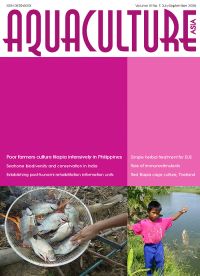
Aquaculture Asia Magazine, July-September 2006

In this issue:

Resources and biodiversity of seahorses and their need for conservation in India. Captive breeding of pangasid catfish Pangasius pangasius. Establishment of post-tsunami rehabilitation information units in Thailand. Poor farmers culture tilapia intensively in ponds in Central Luzon, Philippines. Simple herbal treatment for treatment of EUS in snakehead. DNA vaccination in health management. The role of immunostimulants. Red tilapia cage culture in central Thailand. Quality improvement of farmed fish in Iranian markets.

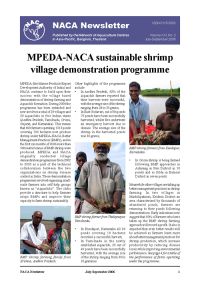
NACA Newsletter Volume XXI, No. 3, July-September 2006

In this issue:

MPEDA-NACA sustainable shrimp village demonstration programme. Inter-calibration of white spot syndrome virus (WSSV) PCR laboratories in India. Shrimp health management training. Rotary International/NACA meeting facility up at Koh Yao Noi. Tsunami-affected farmers train in marine cage aquaculture. Marine finfish aquaculture network at the APAN meeting in Singapore. Aquatic animal health policy workshops build consensus in ASEAN nations. Aquaculture Compendium released. Developments in establishing a conservation plan for the Mekong giant catfish. ROUNDTABLE: Exploring south-south cooperation opportunities in sustainable shrimp farming in West Africa, Conakry (Guinea). Technical missions to Cambodia and Lao PDR.

Better-practice approaches for culture-based fisheries development in Asia

This manual provides guidelines for attaining better practices in culture-based fisheries, an emerging practice in rural areas in the Asian region. It deals with the principles of culture-based fishery practices, primarily based on relatively long-term experiences in Sri Lanka and Vietnam. It deals with the gross factors that are applicable to improving fish yields and therefore revenue; and sustaining culture based fisheries as a development activity in the long-term.

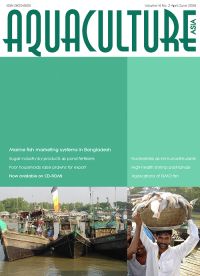
Aquaculture Asia Magazine, April-June 2006

In this issue:

High-health postlarvae a prerequisite for sustainability of the Indian shrimp industry. Broodstock and all-female scampi grow out ponds in south India. Genetically modified fish and potential applications. Rainbow trout farming in hill terraces of Nepal. Sugar industry by-products as plankton boosters and yield enhancers in carp culture. Growth and production of Penaeus monodon in low saline culture systems. Poor households raise prawns for export. Marine fish marketing in Bangladesh.

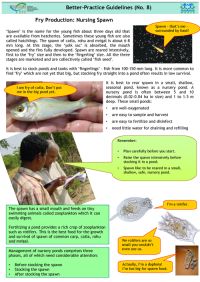
Better practice guidelines: Fry production - nursing spawn

‘Spawn’ is the name for the young fish about three days old that are available from hatcheries. Sometimes these young fish are also called hatchlings. The spawn of catla, rohu and mrigal is about 6-8 mm long. At this stage, the ‘yolk sac’ is absorbed, the mouth opened and the fins fully developed. Spawn are reared intensively, first to the ‘fry’ size and then to the ‘fingerling’ size. All the three stages are marketed and collectively called ‘seed’.

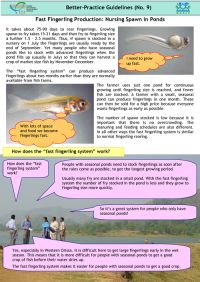
Better-practice guidelines: Fast fingerling production - nursing spawn in ponds

The “fast fingerling system” can produce advanced fingerlings about two months earlier than they are normally available from fish farms.  The farmer uses just one pond for continuous growing until fingerling size is reached, and fewer fish are stocked. A farmer with a small, seasonal pond can produce fingerlings in one month. These can then be sold for a high price because everyone wants fingerlings as early as possible.

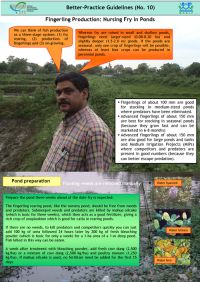
Better practice guidelines: Fingerling production nursing fry in ponds

The fingerling rearing pond, like the nursery pond, should be free from weeds and predators. Submerged weeds and predators are killed by mahua oilcake, which then acts as a good fertiliser. If there are no weeds, to kill predators and competitors quickly you can just add 100 kg of urea followed 24 hours later by 200 kg of fresh bleaching powder for a 1-ha area of a 1-m deep pond.

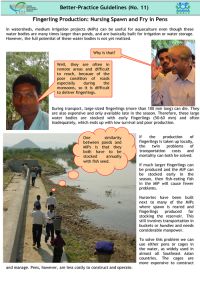
Better practice guidelines: Fingerling production nursing spawn and fry in pens

In watersheds, medium irrigation projects can be useful for aquaculture even though these water bodies are many times larger than ponds, and are basically built for irrigation or water storage. However, the full potential of these water bodies is not yet realised. Net pens or cages can be used to rear fingerlings in such environments.

Better practice guidelines: Advanced fingerling production in seasonal ponds

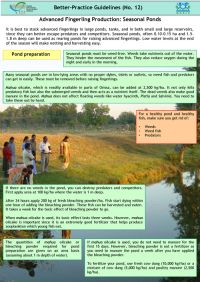
It is best to stock advanced fingerlings in large ponds, tanks, and in both small and large reservoirs, since they can better escape predators and competitors. Seasonal ponds, often 0.10-0.15 ha and 1.5-1.8 m deep can be used as rearing ponds for raising advanced fingerlings. Low water levels at the end of the season will make netting and harvesting easy.

Better practice guidelines: Advanced fingerling production in perennial ponds

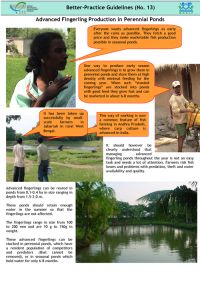
Everyone wants advanced fingerlings as early after the rains as possible. They fetch a good price and make marketable fish production possible in seasonal ponds. One way to produce early season advanced fingerlings is to grow them in perennial ponds and store them at high density with minimal feeding for the coming year. Whe such "stunted" fingerlings are stocked into ponds with good feed they grow fast and can be marketed in about 6-8 months.

Better practice guidelines: Spawn production of common carp

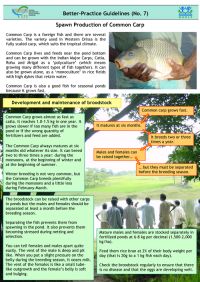
Common carp is a foreign fish and there are several varieties. The variety used in Western Orissa is the fully scaled carp, which suits the tropical climate. Common carp lives and feeds near the pond bottom and can be grown with the Indian major carps, catla, rohu and mrigal as a 'polyculture' (which means growing many different types of fish together). It can also be grown alone, as a 'monoculture' in rice fields with high dykes that retain water.