Freshwater finfish

Information relating to aquaculture of freshwater finfish.

Creative Commons Attribution.

Related

Species / commodity tags

Major farmed commodity or species groups.

In this collection

NACA Newsletter Volume XXI, No. 3, July-September 2006

In this issue:

MPEDA-NACA sustainable shrimp village demonstration programme. Inter-calibration of white spot syndrome virus (WSSV) PCR laboratories in India. Shrimp health management training. Rotary International/NACA meeting facility up at Koh Yao Noi. Tsunami-affected farmers train in marine cage aquaculture. Marine finfish aquaculture network at the APAN meeting in Singapore. Aquatic animal health policy workshops build consensus in ASEAN nations. Aquaculture Compendium released. Developments in establishing a conservation plan for the Mekong giant catfish. ROUNDTABLE: Exploring south-south cooperation opportunities in sustainable shrimp farming in West Africa, Conakry (Guinea). Technical missions to Cambodia and Lao PDR.

Better-practice approaches for culture-based fisheries development in Asia

This manual provides guidelines for attaining better practices in culture-based fisheries, an emerging practice in rural areas in the Asian region. It deals with the principles of culture-based fishery practices, primarily based on relatively long-term experiences in Sri Lanka and Vietnam. It deals with the gross factors that are applicable to improving fish yields and therefore revenue; and sustaining culture based fisheries as a development activity in the long-term.

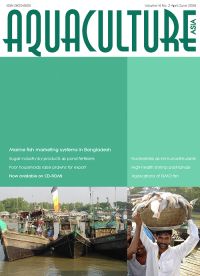
Aquaculture Asia Magazine, April-June 2006

In this issue:

High-health postlarvae a prerequisite for sustainability of the Indian shrimp industry. Broodstock and all-female scampi grow out ponds in south India. Genetically modified fish and potential applications. Rainbow trout farming in hill terraces of Nepal. Sugar industry by-products as plankton boosters and yield enhancers in carp culture. Growth and production of Penaeus monodon in low saline culture systems. Poor households raise prawns for export. Marine fish marketing in Bangladesh.

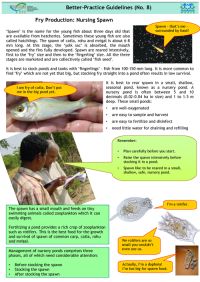
Better practice guidelines: Fry production - nursing spawn

‘Spawn’ is the name for the young fish about three days old that are available from hatcheries. Sometimes these young fish are also called hatchlings. The spawn of catla, rohu and mrigal is about 6-8 mm long. At this stage, the ‘yolk sac’ is absorbed, the mouth opened and the fins fully developed. Spawn are reared intensively, first to the ‘fry’ size and then to the ‘fingerling’ size. All the three stages are marketed and collectively called ‘seed’.

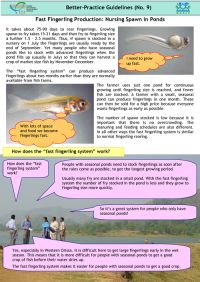
Better-practice guidelines: Fast fingerling production - nursing spawn in ponds

The “fast fingerling system” can produce advanced fingerlings about two months earlier than they are normally available from fish farms.  The farmer uses just one pond for continuous growing until fingerling size is reached, and fewer fish are stocked. A farmer with a small, seasonal pond can produce fingerlings in one month. These can then be sold for a high price because everyone wants fingerlings as early as possible.

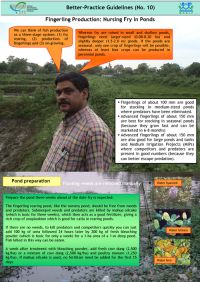
Better practice guidelines: Fingerling production nursing fry in ponds

The fingerling rearing pond, like the nursery pond, should be free from weeds and predators. Submerged weeds and predators are killed by mahua oilcake, which then acts as a good fertiliser. If there are no weeds, to kill predators and competitors quickly you can just add 100 kg of urea followed 24 hours later by 200 kg of fresh bleaching powder for a 1-ha area of a 1-m deep pond.

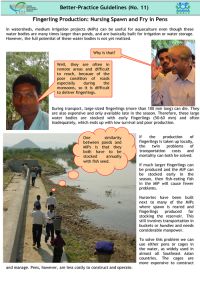
Better practice guidelines: Fingerling production nursing spawn and fry in pens

In watersheds, medium irrigation projects can be useful for aquaculture even though these water bodies are many times larger than ponds, and are basically built for irrigation or water storage. However, the full potential of these water bodies is not yet realised. Net pens or cages can be used to rear fingerlings in such environments.

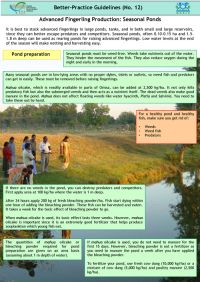
Better practice guidelines: Advanced fingerling production in seasonal ponds

It is best to stock advanced fingerlings in large ponds, tanks, and in both small and large reservoirs, since they can better escape predators and competitors. Seasonal ponds, often 0.10-0.15 ha and 1.5-1.8 m deep can be used as rearing ponds for raising advanced fingerlings. Low water levels at the end of the season will make netting and harvesting easy.

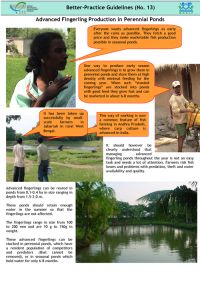
Better practice guidelines: Advanced fingerling production in perennial ponds

Everyone wants advanced fingerlings as early after the rains as possible. They fetch a good price and make marketable fish production possible in seasonal ponds. One way to produce early season advanced fingerlings is to grow them in perennial ponds and store them at high density with minimal feeding for the coming year. Whe such "stunted" fingerlings are stocked into ponds with good feed they grow fast and can be marketed in about 6-8 months.

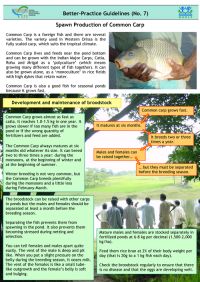
Better practice guidelines: Spawn production of common carp

Common carp is a foreign fish and there are several varieties. The variety used in Western Orissa is the fully scaled carp, which suits the tropical climate. Common carp lives and feeds near the pond bottom and can be grown with the Indian major carps, catla, rohu and mrigal as a 'polyculture' (which means growing many different types of fish together). It can also be grown alone, as a 'monoculture' in rice fields with high dykes that retain water.

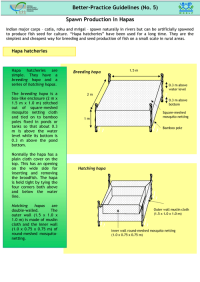
Better practice guidelines: Spawn production in hapas

These guidelines provide advice on producing fish seed of the Indian major carps in hapas within ponds to improve survival.

Aquaculture Asia Magazine, January-March 2006

In this issue:

Nursery rearing of silver barb Puntius goniotus. Artemia enrichment and biomasss production for larviculture. Seed production of mud crab Scylla serrata in India. Macrobrachium on the southwest coast of India. Fish wastes in urban and suburban markets of Kolkata: Problems and solutions. Groups of poor women farming carps in leased ponds, Bangladesh. Lymphocystis disease and diagnostic methods in China. Mesocosm technology advances grouper aquaculture in northern Australia.

Report of the fourth meeting of the Asia Regional Advisory Group on Aquatic Animal Health, 22-24 October 2005

The Asia Regional Advisory Group on Aquatic Animal Health meets annually to discuss regional health issues including emerging disease threats. This report includes a review of regional disease status circa 2005, global and regional disease reporting arrangements, global issues and standards, progress in implementation of the the Regional Technical Guidelines on Health management for the Responsible Movement of Live Aquatic Animals, identification and designation of regional aquatic animal health resources and regional and international cooperation.

Policy brief: Self-recruiting species from farmer-managed aquatic systems - are they important to the livelihoods of rural communities?

Self-recruiting species are defined as aquatic animals that can be harvested from farmer managed aquatic systems without regular stocking. This may include indigenous or introduced, small or larger species. Identified self-recruiting species in the Red River Delta includes exotic species (tilapia), large (snakehead, walking catfish and river catfish) and small (Anabas and Carassius auratus) indigenous fish species and non-fish species (freshwater shrimp and crabs).

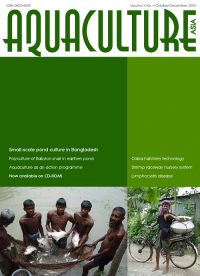
Aquaculture Asia Magazine, October-December 2005

In this issue:

Small-scale pond culture in Bangladesh. Issues and challenges in community-based aquaculture. Aquaculture as an action programme building confidence and self-worth. Transforming policy recommendations into pro-poor service provision. Grow out of spotted Babylon to marketable size in polyculture with seabass. Influence of economic conditions and global shocks on grouper markets. Status of cobia hatchery technology in Vietnam. Organic shrimp raceway system. Macrobrachium rosenbergii in Vembanad Lake. Management of monogenean parasites.

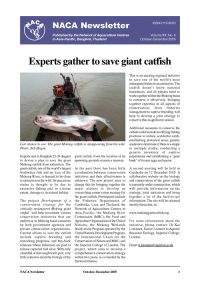
NACA Newsletter Volume XX, No. 4, October-December 2005

In this issue:

Experts gather to save giant catfish. Workshops on dissemination of better practice models for culture-based fisheries. Dr Chris Baldock, 1947-2005. MAHSEER 2006. MOU signing on conservation of Mahseer in Malaysia and Indonesia. Application of molecular genetics in aquaculture and inland fisheries management. New president of Iran Fisheries Organization. Workshop on the fishery management tool 'EnhanceFish'. Regional Mariculture Development Workshop in China, March 2006. Invitation to apply for position of Director General of NACA. MPEDA expands program on shrimp farmer clubs.

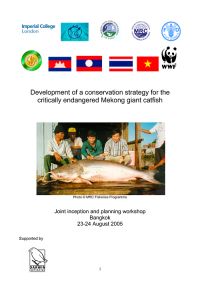
Development of a conservation strategy for the critically endangered Mekong giant catfish: Joint inception and planning workshop

This is the report of an inception workshop for the Mekong Giant Catfish Working Group. The Mekong giant catfish Pangasianodon gigas is listed as critically endangered in the 2003 IUCN Red List. The purpose of the workshop was to exchange information on the current state of the Mekong giant catfish and the relevant conservation and research activities of key organisations, and to establish a joint planning process aimed at developing an overarching conservation strategy for the Mekong giant catfish.

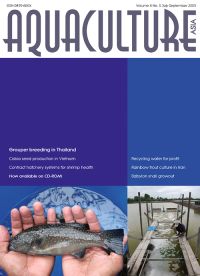
Aquaculture Asia Magazine, July-September 2005

In this issue:

Asian Development Bank study on aquaculture and poverty. The consequences of converting to organic shrimp farming. Recycling water and making money with Artemia. Advances in the seed production of cobia Rachycentron canadum in Vietnam. Australian success with barramundi cod Cromileptes altivelis. Recent grouper breeding developments in Thailand. Application of probiotics in rotifer production systems. Contract hatchery systems. Rainbow trout culture in Iran. Spotted babylon Babylonia areolata growout in earthern ponds.

Primary aquatic animal health care in rural, small-scale aquaculture development

This document is the technical proceedings of the Asia Regional Scoping Workshop on “Primary Aquatic Animal Health Care in Rural, Small-scale, Aquaculture Development,” held in Dhaka, Bangladesh from 27 - 30 September 1999. The objectives of the workshop were  to review information on socio-economic impacts, risks of disease incursions and health management strategies in rural, small-scale aquaculture and enhanced fisheries programmes; and to identify potential interventions for their better health management and appropriate followup actions.
Asia diagnostic guide to aquatic animal diseases

The Asia Diagnostic Guide to Aquatic Animal Diseases or ‘Asia Diagnostic Guide’ is a comprehensive diagnostic guide in support of the implementation of the Asia Regional Technical Guidelines on Health Management for the Responsible Movement of Live Aquatic Animals. It was developed from technical contributions of members of the Regional Working Group and Technical Support Services and other aquatic animal health scientists in the region and outside who supported the Asia-Pacific Regional Aquatic Animal Health Management Programme.