Freshwater finfish

Information relating to aquaculture of freshwater finfish.

Creative Commons Attribution.

Related

Species / commodity tags

Major farmed commodity or species groups.

In this collection

Pengba, Osteobrama belangeri – a candidate species for diversification in aquaculture

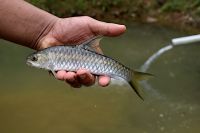
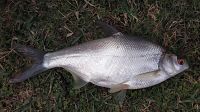
Pengba (Osteobrama belangeri) is a near-threatened minor carp endemic to eastern Manipur in India, Yunnan and Myanmar. A migratory species, wild populations of pengba have declined due to the construction of dams and barranges, and possibly also due to the introduction of alien species. Pengba is highly preferred by consumers and attracts a high market price. This article describes the feeding habits and reproductive biology of pengba, and aquaculture techniques for seed production and grow out in monoculture or polyculture. 

Innovative fish sale improved livelihoods at Jurala dam in Telangana, India

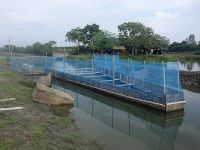
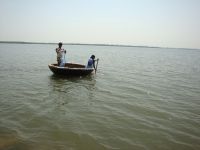
About 200 families that were displaced by construction of the Jurala reservoir have found new employment in fishing and value-added industry. Local people who up fishing add value to their catch by keeping it for live sale in locally-manufactured cages. Local people also use the live fish to prepare a variety of fresh fish dishes, servicing the tourist trade attracted to the reservoir. Over 400 people are now directly or indirectly self-employed through these practices. This article describes the new practices and the improved income that is being generated by fishers and local entrepreneurs.

Present status of medium saline ‘bheri’ fishery and integrated mangrove-aquaculture in West Bengal, India, Part 2

This is part 2 of an article describing farming practices in bheri systems in West Bengal, India, including their integration with mangrove aquaculture. Since the late 1960s, brackishwater rural aquaculture in West Bengal grew and improved at a fast rate, from an extensive method of farming to a modified-extensive method. Part 2 discusses brackishwater polyculture in South 24 Parganas, including the experiences of farmers implementing an integrated mangrove-aquaculture project, and information on local bheri fisheries derived from published articles.

Aquaculture and fisheries perspectives in Arunachal Pradesh

Arunachal Pradesh is a hill state with a population of 1.38 million in far north-eastern India. With climate ranging from tropical to alpine across a steep altitudinal gradient, the state has a high fish biodiversity and a wide range of aquaculture systems and fishing practices. Both indigenous and exotic species are farmed and fished.

This article describes the species, aquaculture systems and capture fisheries practiced in Arunachal Pradesh as well as their future prospects for further development.

Report of the 21st Asia Regional Advisory Group on Aquatic Animal Health

This report summaries the proceedings of the 21st meeting of the Regional Advisory Group on Aquatic Animal Health, held 17-18 November 2022. The role of the group is to review trends in disease and emerging threats in the region, identify developments in global disease issues and standards, to evaluate the Quarterly Aquatic Animal Disease Reporting Program and to provide guidance on regional strategies to improve aquatic animal health management.

Reported Aquatic Animal Diseases in the Asia-Pacific Region during the Fourth Quarter of 2022

With the implementation of the new aquatic animal disease reporting in the Asia Pacific region from January 2021, and in lieu of the published QAAD Reports (last issue published was 4th quarter of 2020), NACA is publishing reported aquatic animal diseases submitted by countries in the Asia-Pacific region. This report covers the fourth quarter of 2022 and the original and updated reports can be accessed from the QAAD page

Global Seafood Trade Fair 28-30 June, Guangzhou, China

In June, China will open its doors to the world through the Global Seafood Fair. With over 50,000 visitors and a strong buyer presence, the fair is an excellent opportunity for businesses to showcase their products. The event will feature over 1,000 exhibitors and more than 10,000 products for buyers to choose from. Attendees can also participate in several industry-focused events, including the Global Shrimp Industry Development Summit Forum, the Overseas Seafood Products Digital Trade Forum, the Tilapia Industry Chain Summit, and the China Aquatic Prepared Dishes Development Summit.

NACA Newsletter, Vol. XXXVIII, April-June 2023

In this issue:

Webinar on fish welfare: What we need to know? Artemia side event at the FAO Sub-Committee on Aquaculture; Handbook for Artemia pond culture in Bangladesh; NACA YouTube channel: @aquacultureasia; Reported aquatic animal diseases in the Asia-Pacific region during the third quarter of 2022; 13th Asia-Pacific Marine Biotechnology Conference, 2-6 October 2023, Australia; Global Seafood Trade Fair, 28-30 June, Guangzhou, China.

Aquaculture Asia Magazine, January-March 2023

In this issue:

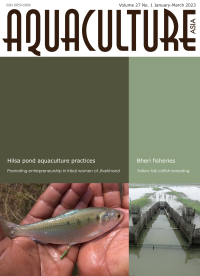
Augmenting entrepreneurial attitude among tribal women of Jharkhand through a skill development programme in fish value added products; Culture of hilsa, Tenualosa ilisha in freshwater ponds: Progress and prospects in farming practice; Present status of medium-saline ‘bheri’ fishery and integrated mangrove aquaculture in West Bengal, India: A short study, Part I; Information for farmers on yellow tail catfish, Pangasius pangasius, for easier captive production; Captive breeding and larval rearing of Cirrhinus reba, a small indigenous fish of aquaculture importance; NACA Newsletter.

Captive breeding and larval rearing of Cirrhinus reba, a small indigenous fish of aquaculture importance

Cirrhinus reba or ‘reba carp’ is a commercially important indigenous minor carp species distributed over south Asia. It is highly popular among consumers and fetches a better price than the major carps.  A herbivorous species, C. reba can easily digest plant protein sources. It has been identified as a priority species for aquaculture diversification in India and has great scope for incorporation in carp culture and polyculture systems.

Information for farmers on yellow tail catfish, Pangasius pangasius, for easier captive production

The yellow tail catfish Pangasius pangasius is found throughout the rivers of the Indian subcontinent. A large, omnivorous, and highly fecund species, it is suitable for aquaculture. Initial work on captive breeding of yellow tail catfish was carried out by scientists from the ICAR-Central Institute of Freshwater Aquaculture in the early 1990's. This article provides updated information on captive reproduction, larval rearing and nusery techniques for this species, which will be of use for farmers and entrepreneurs interested in producing it.

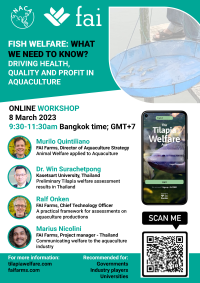
Free webinar on Fish Welfare: What we need to know?

FAI and NACA will convene a webinar on fish welfare issues on 8 March from 9:30-11:30 am Bangkok time (GMT+7). The webinar will address the relationship between welfare, health, quality and profit in aquaculture production. The programme will feature talks on:

  • Animal welfare applied to aquaculture.
  • Preliminary tilapia welfare assessment results in Thailand.
  • A practical framework for assessments on aquaculture productions.
  • Communicating welfare to the aquaculture industry.

Participation is free but registration is required, please download the attached flyer for details.

Present status of medium-saline ‘bheri’ fishery and integrated mangrove aquaculture in West Bengal, India, Part I

Since the late 1960s, brackishwater rural aquaculture in West Bengal grew and improved at a fast rate, from an extensive method of farming to a modified-extensive method. The indigenous bheri fishery is a well-known extensive aquaculture system throughout all coastal states of India. Bheri fishery isn’t a capital-intensive practice. This article describes farming practices in bheri systems in West Bengal, India, including their integration with mangrove aquaculture. A second part of this article will be published in the next issue.

Culture of hilsa, Tenualosa ilisha in freshwater ponds: Progress and prospects in farming practice

Hilsa are a highly favoured food fish on the Indian subcontinent, but wild populations have been declining very fast due to over exploitation and disturbance of their riverine spawning grounds. Hilsa have a complex life cycle, migrating from the sea to riverine environments to spawn and are very sensitive to handling, which has complicated efforts to breed them in captivity. The ICAR-Central Institute of Freshwater Aquaculture has initiated a programme to domesticate hilsa to reduce dependence on wild catch. This article documents the first successful approaches to rear larvae through to table sized fish and to develop mature hilsa broodstock in a farm environment.

Reported Aquatic Animal Diseases in the Asia-Pacific Region during the Third Quarter of 2022

With the implementation of the new aquatic animal disease reporting in the Asia Pacific region from January 2021, and in lieu of the published QAAD Reports (last issue published was 4th quarter of 2020), NACA is publishing reported aquatic animal diseases submitted by countries in the Asia-Pacific region.  This report covers the third quarter of 2022 and the original and updated reports can be accessed at the QAAD page

Update: 2022 Global Forum on Sustainable Development of Fisheries to be held on 13 December

Update: The forum will now be held on 13 December and and updated conference agenda is available below. Please register your attendance using the form linked below. A Zoom link will be sent to all registered participants before the meeting, thank you.

A free online forum will be organised by the Agriculture Trade Promotion Center, Ministry of Agriculture and Rural Affairs of the People’s Republic of China, and Yellow Sea Fisheries Research Institute, Chinese Academy of Fishery Sciences, and NACA. The forum aims to strengthen international exchange and cooperation in aquatic trade, promote high-quality development of fisheries, disseminate advanced concepts, technologies, and models of aquaculture in the Asia-Pacific region and Silk Road countries, and promote the health and sustainable development of global fisheries. Participation is free but registration is required.
FAO/NACA workshop to developing a regional strategy for aquatic organism health using progressive management pathways

On 28-29 November FAO and NACA collaborated on a virtual workshop to develop a regional strategy for aquatic organism health, using a progressive management pathway for improving aquaculture biosecurity. The workshop was held under the auspices of the project “Responsible use of fisheries and aquaculture resources for sustainable development component 3: Biosecurity and health management”. The workshop involved 31 experts from 16 countries, including national focal points, FAO and NACA. The objectives of the workshop were to: Present and analyse country responses to a self-assessment survey on biosecurity and health management capacity and performance; to provide guuidance to country participants on conducting a SWOT analysis; and to prepare a detailed plan for Phase II of the initiative.

Reported Aquatic Animal Diseases in the Asia-Pacific Region during the Second Quarter of 2022

With the implementation of the new aquatic animal disease reporting in the Asia Pacific region from January 2021, and in lieu of the published QAAD Reports (last issue published was 4th quarter of 2020), NACA is publishing reported aquatic animal diseases submitted by countries in the Asia-Pacific region.  This report covers the second quarter of 2022 and the original and updated reports can be accessed at the QAAD page

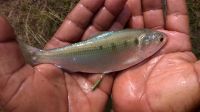
Conducting artificial fertilisation, hatching and spawn development of Indian shad, Tenualosa ilisha: Pathfinding hilsa domestication

Hilsa (Tenualosa ilisha) is highly favoured as a food fish by consumers but has a complex life cycle and has proven very difficult to breed. Domestication of hilsa requires extra effort while nurturing the larval stage, which is very sensitive and susceptible to mortality. This article describes standardised protocols developed by the Kalyani Field Station of the ICAR-CIFA Regional Research Centre, Rahara, for artificial fertilisation, incubation and larval rearing of hilsa, as the first steps towards the goal of hilsa domestication and culture.

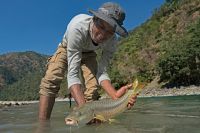
Recreational fisheries in Uttarakhand

Establishing recreational fisheries in Uttarakhand's highland lakes and river systems offers new opportunities to generate livelihoods and income for hill people. The development of catch-and-release sport fisheries can also contribute to conservation of aquatic biodiversity through development of captive breeding technologies, supportive breeding based stock enhancement, and community participation in management of both fishery and habitat. This article describes established and emerging sport fisheries in the highlands of Uttarakhand including for mahseer, goonch and brown trout. It also addresses as yet unrealised opportunities for establishment of recreational fisheries identified through geoinformatic approaches, and partnerships between local communities and government in natural resource management.